
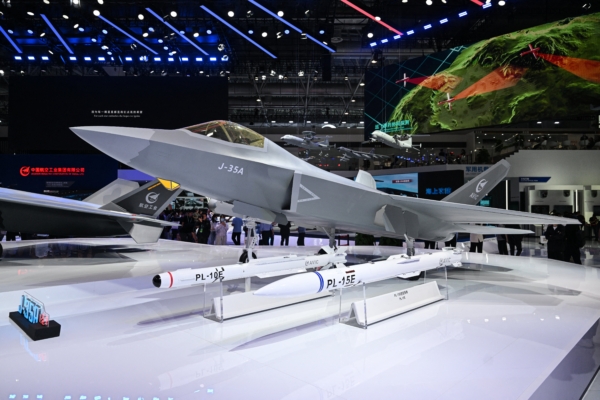
Recently, at the Singapore Airshow, a model of the Chinese J-35 fighter jet was displayed, sparking controversy when Palmer Luckey, a young Silicon Valley genius and billionaire, measured the J-35 with a tape measure and expressed doubts about its capabilities. This action drew strong reactions from Chinese officials causing a stir in the state media. Analysts believe that China’s strong response reveals its vulnerabilities and concerns.
On February 6th, at the China Aviation Exhibition at the Singapore Airshow, Palmer Luckey, the founder of the American defense contractor Anduril Industries, was photographed measuring a model of the latest Chinese stealth fighter jet, the J-35A. He later posted on X platform that he was not convinced that the aircraft lived up to its reputation.
This move immediately triggered a backlash from the state-run Chinese media, with the Global Times stating that “precise measurements require a vernier caliper” and that using a tape measure was a “performance art” with no technical basis, accusing Luckey of lacking professional ethics.
The article was subsequently reposted by the Chinese military web, accusing Luckey of “defaming” the J-35 fighter jet.
Why did China react so strongly and aggressively to this incident? Analysts believe Luckey’s actions hit directly at China’s military propaganda vulnerabilities. The Chinese authorities understand the strong capabilities of companies like Anduril Industries and are fearful of their cooperation with Taiwan.
During the earlier period of “hiding brightness and biding time,” China aimed to weaken the perception of the “China (PRC) threat” by portraying a “closed,” “opaque,” and “backwards” image of the Chinese military to foreign observers, emphasizing the necessity of military external propaganda to align closely with the thinking habits of foreign audiences.
Subsequently, the Chinese military has been seeking ways to enhance its external propaganda efforts. Initiatives such as the establishment of the Chinese Ministry of Defense press conferences, media meetings, military open days, white papers, military-cultural exchanges, and media interviews have been implemented.
As China vies for regional dominance and tensions with the United States escalate, this official propaganda machinery has become increasingly assertive.
China has also shifted its military propaganda strategy by building an official standard discourse and creating a cognitive framework to seamlessly connect information dissemination and evoke desired responses from the audience. Rather than concealing its latest weapons, China now embraces social media to track and report on these new weapons, showcasing its military power and aiming to shape the image of a “strong country” and “strong military.” This has become a standardized propaganda approach.
In March 2019, the Chinese leader called for efforts to “construct a discourse system for external communication.” In 2020, the Chinese military emphasized that social media is profoundly altering people’s perceptions, highlighting the significance of information and cognitive warfare on social media platforms as a force multiplier in modern warfare.
A 2020 analysis by the Rand Corporation of Chinese military media over the past decade found that while domestic platforms like Weibo and WeChat remain significant for public opinion, the utilization of Western social media platforms like Twitter, Facebook, and YouTube by Chinese military experts and journalists has been increasing. Research on social media strategies has also been on the rise, from leveraging the influence of influencers and the use of grassroots marketing methods.
Rand policy analyst Mo Xiaolong stated that “around 80%-90% of Chinese military references focus on domestic Weibo and WeChat platforms, with about 10% monitoring foreign social media… domestically, the military is allowed to have accounts; however, many document authors are urging relaxation of restrictions to allow the military to embrace overseas social media as a better channel for information operations.”
In December 2025, the Chinese Ministry of Defense and the PLA stationed in Hong Kong officially opened an official account on the foreign social media platform X.
The J-35 (Jian-35) is developed by the Shenyang Aircraft Design Institute, a subsidiary of the Aviation Industry Corporation of China (AVIC), and produced by the Shenyang Aircraft Corporation (Group) Co., Ltd. In recent years, the J-35 fighter jet has made numerous appearances at various airshows, with state media openly discussing the brainwashing function of the J-35 exhibitions, labeling them as “a national treasure tour.” This is especially aimed at educating young people about the so-called “patriotic sentiment” behind these displays.
Throughout the Chinese media coverage, there has been a continuous emphasis on the superiority of certain indicators of the J-35 and its technological breakthroughs, creating an impression that the J-35 can be compared to the American F-35.
This is a typical example of Chinese cognitive warfare.
In November 2024, the J-35A was first exhibited at the Zhuhai Airshow. During the September 3 military parade last year, multiple J-35 and J-35A aircraft were showcased once again. Twenty days later, the official promotion stated that the J-35 had successfully conducted electromagnetic catapult take-off and landing tests on the Fujian aircraft carrier. In November of the same year, the J-35 made its debut flight demonstration at the Zhuhai Airshow.
At the beginning of the new year, the China Aviation Industry released videos of several J-35s painted with green primer, indicating that the J-35 may be close to mass production. The Liaoning Daily also reported that Shenyang Aircraft promised to double its aircraft production in the next three to five years.
Some analysts believe that it is unusual for the China Aviation Industry to showcase the aircraft in the production stage again, but this has become more common over the past year. Beijing seems to want the world to know that it is not only capable of manufacturing stealth aircraft, but also of mass-producing fifth-generation aircraft and maintaining modern aerial combat capabilities, especially in maritime aerial combat.
As the J-35 fighter jet is optimized for regional power projection, this could be bad news for Taiwan, potentially complicating Taiwan’s air defense plans. This aligns with the increase in military exercises around Taiwan and the growing pressure tactics from the Chinese military.
At the beginning of February this year, the J-35 model participated in the largest Asian Singapore Airshow, attracting significant coverage from the Chinese military media.
Luckey’s actions undoubtedly poured cold water on China’s external propaganda efforts.
Taiwan’s Liberty Times commented that Luckey’s proactive move was clearly premeditated, aiming to negatively impact China’s heavily promoted stealth fighter jet brand.
So far, Luckey’s post of measuring the J-35 with a tape measure has garnered nearly 500,000 views. Comments from netizens include: “China’s J-35 is just another overhyped paper tiger. Military technology never lives up to the hype.”
“They are good at making models,” and “If issues can be found using a tape measure, who knows who Xi will go after next?”
Some netizens compared it to a “large insult to China,” saying, “A hardware store tape measure shattered the dreams of the fifth-generation fighters for the little pink fanatics.”
Su Ziyun, a researcher and director of the National Defense Strategy and Resources Research Institute at the National Security Research Institute, told The Epoch Times that theoretically, performance constraints of a fighter jet can be estimated through measurements like size, fuselage length, and wing area. However, he believes that model sizes may not necessarily match actual aircraft sizes, so Anduril’s actions seem more symbolic.
“He might have known from various channels that there are many flaws in the J-35, so he made a symbolic gesture with the tape measure.”
Senior military commentator Mark told The Epoch Times that Luckey’s actions can be seen somewhat as “performance art” because using a tape measure cannot truly assess the performance of the fighter jet. Perhaps he could understand the size of the aircraft, wing area, wing sweep angle, etc., to estimate the aerodynamic parameters of the aircraft. By analyzing data such as the angle of each operational surface and the lines of the fuselage, an assessment can be made on whether the stealth design is effective.
“When he said he ‘wasn’t convinced it meets the real deal’s standards,’ he was probably referring to the inflated performance claims of the J-35.”
The J-35 is allegedly benchmarked against the American F-35 fighter jet, but experts previously interviewed by The Epoch Times stated that in terms of stealth capabilities, avionics, engines, etc., the US F-35 holds an absolute advantage.
Former F-35 squadron commander Dave Berke stated that “on paper, the J-35 is impressive. But theory and actual combat capability are two different things; it takes years of testing, setbacks, and improvements for carrier-based aircraft to transition from design to operational capability.”