
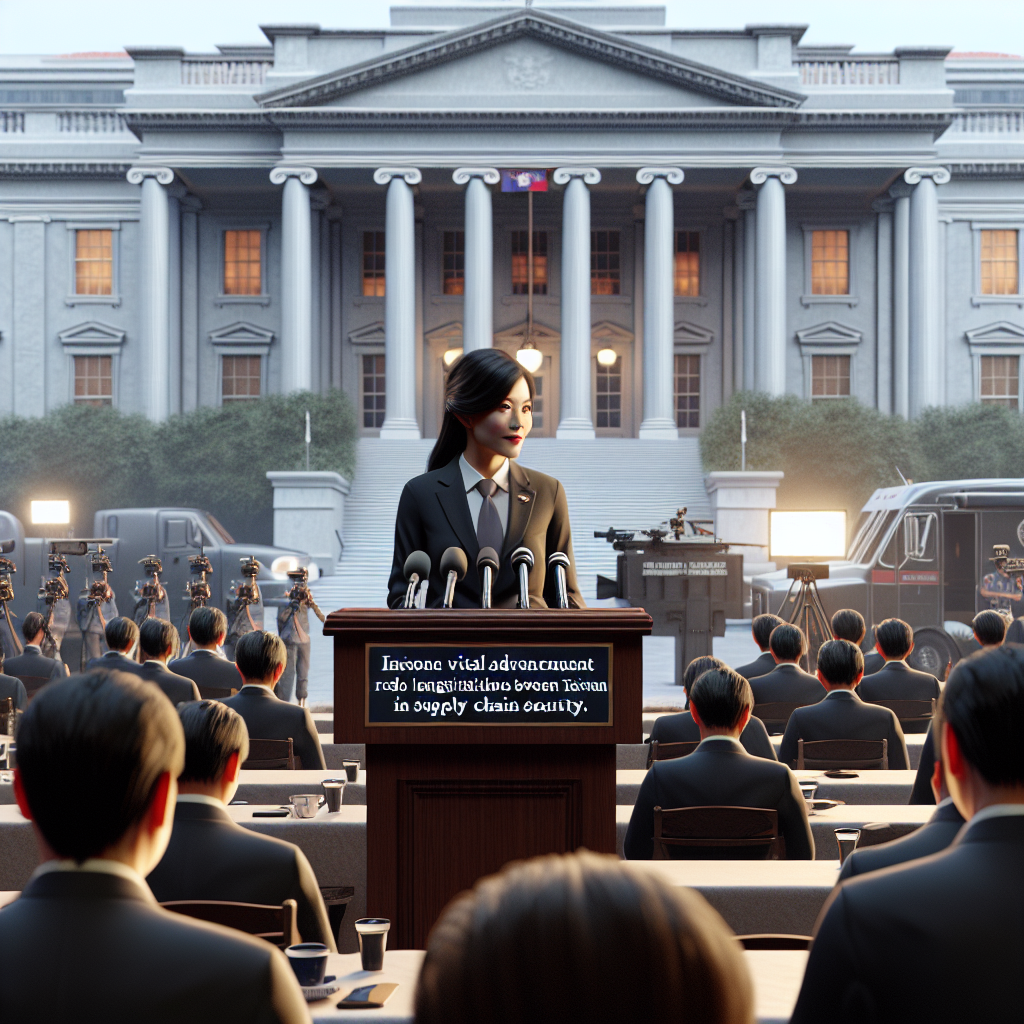
On February 12th, Taiwan’s Vice Premier, Chen Li-chun, attended a press conference in Washington D.C. to announce a significant breakthrough in Taiwan-US economic and trade negotiations. Experts believe that the United States used the trade agreement to deepen Taiwan’s ties to supply chain security and strategic cooperation. It is estimated that the agreement will be passed by Taiwan’s legislature, which is dominated by both the blue and green political parties. This positions Taiwan as a key player in the third phase of its economic development, finally finding its place as a significant global entity.
Taiwan and the United States previously signed a Memorandum of Understanding (MOU) on investment in January, and on Thursday (12th), they completed the signing of the Agreement on Reciprocal Trade (ART). The agreement includes a significant reduction in average tariffs on Taiwanese products exported to the US, from 35.7% to 12.33%. This ensures that Taiwan maintains global competitiveness in semiconductor and traditional industries, standing on equal footing with competitors from Japan and South Korea.
Following the new trade agreement with the US, Taiwan is set to invest $250 billion in the American market, sparking criticism from opposition figures who claim it could lead to Taiwan being “stripped of its resources”. However, according to the latest data from Taiwan’s Ministry of Finance, Taiwan’s exports to the US reached $198.27 billion in 2025, a 78% increase from the previous year. Taiwan’s trade surplus with the US hit a record high of $150.12 billion, doubling year-on-year. Officials project that the surplus could surpass $200 billion this year due to the strong demand driven by AI.
In an interview with a media outlet, political and economic analyst Wu Chia-lung pointed out that the new trade agreement between Taiwan and the US has two key features. Firstly, it fails to address the US trade deficit with Taiwan. Wu believes that in order to balance the trade gap, the US should be much stricter on Taiwan. Secondly, the US is using the trade agreement to bring Taiwan into its sphere of influence, establishing a deep connection between supply chain security and strategic cooperation. While the US appears to be addressing the trade deficit on the surface, the real focus is on national security issues with tariffs serving as a policy tool for the Trump administration.
Wu predicts that Taiwan will maintain its high export levels and growth momentum from the latter half of 2025, especially with the arrival of Japan’s “Reiwa era”. As a result, Taiwan’s next effort would be to sign a trade agreement with Japan to create opportunities for joint investments into the US, upgrading bilateral trade and investment between Taiwan and Japan.
Regarding the potential boycott of the Taiwan-US trade agreement by both blue and green political parties, Wu highlighted the role of the legislature in determining the outcome. If the Kuomintang decides to support the agreement or slightly block it before ultimately passing it, it could have political implications domestically. The People First Party’s 8 seats in the legislature would become inconsequential. The key lies in the cooperation between blue and green parties in the legislature.
In conclusion, the signing of the Taiwan-US Agreement on Reciprocal Trade represents a structural repricing rather than a typical trade agreement. This will bring significant benefits to the Taiwan Stock Exchange, particularly in industries such as semiconductors, machinery, textiles, and biotechnology. The agreement signifies Taiwan’s transition into a strategic ally of the US, indicating an international repositioning of Taiwan from a marginalized player to an important global power.