
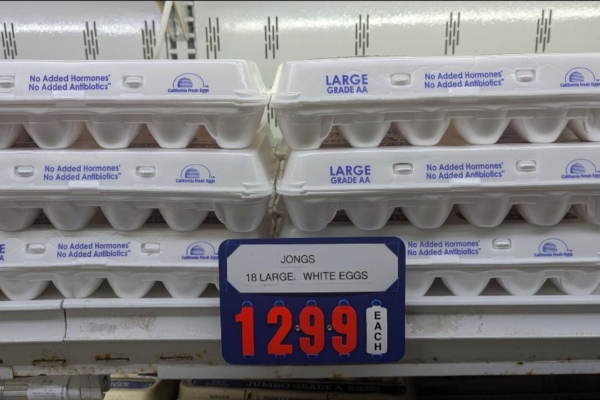
Last year, the price of eggs soared, leading to jokes among Americans that eggs had become a luxury item. However, what used to be a luxury has now become an affordable daily staple food.
In January 2025, the price of eggs skyrocketed, with some US retailers selling a carton of eggs for over $9. Supermarket shelves were left empty due to the decrease in supply caused by avian flu, leading some stores to impose purchase limits. Online, people joked that they needed to dip into their retirement savings just to buy a box of eggs.
Since January this year, the trend of egg prices has taken a complete turn.
According to the latest Consumer Price Index (CPI) report released by the US Bureau of Labor Statistics on Friday (February 13), after seasonal adjustments, egg prices in January decreased by 7% compared to the previous month, a 34.2% drop from the same period last year. CPI is a key indicator the government uses to measure consumer inflation, tracking price changes for commonly used goods and services.
This price decline marked the largest year-on-year decrease in all goods and services in the January CPI report.
According to data from the US Bureau of Labor Statistics, the average price of grade A large eggs has nearly returned to historical normal levels, but still remains relatively high compared to before the pandemic.
The price fluctuation is primarily related to avian flu. Avian flu has been ongoing for several years and has disrupted the US egg supply. According to data from the US Department of Agriculture, since the large-scale outbreak in early 2022, over 174 million poultry have been affected.
The industry association “Eggs Unlimited” stated that seasonal factors also played a role, as demand typically rises during the holiday baking season and then drops in January.
According to market data from the US Department of Agriculture, just in January 2025, avian flu led to the death of nearly 19 million laying hens, about 8% of the regular laying hen population. The sudden decrease in supply drove prices up.
In contrast, the total loss in January 2026 was about 2.8 million birds, roughly 1% of the regular bird population.
While avian flu continues to impact the US poultry industry, the scale of damage is much smaller than a year ago, allowing for production to recover.
The US Department of Agriculture predicts that the average price of eggs in 2026 will decrease by approximately 39% compared to 2025, reflecting improvements in production following last year’s outbreak.
However, the egg market remains highly sensitive to outbreaks, and if a new wave of avian flu leads to supply shortages, these predictions could quickly change.