
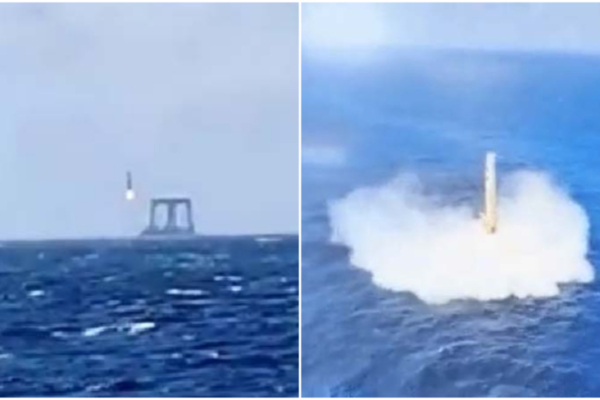
The Chinese Communist Party is currently attempting to emulate SpaceX’s rocket recovery technology pioneered by Elon Musk, but without success. In a recent test of a “sea-based (test) rocket recovery,” the rocket did not land on the makeshift square recovery platform as intended, but instead plunged directly into the sea. Despite this, Chinese state media heavily promoted the test as a “success,” sparking ridicule from internet users.
On February 11, a test of the Long March 10 carrier rocket system took place at the Wenchang Space Launch Center in Hainan. The China Manned Space Engineering Office described it as a “low-altitude demonstration verification and maximum dynamic pressure escape flight test for the Dream Boat manned spacecraft system.”
Video footage from the scene shows the test rocket launching from the ground, undergoing brief low-altitude flight before separating from the spacecraft and plummeting back into the sea.
When the test rocket hit the sea surface, it attempted to imitate SpaceX’s reusable rocket by vertically landing with its tail down. However, the Chinese rocket failed to land on the makeshift square recovery platform and instead fell into the nearby sea. Mainland internet users were quick to comment: “The first-stage rocket fell 200 meters away from the recovery net, is this a failed recovery?” “Why is it splash recovery and not net recovery?”
It is understood that the square recovery platform used in this test is a so-called original Chinese “net-style” recovery device, mockingly dubbed by internet users as the “net fishing for fish plan overtaking on the bend.” The outcome of this Hainan rocket recovery test saw the rocket missing even the “big net,” landing directly in the sea.
Despite this, Chinese state media claimed the test was a “complete success,” emphasizing that it was a “controlled safe splashdown in the designated sea area” as planned. The China Manned Space Engineering Office continued to maintain that the test was a “complete success.”
On social media platforms, netizens mocked the situation, with comments like, “The Long March 10’s successful splashdown on the sea surface video is being hyped as China entering the rocket recovery era. But after watching the video, I am full of questions. It didn’t catch the net, it just fell next to the recovery ship in the sea.” “In a controlled state, aiming for a splashdown on the sea, is the big platform next to it there for show? To set the mood?” “Is it so hard to admit failure?”
Overseas democracy advocate Tang Baiqiao also posted on social media, jokingly saying, “Close enough. The meaning is there anyway.”
Before the end of last year, China had conducted two tests of reusable rockets, both of which failed to achieve recovery. However, Chinese state media Xinhua News Agency claimed that the “carrier rocket’s second stage entered the intended orbit, while the first stage failed to recover successfully, accomplishing the basic mission of the flight test.”
Assistant Researcher Wang Xiaowen from the Taiwan Institute for National Defense and Security Studies previously told the Epoch Times that China’s “shanzhai” (copycat) technology or “reverse engineering” results derived from stolen technology are unreliable. China’s aim is to dominate satellite orbits and communication spectrums, but without a solid foundation in basic science, even launching numerous satellites and rockets may result in continuous failures.
Currently, American entrepreneur Elon Musk’s SpaceX is the only company globally to have successfully commercialized reusable rockets.
The South China Morning Post reported that so far, China has been eager to catch up with the United States, with both state-owned and private enterprises striving to advance the launch and recovery of the first reusable rocket. Despite these efforts, China remains a decade behind the United States in technology.