
With the advancement of the closure policy of the Hainan Free Trade Port, local land disputes have been frequent, triggering intense conflicts between officials and civilians. Villagers revealed that while the closure policy aims to boost the economy, it has exacerbated issues such as land grabbing, unemployment, and rising prices, leading to simmering discontent among the people, which could erupt into widespread resistance at any moment.
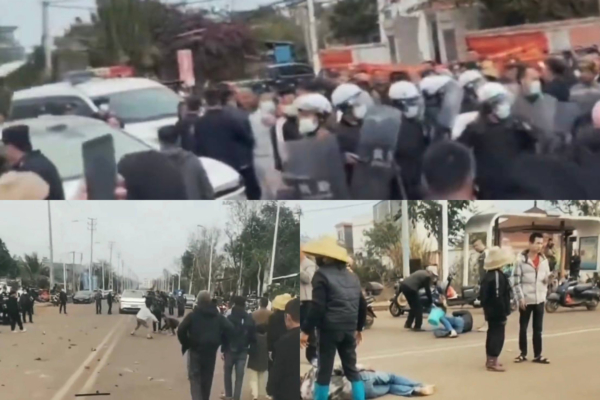
According to a post by the social media influencer “Yesterday” on X platform, on February 1st, there was a fierce clash between police and civilians in Daya Village, Lin’gao County, Hainan. Villagers disclosed that due to dissatisfaction with long-term forced demolitions, corruption, and unfair elections by the local government, the villagers, who had been harboring grievances, gathered in front of the village committee in Daya Village on that day to defend their rights and intercepted a government vehicle to demand an explanation. Subsequently, a large number of police, riot police, and government personnel were swiftly mobilized to the scene, leading to immediate clashes.
Video footage shows riot police wielding shields and batons to beat villagers and spraying pepper spray at them, while the villagers retaliated with stones and bricks, creating a scene of chaos with several villagers injured and lying on the ground.
Local villager Li Feng (alias) told a reporter from Epoch Times, “Forced demolitions without compensation, signing blank contracts, then forced demolitions. Many people disagreed and fought with them, resulting in injuries.”
In Hainan, similar violent conflict incidents have occurred frequently. On October 31, 2025, the theft and cutting down of betel nut trees by the Hainan Natural Rubber Industry Group’s Jiacha Division angered local residents. People gathered outside the company building to protest, overturning vehicles and throwing stones at company employees and riot police.
Li Feng explained that conflicts and disputes in Hainan almost always revolve around land. “We can endure anything, but land is the bottom line. Now collective land has all been reclaimed by the state. Are they forcing the people to live under the Nanqiao Bridge?” he questioned.
He further expressed that in Hainan, there is chaos in management, with village heads colluding with outsiders such as businesses and the government to unlawfully take away villagers’ land. “I have also encountered such problems, deliberately writing the land certificate under individual names, ignoring other family members,” he stated.
He also mentioned that current official policies aim to drive away rural residents working outside the village and force those remaining to relinquish agreements to rural land. He firmly refuses to sign such agreements, questioning their implications on their rights and livelihoods.
As of December 18 last year, the entire island of Hainan Free Trade Port was closed off, with Vice Premier Ho Lifeng of the Communist Party attending related activities. Official media then reported that all eight external open ports and 10 “secondary ports” on the island of Hainan were put under regulated facilities. Hainan Island’s over 30,000 square kilometers officially became a customs-monitored special zone, promoting the concept of “‘First line’ open, ‘Second line’ controlled, and internal freedom,” all under the guise of “opening up to the outside world.”
However, has the closure of the free trade port brought benefits to the local residents? What do the villagers perceive of the closure and free trade port in Hainan? Li Feng shared the sentiments of the common people to the reporter.
“Now with the free trade port, many people come to grab farmers’ land, like bandits… Hainan’s early dress style was influenced by Vietnam, not the inland style. If they continue like this, the whole populace will be disgruntled. If someone organizes, most people would agree to kick out the management (government) from the island; we don’t even feel a sense of belonging. Now they keep grabbing and robbing, just like bandits,” Li Feng lamented involuntarily.
“Land is valuable, and everyone wants to occupy it. There are land disputes everywhere in Hainan now; the entire island is plagued with land issues, continuously shifting from forest back to cultivation,” he remarked. “It’s only after the port closure that the land became valuable. At this rate, we all hope that the Americans will take over.”
Li Feng also indicated that the closure has brought unemployment, increased living costs, and made life difficult for villagers. He cited examples of postal services no longer being free after closure, rising prices for commodities like persimmons, and the deliberate introduction of foreign betel nut varieties post-closure just to manage large betel nut plantations, resulting in the price of betel nuts plummeting from 38 yuan per jin to 8 yuan per jin.
“What’s the difference between closure and not closing? We haven’t seen any changes but only an increase in living costs. When looking for jobs, all positions advertised are fake, and no one is hiring,” he said.
“Now they want to seize farmers’ land and don’t allow them to return home to build houses. Building a house is expensive; the economy hasn’t improved; prices are high; jobs are rare; renting is costly; life is stressful. So life is tough!” he continued. “Why should I praise the closure? What good does it bring?”
He cryptically concluded his thoughts with the reporter, “If someone takes the lead, things could change in Hainan. They keep seizing land, allowing them to continue to be arrogant while we are being bullied without resistance. Eventually, there will be a collective eruption.” “I know everyone’s thinking now; we are all enduring, and when the time comes, there may be a leader to lead the way. Isn’t it about time?”