
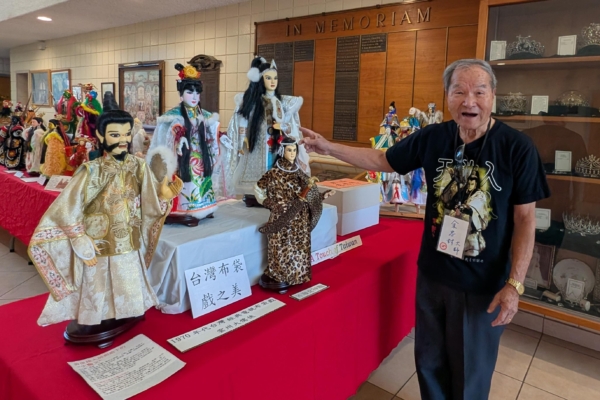
For many people in Taiwan, glove puppetry is not just a performing art, but also a vessel of family memories and emotional connections. Taiwanese glove puppetry collector Yu Zhongcun, based in the US, shared in an interview with The Epoch Times that his passion for glove puppetry stems from childhood memories of watching shows with his father at the temple entrance.
“While watching the show, I would walk around with my father, it was a very early and simple memory of familial affection,” Yu Zhongcun recalled his childhood in Qilian, where adults were busy with farm work and he shared this time in front of the temple with his father. Later, as he went abroad for development and couldn’t spend a long time accompanying his father, it wasn’t until his father passed away that he started consciously collecting glove puppetry dolls, hoping to reminisce about the past times spent with his father.
“At first, it was just collecting a few pieces as a commemoration, but later on, the collection grew and slowly became a specialized collection of Taiwanese glove puppetry dolls.” While not involved in performances, he is very concerned about the development, artistic value, and creative evolution of glove puppetry, especially the transformation process of Taiwanese glove puppetry dolls in terms of design and production.
Yu Zhongcun introduced that in the early days, glove puppetry dolls were around one foot tall, but gradually developed to be over three feet in size. Representative examples include the glove puppetry dolls from the Thunderbolt Puppet Theater, which not only boast exquisite designs but have also successfully transformed into a modern entertainment industry. He said, “Thunderbolt is no longer just a traditional theater troupe, but a publicly listed company that has expanded its influence beyond the Chinese community through television and visual media.”
The puppetry dolls in Yu Zhongcun’s collection can be roughly divided into three to four types, including the Golden Light series, historical themes, divine figures, and traditional glove puppetry dolls. Yu Zhongcun elaborated, “For example, the Golden Light series and the Mazu series have more elaborate designs; historical themes carry a sense of dignity; while traditional glove puppetry dolls retain a lot of manual details.”
He emphasized that the costumes of traditional glove puppetry dolls are mostly handcrafted, including embroidery and sewing details, showcasing exquisite craftsmanship; in contrast, modern glove puppetry dolls heavily utilize modern fashion designs and color theory, with fewer embroideries. The style tends to be more neutral or even incorporates Western elements, “Eye shapes, facial proportions are different from traditional Asian aesthetics, it is already a new visual language.”
Yu Zhongcun’s journey of collecting also reflects his personal struggles from Taiwan to the US. He admitted that in 1967, he crossed the ocean to the US and has now spent fifty years there, experiencing all the ups and downs, along with many life choices. Originally applying to study Agricultural Economics, he later switched to Urban Planning and Landscape Architecture due to the differences in fields. Eventually, he returned to the Resource Development department, pursuing a doctoral degree.
After obtaining his Ph.D., he initially wanted to resign from his state government job and return to Taiwan to work. However, after much consideration, taking into account practicalities and his children’s educational pursuits, he decided to stay in the US. He added, “If I had returned to Taiwan back then to contribute my studies, teaching and promoting correct and sustainable land development, perhaps some destruction and disasters could have been reduced.”
Since deciding to continue staying in the US, he made an extraordinary risky decision: to “quit academia and venture into business,” transitioning from the academic peak to entrepreneurship, operating a decorative arts and interior design business in Beverly Hills.
“Quitting academia to enter business” was one of the toughest decisions in Yu Zhongcun’s life, but the business experiences over the past twenty-plus years have truly integrated him into mainstream American society, greatly benefiting his future involvement in public affairs and social services.
Starting his collection in 1997, his home now houses over 300 glove puppetry dolls, spanning various eras and styles. He particularly highlighted a delicately handcrafted “Lu Bu” puppet, which not only has intricate design but also features purely handcrafted internal structures and costumes, making it a very rare piece.
For Yu Zhongcun, these puppetry dolls are not just objects, but a microcosm of the development of Taiwanese glove puppetry art, also carrying profound emotions towards his father and hometown culture.