
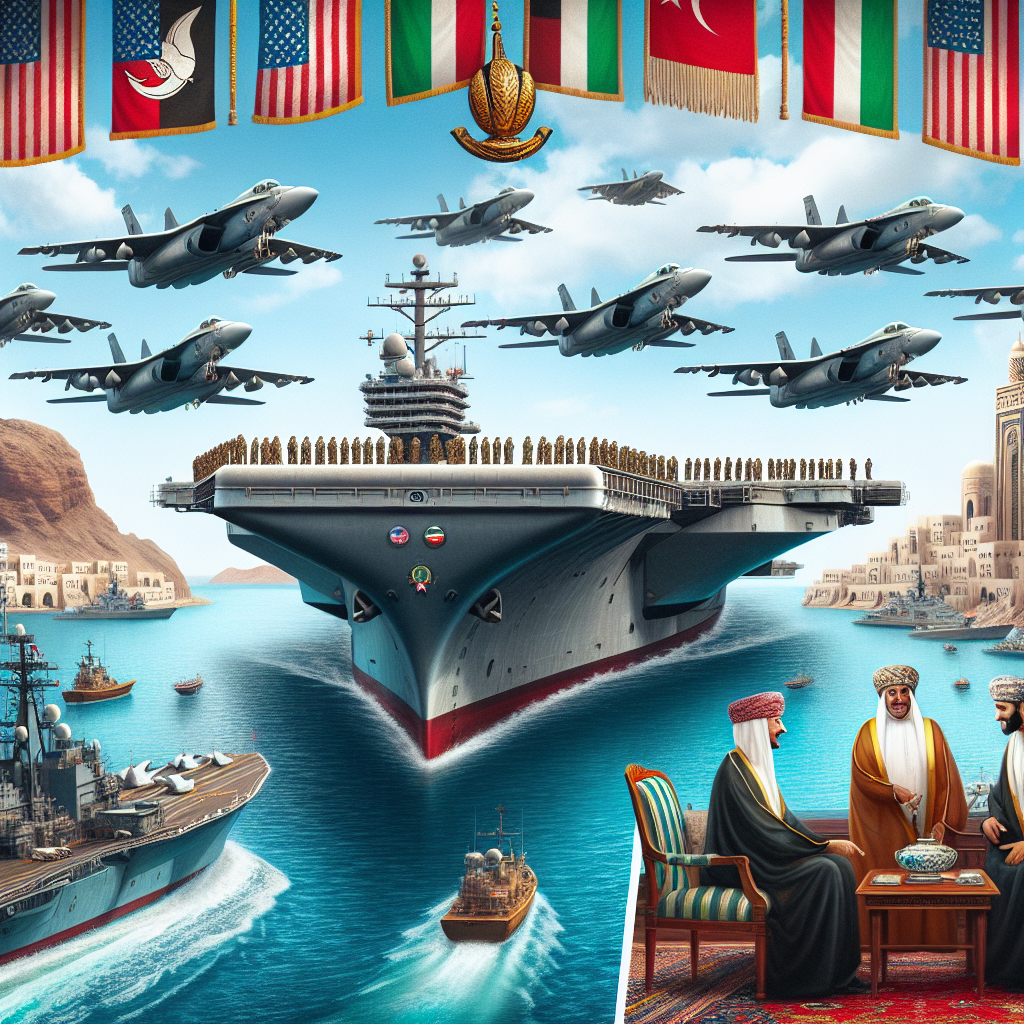
The US Navy’s aircraft carrier strike group, the USS Abraham Lincoln, at the behest of President Trump, has arrived in waters near Iran. Simultaneously, representatives from the US and Iran have engaged in the first round of indirect talks in Oman. With the US possessing 11 aircraft carriers, why did Trump choose the Lincoln?
While negotiations between the US and Iran are ongoing, the US has amassed a significant military presence in the Middle East. The Lincoln carrier strike group is currently positioned in the Arabian Sea, with one plane having already shot down an Iranian drone.
Trump has warned that if the US and Iran cannot reach an agreement, “bad things” could happen, increasing pressure on Iran.
The US Central Command released a photo showing an F/A-18F Super Hornet from the VFA-41 squadron preparing to land on the Lincoln aircraft carrier’s flight deck in the Arabian Sea on January 30th. The Lincoln is deployed in the US Fifth Fleet’s operational area to support maritime security and stability within the responsibility of the US Central Command.
The carrier air wing includes F/A-18 Super Hornets, F/A-18 Growlers, and F-35 Lightning II fighter jets, equipped to strike the Iranian navy and penetrate deep into Iranian territory.
Before heading to the Arabian Sea, the carrier was conducting operations in the South China Sea region in the Indo-Pacific.
The carrier’s geographic location in the Indo-Pacific region, along with the deployment of F-35C stealth fighter squadrons, makes it a preferred strategic deployment. The carrier provides real-time stealth operational capability, shortening response times from weeks to days.
President Trump has stated that a “massive armada” is heading to the region “just in case.” The USS Abraham Lincoln has been redeployed from the Indo-Pacific to the Middle East, positioning a formidable fleet near potential adversaries.
Upon receiving the order, the Lincoln carrier was on a mission in the South China Sea and Indian Ocean. It usually takes several weeks to transfer a carrier from the US West Coast. By moving the Lincoln, the US Navy has reduced response times to just a few days, quickly filling strategic gaps.
This deployment marks a significant shift in naval power, largely due to the deployment of F-35C Lightning II fighter jets. The Lincoln is the first carrier to carry the Navy Marine Corps’ F-35C squadron, the “Black Knights.” These fifth-generation fighter jets bring unmatched stealth capabilities to the region.
The nickname “Black Knights” of the Marine Aircraft Group 3’s VMFA-314 squadron, which made history with F-35C combat records during a strike against Yemeni rebels in November.
The exceptional stealth capabilities of the F-35C were a primary reason for choosing the Lincoln. Unlike the older F/A-18 Hornets, the F-35C is designed to penetrate enemy airspace protected by advanced air defense systems, crucial for operations near countries like Iran with sophisticated radar networks.
Military planners consider the Lincoln carrier as a “first-day strike” asset, capable of immediate action upon arrival. The combination of stealth aircraft and experienced crew members means the strike group requires minimal preparation time.
If diplomatic efforts fail, they are prepared for high-intensity combat.
The redeployment of the Lincoln carrier allows the Pentagon to swiftly inject power into the Middle East without fully exposing the Pacific. While this led to withdrawing a major ship from the South China Sea, it is the most effective way to balance global commitments. Deploying from the US mainland would create a longer vulnerable period.
The F-35C fighters are not just bombers, they are advanced flight sensors. They gather intelligence and share real-time target data with other ships and aircraft. This sensor fusion technology enables the strike group to maintain clear situational awareness even in signal-jamming environments.
The carrier is not alone in combat; it is escorted by powerful destroyers and cruisers. These vessels are equipped with Aegis combat systems and Tomahawk cruise missiles, enhancing offensive and defensive firepower. This formation allows the strike group to effectively defend against drone swarms and missile attacks.
The strike group includes three Arleigh Burke-class destroyers, each carrying Tomahawk cruise missiles with a range exceeding 1,000 miles. Additionally, two Arleigh Burke-class destroyers are deployed in the Persian Gulf and the Strait of Hormuz.
The crew of the USS Abraham Lincoln has been at sea for months, well-trained, and accustomed to the operational environment. This high state of readiness is a key factor in this deployment.
A carrier just returned from port would need time to reach the same combat efficiency level.
The arrival of the Lincoln sends a clear deterrent signal to the regional parties. By deploying the most advanced carrier air wing in the Persian Gulf, the US demonstrates its ability to bypass traditional air defense systems. This deployment aims to prevent escalation by showcasing overwhelming technological superiority.
The US has also reinforced its military bases in Saudi Arabia, Bahrain, Qatar, and the United Arab Emirates. It is believed that dozens of transport planes have delivered additional Patriot and THAAD missile defense systems that can intercept Iranian ballistic missiles.
At the same time, US Air Force F-15E Strike Eagle fighters have flown from the UK to Jordan.
With diplomatic efforts with Iran failing, the US has a substantial reserve of military forces.
Jordan and Israel are geographically closer to northern Tehran in Iran than the Lincoln carrier battle group in the Arabian Sea.