
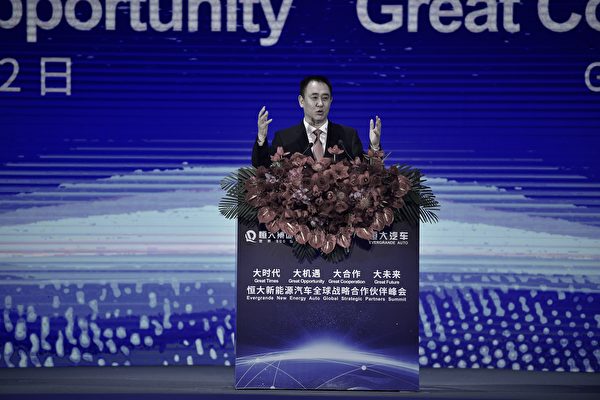
Recently, the Hong Kong High Court’s original civil court rejected the appeal application filed by the founder of Evergrande, Xu Jiaying, and his related companies regarding the appointment of receivers. At the same time, the court ordered Xu Jiaying to pay approximately 1.2 million Hong Kong dollars in litigation costs by February 20, 2026, failing which he will be prohibited from presenting a defense in the related litigation.
According to a report from “Daily Economic News,” the above information was obtained from the Hong Kong High Court on February 3.
Information indicates that in September 2025, the Hong Kong High Court appointed Du Aidie and Huang Yongshi as joint receivers and managers of all assets and business of Xu Jiaying, and ordered Xu Jiaying to bear the related costs.
Subsequently, Xu Jiaying filed an application for appeal and stay of execution, with the main reasons being that the court incorrectly applied the standards for the appointment of receivers, the scope of the order exceeded judicial jurisdiction, and the receivers should not have been appointed by Evergrande’s asset liquidator. If the appeal application is approved, the execution will be stayed until the final appeal decision or another court order.
The court deemed that the reasons provided by Xu Jiaying were not reasonably arguable and ultimately rejected the appeal in its entirety, and ordered Xu Jiaying and others to bear the costs generated by Evergrande’s summons for appeal permission and stay of execution summons.
On September 16, 2025, the Hong Kong High Court issued an order appointing receivers for Xu Jiaying and ordered him to pay Evergrande’s litigation costs incurred in the application for the receivership order. On October 21, 2025, the High Court assessed the litigation costs to be 1.2 million Hong Kong dollars and demanded that Xu Jiaying pay by November 4, 2025, which he has not done so far.
Xu Jiaying’s side explained that he is currently under the control of mainland authorities, limiting his communication. There is approximately 20 million Hong Kong dollars in lawyer fees deposited at a former law firm, but due to authorization proof issues, they have not been able to access it.
However, the Hong Kong High Court did not accept Xu Jiaying’s party’s explanation. Ultimately, it ruled that Xu Jiaying must pay the 1.2 million Hong Kong dollars in litigation costs by 4:00 pm on February 20, 2026, or he will be prohibited from presenting a defense in the consolidated litigation.
Reports indicate that Xu Jiaying and his wife, Ding Yumei, had already set up a large offshore trust structure for their children before the Evergrande crisis. Around 2019, they established a single-family trust fund worth up to 23 billion US dollars in the United States, designating their two sons as beneficiaries. The substantial trust funds primarily came from dividends and cash proceeds Xu Jiaying and his wife received from Evergrande over the years.
Previously, the Hong Kong court had ruled to include Xu Jiaying’s family trust in the scope of assets under receivership. This ruling is considered a significant challenge to the notion of “absolute safety of offshore trusts.”
The court believes that when a trust is used to evade debt responsibilities or harm creditors’ interests, its asset segregation effectiveness can be breached.
Industry experts believe that this case reinforces the principles of “substance over form” and prevention of fraudulent asset transfers in the common law system, with far-reaching implications for asset planning among high-net-worth individuals.
Information shows that Xu Jiaying’s family had established an offshore trust overseas with an estimated value of around 23 billion US dollars. With the Hong Kong judgment in place, the liquidator may seek judicial assistance overseas to pursue the related assets.
Currently, asset freezing and cross-border enforcement have been initiated in multiple legal jurisdictions. Legal circles generally view this case as potentially becoming an important precedent for global cross-border debt recovery.