
Xi Jinping, the leader of the Chinese Communist Party, endured hardships during his time as a young intellectual in Liangjiahe, but later claimed it was a case of “seeking hardship voluntarily”. Hong Kong officials recently referenced this “Xi quote” to lecture the Hong Kong police, but were mocked for “insulting Xi”.
On January 31, the Commissioner of the Hong Kong Special Administrative Region Security Bureau, Tang Ping-keung, delivered a speech at the Hong Kong Police College graduation ceremony, citing Xi Jinping’s difficult experiences in his youth as an example and emphasizing that police officers should “seek hardship voluntarily”. He mentioned that Xi Jinping, at less than 16 years old, went to work in the Liangjiahe village in Yan’an, doing various laborious tasks such as farming, coal mining, and fertilizing the fields. Xi’s primary requirement for himself was to seek hardship voluntarily, rather than passively endure suffering, and so on.
Senior commentator Feng Yiqian wrote in a post on social media on February 2 that Xi Jinping had indeed said, “My primary requirement for myself is to seek hardship voluntarily.” As early as the 1980s, when he served as a member of the Xiamen Municipal Committee and Deputy Mayor, Xi Jinping had shared with local university students the tough work he did when he was young, including jumping into a dung pit in the dead of winter to fertilize, getting covered in excrement, urine, wet, and stinky. Normally, such experiences could be described positively as “hardworking”, but Xi Jinping preferred to use the negative term “seeking hardship voluntarily”. It is not clear whether this was intentional self-deprecation or limited by his elementary vocabulary.
Feng Yiqian mentioned that in any case, “Xi Jinping seeking hardship voluntarily” has become a subtly negative term among internet users, akin to “success does not require boasting,” but using it derogatorily is akin to calling someone’s son a dog, which could be embarrassing.
“Seeking hardship voluntarily” and the Chinese idiom “inviting suffering upon oneself” are synonymous terms used to describe someone’s actions or decisions as futile, troublesome, or self-inflicted.
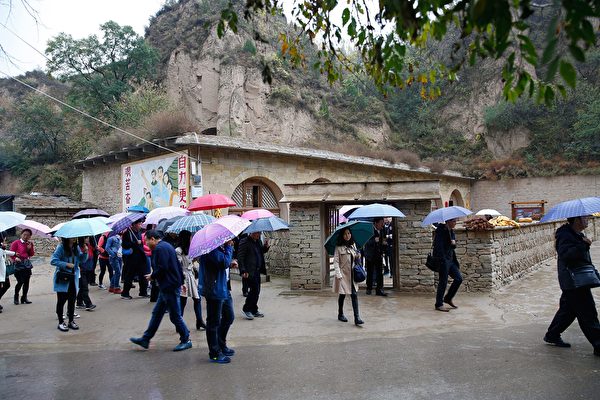
Public records show that in 1969, at 15 years old, Xi Jinping went to live in the Liangjiahe village in Yan’an County, Shaanxi Province, as part of Mao Zedong’s “Up to the Mountains and Down to the Countryside Movement” where millions of urban youth were forced to go to the countryside for “re-education”.
On August 14, 2004, Xi Jinping, who was then the Secretary of the Zhejiang Provincial Party Committee, gave an interview to Yan’an TV station. Xi recalled his initial discomfort adapting to the local life in Liangjiahe, where others worked on the mountains every day, but the young Xi was idle, leaving a bad impression on the locals. After enduring a few months of hardship, he secretly returned to Beijing, but was sent to a “school for delinquent youths” by his uncle’s suggestion. After half a year, he was released and returned to Liangjiahe.
Previously, CCP media articles also quoted Xi Jinping’s remarks on “seeking hardship voluntarily” to demand young officials to follow his footsteps. Commentator Li Yanming wrote that since Xi Jinping came to power, especially after the 19th National Congress of the Communist Party of China, he has taken a sharp turn, including targeting high-tech companies, private enterprises, internet celebrities, educational institutions, implementing nucleic acid lockdowns, and more; China is facing various crises and widespread grievances. Furthermore, almost every project led by Xi Jinping has ended in failure, raising concerns about the subtle negative implications in CCP media.