
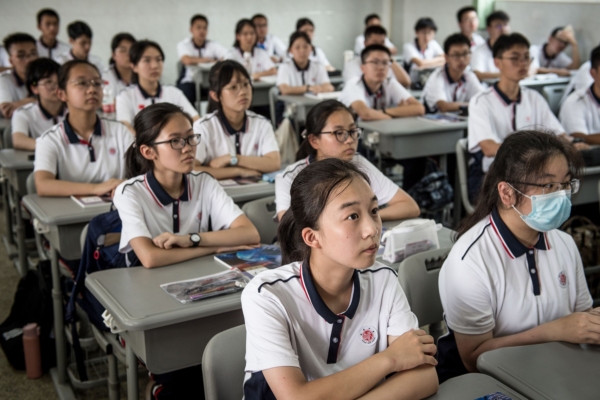
Recently, education authorities in various parts of China have successively announced the cancellation of “non-graduating year” unified exams, claiming to break the reliance on “scores only” and provide students with more freedom. However, this measure has sparked strong attention.
Legal and educational professionals have pointed out that in the current situation of severe uneven resource allocation and an imperfect integrity system, the cancellation of unified exams may lead to a bias in the evaluation mechanism towards the privileged children of the elite, thereby weakening the possibility for children from ordinary families to achieve social mobility through scores.
According to a recent report by Nandu Net, the Qingdao City Education Science Research Institute has confirmed the cancellation of the end-of-term unified exams for the first and second year of high school throughout the city, but stated that test papers will be provided for schools to use voluntarily. The Chengdu City Education Research Institute also confirmed the cancellation of relevant grade unified exams for the 2025-2026 school year’s first semester.
In addition, netizens in cities such as Changsha, Nanjing, Hangzhou, and Xiamen have also disclosed similar measures being implemented in their areas.
An article by Xinhua Net on January 29 reported that this move originated from a notification issued by the Chinese Ministry of Education in December 2025, which stated to “strictly prohibit organizing regional or inter-school exams for primary and secondary school non-graduating year levels.” The aim of this move is to “liberate” children by promoting evaluation methods shifting from “solely based on scores” to comprehensive evaluations from multiple dimensions.
However, the official policy has stirred up a storm on the internet. Parents are concerned about not being able to grasp their children’s true levels, teachers doubt that the exam pressure has decreased, and netizens criticize this as a mere “superficial alleviation.”
Ms. Zhang Min, a resident of Wuhan, Hubei province, expressed her concerns in an interview with Epoch Times. She stated that while the cancellation of unified exams appears to reduce burden, it actually leaves parents more clueless: “Parents have no idea how well their children are doing, at what level. In this situation, they can only rely more on extracurricular tutoring to fill the information gap.”
Zhang Min believes that the fundamental contradiction of the policy lies in the unchanged selection system: “No matter how much emphasis is placed on happy education, as long as the selection mechanism for transitioning from primary to middle school and from middle to high school, as well as the college entrance examination remain the same, it ultimately comes down to hard scores. The current approach is superficial on the surface but contradictory at its core, a show of alleviation performed to appease those in power.”
She further analyzed that the decision to not publicly announce ranking may be related to the frequent emergence of students’ psychological issues recently: “As the New Year approaches, if the grades are not ideal, parents worry that their children may not be able to handle the pressure. However, this is a superficial solution and does not address the root cause. Genuine education reform needs to start from the fundamental selection system, rather than simply refraining from disclosing scores.”
Regarding the issue of uneven distribution of educational resources, Zhang Min bluntly stated, “Public schools promote happy education while private schools continue to focus on elite training, which will only further advantage the children of the wealthy, while children from ordinary families lose the opportunity to compete fairly through unified exams.”
Human rights lawyer Wu Shaoping analyzed the reform dilemma from an institutional perspective. He explained to Epoch Times that in the absence of objective standards, when evaluation power is concentrated in the hands of teachers, it will inevitably lead to a crisis of fairness: “In a system where power can override everything, officials’ children enjoy privileges in schools. Without standardized exams, can teachers provide an objective evaluation for privileged children? What about children from ordinary families?”
Wu Shaoping emphasized that the collapse of the integrity system in Chinese society makes subjective evaluations even more unreliable: “Students from good family backgrounds, even with average performance, may be evaluated as excellent by teachers. This evaluation system not only fails to promote fairness but instead solidifies class divisions, causing education to lose its function as a channel for social mobility.”
He believes that the unfair distribution of educational resources is another deep-seated contradiction: “Officials prioritize allocating high-quality resources and financial investment to key schools where their own children study. Without addressing this structural injustice, any evaluation reform is just empty talk.”
Referring to the pressures on teachers, Wu Shaoping pointed out the core contradiction: “While exams are canceled, the assessment criteria for teachers have not changed. Teachers’ promotions and commendations still rely on students’ performance, making the pressure even greater. In the past, with unified exams, it was possible to say ‘it’s difficult for everyone in the district’ if the scores were not good; now with independent test creation, the responsibility falls entirely on the teachers.”
Jiang Pinchao, a writer at the Library of Congress in the United States, criticized the policy from a broader social and political perspective. He told Epoch Times that the essence of this policy is a strategy to deceive the masses: “The traditional concept in Chinese society of ‘studying hard to become officials’ is deeply ingrained, and only through studying can the lower class possibly change their fate. Now, by reducing study time and decreasing the frequency of exams, the actual result is cutting off the upward mobility path for the underprivileged and solidifying the privileged class.”
Jiang Pinchao likened this action to the Cultural Revolution era: “Back then, Zhang Tiesheng, who was encouraged to submit blank exam papers, was lauded as a hero, promoting the idea that studying is useless. Now, by indirectly advocating not to focus too much on learning, the essence is the same – to make the common people content with their lower status, not competing with the privileged class for benefits.”
Regarding the motivation behind the population policy, he analyzed, “The birth rate in 2025 is less than 9 million, not even half of the population during three consecutive years of natural disasters. The authorities may be attempting to stimulate childbirth by reducing the educational burden, but this is like grasping at straws. Without increasing income, improving welfare guarantees, simply lowering educational standards cannot solve the fundamental problem, but rather exacerbate it.”
Jiang Pinchao pointed out the deviation between policy and public opinion: “The common people deeply understand that only through studying can they enhance their competitiveness. The concept of ‘in books, there are treasures’ has been passed down for generations. Now telling them not to study too hard is completely contradictory to public understanding, naturally provoking widespread criticism.”
All three interviewees unanimously agreed that reform without touching the college entrance examination (Gaokao) system is doomed to fail.
Wu Shaoping categorically stated, “Junior high school to high school admissions are based on grades, and the college entrance examination ultimately determines a person’s lifelong trajectory. If the selection criteria remain unchanged, how can schools, parents, or students not prioritize scores? These reforms have been attempted many times but ultimately revert to the traditional path of exam-oriented education because the fundamental contradiction has not been resolved.”
Zhang Min validated this statement with her personal experience, “In China, students are required to write essays starting from the first grade, there are monthly tests, unit tests, but with no change in the college entrance examination system, these so-called efforts to reduce burden are merely superficial. Parents can only continue to keep up, because if they see others taking extra classes, they feel that not doing the same would put their children at a disadvantage.”
Jiang Pinchao further supplemented from the perspective of educational content, “Even if it’s not just about scores, the ideological indoctrination prevalent in political and history classes is stifling students’ critical thinking. A compulsory education system that instills totalitarian ideology will never cultivate creative talent. Scores are not the only issue; the educational content itself has fundamental flaws.”
Wu Shaoping concluded, “To truly reform, there must be an impartial evaluation mechanism immune to power interference, achieve fair distribution of educational resources, and reform the Gaokao selection system. However, in the current system where power dominates everything, these necessary conditions are lacking. So-called happy education will only result in a new round of turmoil, ultimately harming the children of ordinary families.”