
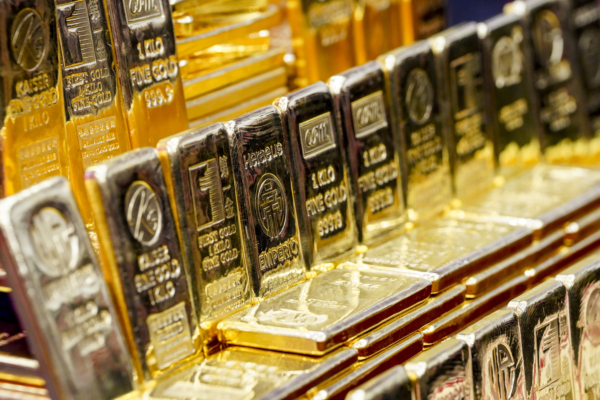
On Friday, January 30th, the prices of gold and silver plummeted simultaneously. In the gold markets of Beijing and Shenzhen, the price of gold per ounce dropped by over $400 in a single day, shocking the public. “The price dropped by tens of RMB per gram in just a few words,” said one person. At the same time, stocks related to the gold sector in A-shares also experienced a “limit down” trend.
According to reports from jingr.com, on January 30th, international gold prices experienced a significant drop. The spot price of gold plummeted from a high of $5450 per ounce, breaking below $5000 at one point with the largest drop reaching 8%. International silver prices also tumbled, with spot silver falling below the key level of $100 per ounce, dropping over 17%.
Several gold jewelry brands saw a significant price adjustment for their 24-karat gold jewelry. On January 30th, Chow Sang Sang quoted at 1662 RMB/gram, Chow Tai Fook at 1685 RMB/gram, Lao Feng Xiang at 1620 RMB/gram, and Lao Miao Gold at 1668 RMB/gram. However, on the 29th, the price per gram for several brands exceeded 1700 RMB.
On the same day, the gold sector in A-shares experienced a wave of limit down prices. Yunnan Copper, Silver Color, Jiangxi Copper, China Gold, Shandong Gold fell by 10%, Sichuan Gold by 10%, Zhaogold by nearly 10%, and Western Mining by nearly 10%, with widespread limit downs.
Reports indicated that on January 30th, overnight in Beijing, the price for gold recycling dropped by nearly 70 RMB per gram, causing a decrease in transactions despite high popularity at the recycling windows.
“When I first came into the store, the price was still 1159 RMB (per gram), but in the blink of an eye, it updated to 1123 RMB,” said an elderly man who came to sell his gold. He brought nearly 30 grams of gold to sell, but due to the sudden price drop, the total price difference might reach up to nearly 800 RMB.
Store clerks mentioned, “The gold recycling price is adjusting every moment, it changed more than ten times yesterday.” The quoted price is for reference only, and it will fluctuate based on real-time market conditions after inspection.
As reported by “jimocn.com”, in Shuibei Market in Shenzhen, the price of gold per gram dropped by about 60 RMB in less than a day. At 2:00 PM on January 30th, the price of gold bars in Shuibei Market was 1204 RMB/gram, with a recycling price of 1152 RMB/gram, while at 6:29 PM on the 29th, the price was 1265 RMB/gram with a recycling price of 1218 RMB/gram.
Some netizens complained: “Just bought 4 grams of gold, now it’s worth less.” “Just got in, and already lost over a hundred with 1 gram?”
On the evening of January 28th, a private equity tycoon and General Manager of Shenzhen Oriental Bay Investment Management Co., Ltd., Dan Bin, reposted bearish comments on gold on his personal Weibo account, sparking attention.
Throughout history, international gold prices have experienced violent swings, with severe outcomes. Dan Bin mentioned two instances, first from 1979 to 1980 when gold surged from $200 to $850 within a year, and silver from $6 to $50. However, two months later, gold halved in price, and silver dropped by 2/3, leading to a 20-year freeze.
The most recent example was from 2009 to 2011 when international gold prices rose from $880 per ounce to its peak at $1920 per ounce, leading silver to reach $50 again. However, in the following two years, gold prices retraced significantly by nearly 40%, and silver dropped by 70%.
Dan Bin noted that the crazier the rise, the harsher the fall, almost like a law.
In response, Wang Yanqing, Chief Analyst of Precious Metals at CITIC Jiantou Futures, told “Every Economic News” that “markets always have fluctuations; the crazier the rise, the harsher the fall, which is normal. But the key is knowing when the upward trend ends and the downturn begins.”
In 2025, according to a report by the World Gold Council, global gold investment demand reached a milestone of 2175 tons. Physical gold investments in China saw a record high, with purchases of 432 tons of gold bars and coins, growing by 28% compared to 2024.
The report’s analysis cited hedging demand and asset diversification as core driving factors for robust gold investment demand. Geopolitical and geoeconomic risks remaining high, a weakening US dollar, high stock valuations, along with market expectations of a rate cut by the Federal Reserve in 2025 played crucial roles in driving the market.
What are the main factors influencing future gold prices? Zhang Chi, Fund Manager of Hunan Wantai Huarui Investment Fund, stated to “jingr.com” that fluctuations at historical highs are inevitable for gold prices. In the future, attention should focus on whether several key factors supporting gold prices will change.
“When the US economy is strong, the dollar rises, and geopolitical risks decrease, these factors will push down gold prices. Otherwise, gold prices will not plummet,” further explained Wang Yanqing, “The primary factors influencing the future gold price are short-term liquidity and long-term US dollar credit.”