
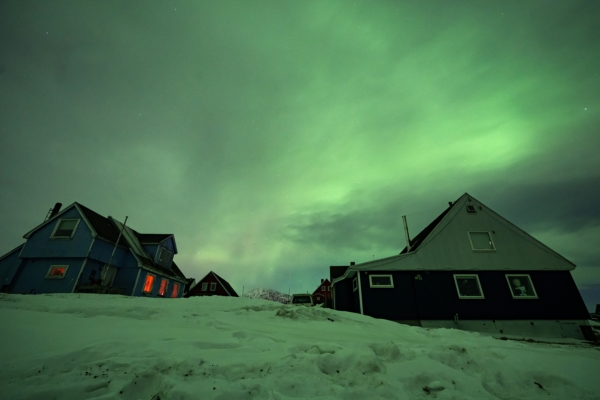
In recent days, the capital of Greenland, Nuuk, has been experiencing dazzling green auroras due to a strong solar storm. The faint green lights dance in the sky like ribbons, flickering on and off. Below, the tranquil small fishing villages glow with warm lights, echoing the cold green auroras in the sky, creating a magnificent scene.
Especially in the early hours of last Sunday (January 25), the city experienced a massive power outage due to strong winds, plunging the entire city into darkness. This blackout provided the residents with exceptional conditions to observe the auroras.
Auroras are considered one of the most beautiful natural wonders, formed by three core elements: solar wind (high-energy charged particle stream), Earth’s magnetic field, and the atmosphere (mainly nitrogen and oxygen). Charged particles from the solar wind flow to Earth and, under the influence of Earth’s magnetic field, enter the vicinity of the north and south magnetic poles along magnetic field lines. They collide with high-altitude atmospheric molecules, producing a colorful glowing phenomenon known as auroras. Auroras usually appear only in regions close to the poles, but when solar activity intensifies and solar winds become more intense, the aurora-producing region may expand to mid-latitude areas.
The most common color of auroras is fluorescent green, followed by orange, purple, and various shades of red, pink, blue, and yellow. Green is the predominant color of auroras in polar regions.
Due to Greenland’s location deep within the Arctic Circle and sparse population (minimal light pollution), during aurora activity periods, almost every corner of the island provides an opportunity to directly gaze at the beautiful auroras in the night sky. This world’s largest island has thus become one of the best places globally to observe the northern lights, attracting numerous tourists and astrophotography enthusiasts who come here each year to “chase the light.”