
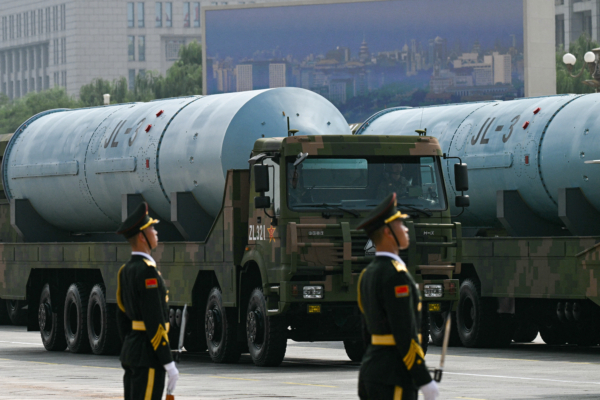
On January 24th, the Vice Chairman of the Chinese Communist Party’s Central Military Commission, Zhang Youxia, was announced to have been arrested. Following this revelation, American media quickly quoted individuals claiming to have insider knowledge, alleging that Zhang was accused of leaking information about the CCP’s nuclear weapon program to the United States and being involved in corruption. However, this news has sparked skepticism, with many questioning the credibility of the reports, suggesting that it might be a case of being fed information that resembles a carefully crafted propaganda narrative by the CCP.
According to The Wall Street Journal, sources revealed that before the Chinese Ministry of National Defense announced an investigation into Zhang Youxia on the 24th, several top military leaders of the CCP attended a high-level briefing earlier that morning. The most shocking accusation made against Zhang was that he allegedly leaked core technical information about CCP’s nuclear weapons to the United States.
Reportedly, some of the incriminating evidence against Zhang comes from Gu Jun, the former general manager of the China National Nuclear Corporation, who was announced to be under investigation on January 19.
However, reports from American media about Zhang’s alleged involvement in leaking CCP’s nuclear secrets to the United States have raised widespread doubts.
Former Chinese Foreign Ministry official Han Lianchao stated on X platform, “I question the authenticity of this news.” He pointed out, “The severity of this accusation does not match the official reports. Another suspicious aspect is that as the head of the Central Military Commission, Zhang Youxia has access to the most critical and top-secret information of the entire military, including nuclear retaliation procedures, far beyond what Gu Jun of the nuclear corporation knows. There would be no reason for him to seek such information from Gu Jun. Even if there were leaks, Gu Jun should not have been privy to it. If it really involves a ‘major accident of leaking nuclear secrets,’ the CCP’s response would have been similar to the handling of the Lin Biao incident in 1971. But at present, such measures have not been taken.”
Pro-democracy activist Wu Renhua commented, “I do not believe Zhang Youxia would betray China’s nuclear weapon secrets to the United States. This should be a fabricated charge intended to gain support from various sectors in China where nationalist sentiments are high to deal with Zhang Youxia.”
Former Central Party School professor Cai Xia stated, “This is a case of ‘creating a crime out of thin air.’ After Xi Jinping arrested Zhang Youxia and Liu Zhenli, quickly announcing it, they completely broke the CCP’s institutional norms. Anomalous behavior always indicates something sinister! They thought they could use the excuse of ‘research and decision-making by the Central Party’ to deceive the entire party and military. However, this has only sparked intense opposition from the party and military’s second-generation ‘red aristocracy.’ They had to fabricate charges that could provoke hatred towards the United States and stoke nationalist sentiments to justify Xi-style coup d’état.”
“ChinaFacts on Chinese Politics and Economy” stated, “Let me share a common sense with you: Foreign media usually have many sources, but most of them are not highly reliable and need to be crosschecked repeatedly. For Zhang Youxia to be arrested on Saturday and reports to be published on Sunday, including the revelation of ‘leaking nuclear weapon accusations,’ this source is extremely reliable and crucial. In the current tense atmosphere, being willing to pass on highly sensitive information in a ‘limited dissemination’ fashion implies that this source is likely an authorized leaker.”
Veteran journalist Nobuo Shibata, speaking on NTD’s “Breaking News” program, interpreted the situation, stating that this news must have been leaked to American media from the Chinese side. The CCP intentionally leaked this information to tarnish Zhang Youxia’s reputation and legitimize the crackdown on him because betraying the country is unforgivable. Furthermore, leaking nuclear secrets is a very serious issue that historically would result in at least a death penalty, suspended death sentence, or life imprisonment. This reflects Xi Jinping’s fear; if he continues to address the issue of Zhang Youxia solely based on ‘corruption problems,’ it has lost its persuasiveness.
Drawing from his past reporting experiences in Beijing, Shibata believes that ‘leaking secrets’ is just an excuse by the CCP and a reason to legitimize the Zhang Youxia incident. The narrative of leaking secrets is likely either fabricated out of thin air or expanded to turn a normal information exchange or interaction with the U.S. military into a leak, which is a common tactic of the CCP used during the Cultural Revolution and subsequent purges.
Shibata later took to his social media to analyze this issue independently, stating based on the process of news generation, The Wall Street Journal’s report appears to be a typical case of “external promotion for domestic consumption.” “Using foreign media to release information and shape narratives is a common technique employed by the CCP to manipulate public opinion. The focus should not be on whether a specific report is true or false but rather on whether it is serving a particular political agenda. Therefore, this is not just a characterization of Zhang Youxia’s individual case but a carefully designed propaganda narrative.”