
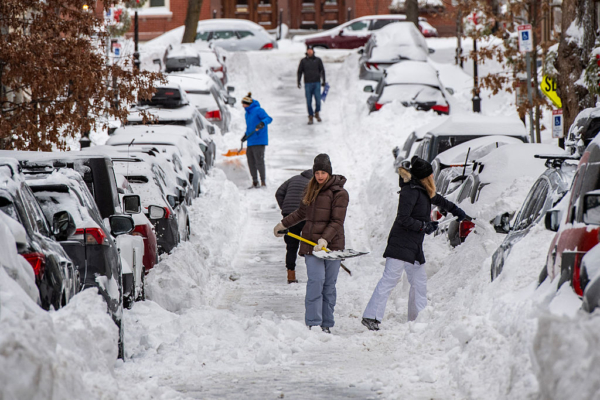
A massive snowstorm that swept across the United States on Monday, January 26 has resulted in at least 13 deaths. Following a weekend of severe weather, authorities issued road safety warnings, with a large number of flights canceled and over 820,000 households experiencing power outages.
The National Weather Service in the United States stated that on Monday, a low-pressure system in southern New England was expected to move eastward into the Atlantic, bringing heavy snow to parts of the Northeast and freezing rain to parts of the central Atlantic. Widespread below-freezing temperatures and bitter winds are predicted to continue affecting millions of Americans until the end of January.
As of Monday morning, major cities in the Northeastern United States have received over 30 centimeters (1 foot) of snow, according to the National Weather Service.
By early Monday morning, Central Park in New York City had received 29 centimeters (11.4 inches) of snow. Other areas in western New York State reported snowfall as high as 43 centimeters (17 inches).
As of 10 p.m. on Sunday, Boston had accumulated 38 centimeters (15 inches) of snow.
By 7 p.m. on Sunday, Washington D.C. had approximately 23 centimeters (9 inches) of snowfall.
The forecast from the weather service predicts heavy snow in the Ohio River Valley to the Northeast on Monday morning, with snowfall in parts of New England potentially reaching up to 18 inches (about 45 centimeters). Forecasters also warned of “disastrous freezing impacts” that could lead to extended power outages.
Meteorologists warn that heavy snowfall will continue to cause widespread traffic disruptions and road closures, while freezing conditions will result in prolonged power outages, substantial tree damage, and hazardous travel conditions.
The National Weather Service in the U.S. reminded the public that after the storm, regions from the Southern Plains to the Northeast will continue to face frigid weather, hindering cleanup efforts, prolonging infrastructure damage, and maintaining dangerous travel conditions over the next few days. They advised the people to continue following local government guidance.
As the cold spell spreads throughout two-thirds of the eastern United States this week, the weather service stated that wind chill values in the Plains region, the lower Mississippi River Valley, the Ohio River Valley, and the central Atlantic will approach their lowest levels.
According to the weather department, from the Southern Plains to the Northeast, “extreme cold temperatures and dangerous winds” are expected, leading to “continual hazardous travel and infrastructure damage” that could last for a week.
The weather department cautioned that low temperatures and frigid winds could cause life-threatening hypothermia and frostbite risks, with prolonged power outages potentially exacerbating the situation. Extreme cold remains one of the leading causes of weather-related deaths in the United States.
Flight tracking website FlightAware reported that as of early Monday, approximately 3,900 flights across the U.S. were canceled, with over 1,500 flights delayed.
Data shows that the airports with the highest number of flight cancellations are located in Boston, New York City, Dallas, Washington D.C., and Charlotte, North Carolina.
By 7 a.m. Monday on the East Coast, Boston’s Logan International Airport had already canceled more than 500 flights, while Washington D.C.’s John F. Kennedy International Airport had over 440 flight cancellations.
According to data from aviation analysis company Cirium, over 11,000 flights were canceled on Sunday, marking the highest number of flight cancellations in the U.S. since the onset of the COVID-19 pandemic. FlightAware’s data showed that on Sunday afternoon, over 10,900 U.S. flights were canceled, with more than 3,400 flights delayed.
PowerOutage.us reported that as of early Monday morning, over 820,000 customers were without power, with around 1 million households in the U.S. experiencing power outages earlier on Sunday afternoon.
By 6 a.m. on Monday on the East Coast, the states with the most severe power outages were Tennessee, Mississippi, and Louisiana.
According to official reports from the states, over the weekend, the snowstorm and extreme cold weather had already claimed the lives of at least 13 individuals.
The Louisiana Department of Health confirmed on Sunday that two men in the northwestern part of the state had died due to hypothermia-related causes from the winter storm.
New York City Mayor Zohran Mamdani announced on Sunday during a press conference that over the weekend, at least five people were found dead “outdoors” in the city. He noted that the causes of death were still under investigation.
Austin, Texas Mayor Kirk Watson declared on Sunday the city’s first winter-storm-related fatality. The Mayor posted on social media that the cause of death was “exposure to the cold environment.”
The Texas Department of Transportation and Public Safety reported a major traffic accident in Kimble County, Texas, on Saturday night due to weather conditions, resulting in one fatality and eight injuries.
The Tennessee Highway Patrol stated that they have been assisting drivers across the state with weather-related accidents. As of last Saturday, Lieutenant Bill Miller reported that troopers had responded to over 160 traffic incidents and more than 50 traffic-related accidents, leading to 18 injuries and one fatality.
At least four states – Kentucky, Maryland, Delaware, and New Jersey – announced on Sunday that all state government offices would be closed on Monday. As the new week began, major cities across the U.S. saw schools either suspending classes or transitioning to remote learning.
Officials in New York City announced that school buildings were closed, with remote learning taking place on Monday. In Texas, the Houston Independent School District and Dallas Independent School District announced school closures on Monday.
Several school districts in the Atlanta metropolitan area, including Gwinnett County, Fulton County, and Decatur City schools, stated they would switch to remote learning on Monday. Meanwhile, schools in DeKalb County canceled classes on Monday.
School districts in Philadelphia, Boston, and Baltimore also announced closures on Monday. The Memphis-Shelby County Public Schools in Tennessee declared that all schools would be closed on Monday due to “dangerous conditions.” The Nashville metropolitan area public schools also announced closures for Monday and Tuesday.