
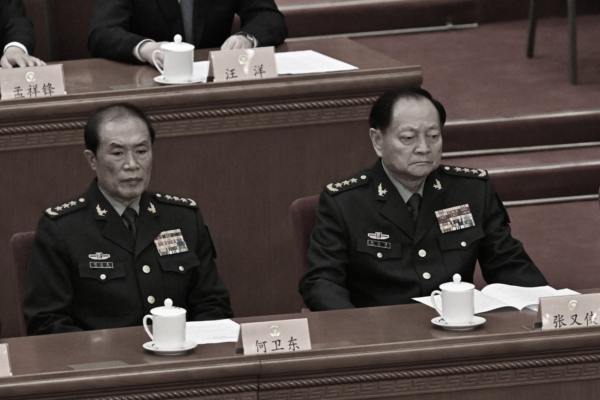
On January 24, 2026, according to Epoch Times, Vice Chairman of the Central Military Commission Zhang Youxia and Commission Member Liu Zhenli have been officially ousted, leaving only 2 members in the CCP Central Military Commission and 4 active-duty generals. Experts analyze that internal strife within the CCP is intensifying, making the future more perilous.
The CCP Ministry of National Defense reported on Saturday (24th) that Vice Chairman of the Central Military Commission Zhang Youxia and Commission Member and Chief of the Joint Staff Department Liu Zhenli are suspected of serious violations of discipline and law and are under investigation.
Zhang Youxia is the fourth Vice Chairman of the Central Military Commission to be taken down since Xi Jinping came to power in 2012. Prior to this, Guo Boxiong, Xu Caihou, and He Weidong were also ousted.
Since the establishment of the 20th Military Commission on October 23, 2022, out of the 7 Commission Members, Minister of National Defense Li Shangfu, Director of the Political Work Department of the Military Commission Miao Hua, and Vice Chairman of the Central Military Commission He Weidong have been ousted. Currently, only Zhang Shengmin and Xi Jinping remain in the Military Commission.
Among the active-duty generals in the CCP, besides Vice Chairman of the Military Commission Zhang Shengmin and Minister of National Defense Dong Jun, there is only General Yang Zhibin, who was promoted to the rank of general in the Eastern Theater Command in December last year, and General Han Shengyan in the Central Theater Command.
Public records show that 75-year-old Zhang Youxia is a “second-generation red,” with his father being General Zhang Zongsun, a prominent figure in the early days of the CCP. Zhang Youxia was born in Beijing in 1950 and is from Shaanxi. He has participated in two border skirmishes with Vietnam and is one of the few active-duty generals in the CCP who have seen combat.
Liu Zhenli, 61 years old, is from Luancheng, Hebei, and has also participated in the Vietnam War.
In response to this, Su Ziyun, Director of the Institute of National Defense Strategy and Resources at the Taiwan Institute for National Defense Security, analyzed for Epoch Times that Xi Jinping likely had plans in advance and had a dagger hanging over Zhang Youxia’s head. “Because when Zhang Youxia resigned as Minister of Equipment in 2017, he was succeeded by Li Shangfu, and at that time, there were some issues related to the Equipment Department raised, but drawing a line to only investigate after 2017 is like hanging a sword over Zhang Youxia’s head.”
Su Zi Yun believes that this incident also involves a power struggle among the second-generation reds, as there are three factions: the first faction emphasizes future democracy and human rights, which is the rational reformist faction; the second faction is purely focused on business and avoids politics, which has also been purged by Xi Jinping; and the third faction is the extreme left, advocating for the CCP’s line.
“Currently, Xi Jinping seems to be leading the extreme left faction. Regardless of the personal guards, group factions, or factions like the Fujian Gang, Xi Jinping has swept them all away, and now only the Xi faction’s extreme left line remains,” he said.
Su Zi Yun stated that the serious internal strife within the military has reduced the likelihood of Xi Jinping launching a war against Taiwan because initially, failure in a Taiwan Strait conflict was unacceptable. Now, with the top senior generals being purged, the entire command chain lacks experienced personnel, decreasing the possibility of war.
He stated that this highlights Xi Jinping’s personal unease. Regardless of the original Fujian Gang, Xi Jinping first targeted Zhang Youxia’s faction, then those of Li Shangfu, Wei Feng, and others, but Zhang Youxia fought back and removed He Weidong, Lin Xiangyang, Miao Hua, among others, and now Zhang Youxia has also been removed.
It appears that Xi Jinping has solidified his control over the military in 2026. However, Su Zi Yun cautioned that the situation remains dangerous because the remaining generals are cornered by Xi Jinping and may take risky actions, posing a major concern for Xi Jinping. Additionally, with the country’s current economic woes, Xi Jinping’s road to reelection remains precarious.
Su Zi Yun concluded by stating that continuing the infighting within the CCP sends a negative signal, as Xi Jinping’s actions have caused problems with military, economic, and ideological aspects, which may lead to more turmoil. He is essentially an “accelerator of conflicts.”
A scholar in Beijing responded to Epoch Times, stating that this power struggle ended in Xi’s victory and Zhang’s defeat; although the CCP appears stable on the surface, internal conflicts will continue and become more brutal in the future. Monitoring of the elders will be stricter, but the Taiwan Strait may become slightly safer. The succession plan after Xi is even more unpredictable and perilous.
(Translation from Chinese to English)