
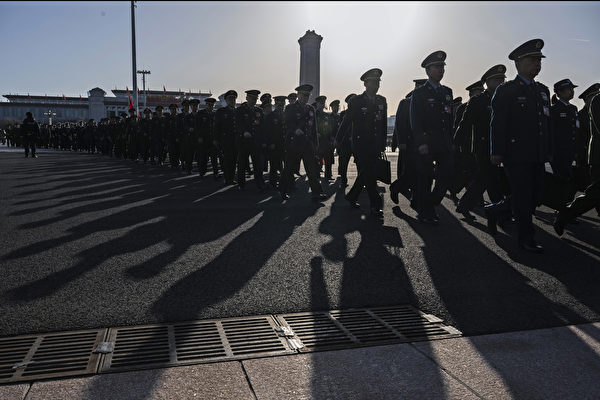
On January 24th, Zhang Youxia, member of the Political Bureau of the Communist Party of China (CPC) Central Committee and Vice Chairman of the Central Military Commission, as well as Liu Zhenli, member of the Central Military Commission and Chief of Staff of the Joint Staff Department of the Central Military Commission, were placed under investigation. Observers believe that this move is seen as retaliation by Xi Jinping against Zhang Youxia. The impact of this event on Xi’s plans regarding Taiwan is also drawing attention.
Australian independent media figure Jiang Wangzheng told Epoch Times that this action is a form of retaliation by Xi Jinping. Originally, Zhang Youxia and Xi Jinping had a very good relationship, but Zhang Youxia disrupted the balance of power within the military. Xi Jinping had hoped for Zhang Youxia to retire early and have Gen. He Weidong and Gen. Zhang Shengmin take over, but Zhang Youxia disagreed and even clashed with He Weidong, He Hongjun, and Zhong Shaojun.
Jiang Wangzheng mentioned that Xi Jinping’s swift move to take down Zhang Youxia came as a surprise to many.
Furthermore, he expressed that based on information he obtained from within the system earlier, Xi Jinping might take action against Taiwan regardless of opposition from military personnel who truly understand military affairs, such as Zhang Youxia.
Researcher Shen Mingshi from Taiwan’s Institute for National Defense and Security Analysis analyzed that the arrests may involve Zhang Youxia and Liu Zhenli attempting to pressure Xi Jinping to step down during the Two Sessions or the Fifth Plenum. Xi Jinping immediately retaliated after obtaining evidence, targeting Zhang Youxia and Liu Zhenli first to eliminate the military support of the anti-Xi faction.
Shen Mingshi noted that the notification from the Chinese Ministry of National Defense regarding the arrests of the two individuals specified that the action was “researched by the Central Committee of the Party.” This indicates that the arrests were initiated by the Party and not through legal, national, or military channels, suggesting it is an act of internal party struggle with significant implications.
Shen Mingshi mentioned that after the Third Plenum of the Twentieth Congress, Zhang Youxia led a significant number of arrests of pro-Xi military leaders and promoted many non-pro-Xi military leaders. Now, the question arises whether the non-Xi faction leaders will be arrested in the short term. The previously arrested pro-Xi figures like Miao Hua, He Weidong, and even Xi’s close aide, Zhong Shaojun, might be pardoned by Xi due to Zhang Youxia and Liu Zhenli’s arrests, and reinstated in their former positions. However, this could potentially cause turmoil within the military as these individuals had been officially investigated, and their return to leadership roles may lead to internal discord.
There are concerns about Xi Jinping’s increasing power and potential preparations for military action against Taiwan. Shen Mingshi stated that if the pro-Xi military leaders like Miao Hua, He Weidong, are still in positions of influence, Xi Jinping might indeed push for military action against Taiwan. However, given their downfall due to corruption and the significant corruption within the entire military, it would be challenging for the CCP to engage in military action against Taiwan in the short term.
He believes that after targeting the main anti-Xi forces within the military, Xi Jinping will first ensure a successful re-election during the Twenty-First Party Congress.
In an exclusive report by Epoch Times on October 24, 2025, it was highlighted that the restructuring of power within the CCP’s military intensified around the Fourth Plenum, with Zhang Youxia’s faction countering Xi Jinping’s cleanup efforts, leading to divergent opinions on the policy of military action against Taiwan within the military.
Several sources close to the Chinese military revealed to Epoch Times that “Zhang Youxia clearly opposed immediate military action in numerous internal meetings, pointing out that Taiwan’s defense system ranks second only to Israel, higher than Ukraine. He raised concerns before the Two Sessions, stating that the likelihood of intervention by the U.S., Japan, Australia, and the Five Eyes alliance is extremely high, and a prolonged attack may trigger internal turmoil. The existing military forces and logistics of the CCP army are deemed inadequate to sustain long-term combat.”
Insiders informed Epoch Times that Zhang Youxia advocated for stability and urged against opening a front in the midst of economic downturn and diplomatic isolation. This stance was perceived by Xi Jinping as “undermining military morale” and served as a catalyst for the subsequent purging of military leaders.