
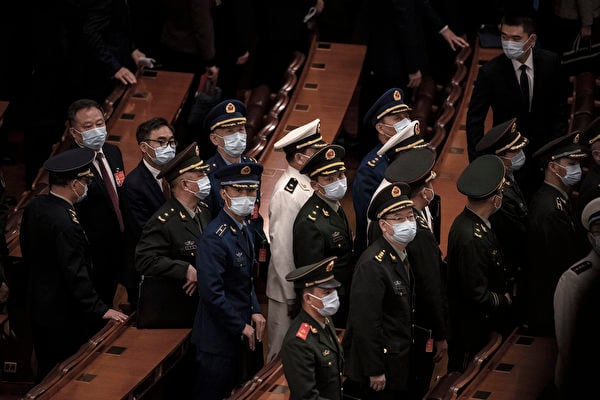
The Chinese Communist Party recently held a seminar for provincial and ministerial-level officials, with Vice-Chairman of the Military Commission Zhang Youxia and Military Commission member Liu Zhenli absent, attracting attention from the public. It has been rumored that Zhang Youxia and 17 other senior military officers have been arrested, which, if true, would create another major upheaval following the downfall of many other military officers like He Weidong. Scholars point out that in 2026, Xi Jinping is likely to face a political crisis, and the military crisis is an extreme manifestation of the overall political turmoil.
Independent commentator Cai Shunkun posted on social media on January 23rd that the news of Zhang Youxia and 17 senior officers being arrested is “absolutely accurate,” including General Liu Zhenli, General Xiao Tianliang, Major General Zhong Shaojun, among others. The arrest operation involved the Ministry of Public Security, the Central Guard Bureau, and the Central Commission for Discipline Inspection, resembling a significant military upheaval.
Cai stated that a large number of military officials will continue to be arrested, with the news of Zhang Youxia and others’ arrests being conveyed to vice-provincial-level officials. Previously, on January 20th, Australian self-media personality Jiang Wang revealed on a platform that Zhang Youxia had been summoned for questioning, along with his son, confidential secretaries, and Liu Zhenli.
Due to the opaque nature of the Chinese Communist Party, the aforementioned information has yet to be verified.
Researcher Shen Mingshi from the Taiwan Institute for National Defense and Security Studies told Dajiyuan that since the Third Plenum of the 20th Central Committee of the Chinese Communist Party in 2024, internal power struggles within the Party leadership have intensified. Before the annual “Two Sessions” in March this year, there may be another wave of high-level power struggles. The recent rumors about Xi Jinping arresting Zhang Youxia may be related to power arrangements within the senior ranks of the Chinese Communist Party ahead of the 21st Party Congress.
Shen analyzed that if Xi Jinping insists on a fourth term, it would have a significant impact on the so-called political security or the unity within the Party and military. Currently, most military positions, including commanders, political commissars, and those in charge of the five major theater commands, are still vacant, leading to various problems within the military. Any changes in domestic or international situations could potentially lead to further chaos.
Liberal legal scholar Yuan Hongbing, currently residing in Australia, believes that Xi Jinping’s political theories are on the brink of collapse, leading to a significant decline in the cohesion within the Chinese Communist Party. The distrust and despair among Party members and officials towards Xi and the future of the Party will deepen. In 2026, Xi Jinping is expected to face a political crisis, with the military crisis serving as an extreme symptom of the overall turmoil.
Yuan noted that nearly all active generals in the Chinese military are facing disciplinary actions, with even more extensive purges affecting lieutenant generals and colonels. Former Military Commission member Miao Hua and his secretary have implicated over 3,000 military officers for disloyalty to Xi Jinping. The so-called massive purge for self-revolution ordered by Xi Jinping has effectively disintegrated the command structures of the Chinese military. 2026 is poised to be the weakest year for the Chinese Communist Party’s armed forces.
Yuan further stated that Xi Jinping’s belief that the massive purge can ensure loyalty from the military will likely lead to a vicious cycle of disloyalty among newly promoted officers. If Xi continues down the path of Mao Zedong’s orthodox ideology, a path that rejects history and humanity, this malicious cycle is unlikely to change.