
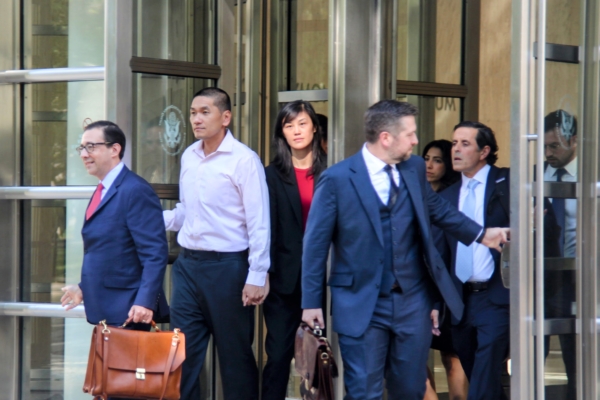
New York Governor Ho Chu’s former deputy chief of staff, Sun Wen, and her husband Hu Xiao, are facing charges of laundering millions of dollars through agents associated with the Chinese Communist Party in exchange for Sun Wen using her authority to facilitate connections between the Chinese government and Governor Ho Chu of New York, as well as (then) Governor Kummer, and further the CCP’s goals. Their defense lawyers wrote to the court on January 20, stating that unless the court significantly delays the retrial, they will apply to withdraw representation due to the couple’s seized assets making it impossible for them to fund an “effective defense.”
The case, announced to be held over again “as soon as possible” by presiding Judge Brian Cogan on December 22, 2025, prosecutors stated they will promptly reassemble the jury and restart the trial. The court scheduled a pre-trial status conference for January 26 this year, requesting both sides to submit a joint status report by January 23 (this Friday).
However, Hu Xiao’s lawyer, Seth DuCharme, representing Sun Wen and her husband, stated in the letter sent on January 20 (this Tuesday) that if the court does not approve a postponement of the retrial date to around November 2026, the current lawyers will apply to withdraw representation at the upcoming status conference.
The letter outlined three core reasons for the request for an extension: first, the defendants are in financial distress as most of their assets are frozen, causing substantial costs for the legal team to maintain the defense; second, negotiations with the government are ongoing in an attempt to seek a solution to avoid a retrial, requiring additional time; third, if the financial issues remain unresolved, a new lawyer (such as a public defender) taking over also needs sufficient time to familiarize themselves with the case.
The defense stressed that the defendants are currently “unable to fund an effective defense through retained counsel.” The letter recounted that almost all available assets were frozen over a year ago, despite a final ruling on whether these assets were obtained illegally. The actual expenses of the first trial also far exceeded expectations. The defense anticipates that the second trial will not be any easier, as the prosecution’s theories and corresponding defense strategies are continually evolving. No one expects to see the same arguments repeated in the same manner in two retrials.
Lawyers stated that whether continuing negotiations with the government or preparing for the retrial, there will be “significant additional costs” incurred. Without government agreement to release some seized assets or a court order allowing assets to be used for legal fees, it is difficult to ensure that the defendants can continue to be represented by the current legal team. The defense revealed that they have been in good-faith negotiations with the government on this matter over the past week, but the prosecution has not indicated willingness to release any assets, and even if granted, liquidating the related assets would also take time.
The letter also mentioned that some of the seized assets stem from the money laundering conspiracy mentioned in the fourteenth charge, and the court had indicated during the trial that the charge may have flaws under Federal Rule of Criminal Procedure 29. Nevertheless, the related assets remain frozen, further exacerbating the defendants’ financial pressures.
The defense stated that Sun Wen and Hu Xiao have thoroughly discussed the situation and both agree that if the financial and asset issues are not resolved before the retrial, the current lawyers will withdraw representation. If the court approves an extension to the fall, the lawyers will notify by May 31 whether they will withdraw; if the extension request is denied, the defense will formally submit a withdrawal request at the status conference on January 26.
The background of this letter revolves around the long-standing dispute over the defendants’ frozen assets and legal fees. The defense revealed last year that as of July 2025, legal fees had exceeded $2 million, with an additional expected increase of around $1 million by November of the same year. The family’s monthly expenses were approximately $20,000, leading to an application to utilize around $7 million of frozen assets for payment, which was rejected by the court.
Currently, Sun Wen and Hu Xiao are facing multiple federal charges, including illegally acting as foreign agents, wire fraud, conspiracy to commit telecommunications fraud, bribery, conspiracy to defraud the U.S. government, with Hu Xiao also charged with tax evasion. The assets seized or frozen by the prosecution include a $3.6 million luxury home in Manhasset on Long Island, a $1.9 million apartment in Honolulu, a $1.5 million rental home on Forest Knolls, as well as Ferrari, Mercedes-Benz, Land Rover vehicles, and bank deposits.
For the U.S. government, this case is seen as a crucial test that goes beyond a single corruption charge. The case provides a rare public scrutiny examining how the government discloses and substantiates “influence operations” that navigate between the political system, overseas community organizations, and state-directed clandestine activities.
The case also sheds light on how investigative agencies describe the practice of using community organizations, consular officials, and political relationships as channels of influence. U.S. intelligence agencies have long sought to define and address such activities but have rarely conducted comprehensive litigation in front of a jury. The prosecution in this case combining corruption and fraud charges, related charges to “agents,” evidence on cell phones, and a foreign influence framework, is seen as potentially paving the way for similar cases involving federal, state, and local government internal matters in the future.
The controversy surrounding the defendants’ frozen assets is also regarded by the legal community as a potential practical precedent. The defense argues that without the ability to access the seized assets, they cannot provide an “effective defense”; however, the prosecution insists on maintaining the freeze until the case is resolved. This tug-of-war is believed to test how the government balances the rights of the defendants to pay legal fees while restricting assets.
Regarding the implicated assets, the government’s evidence submitted describes two parallel financial channels at work: one involving contract kickbacks during the New York pandemic period and the other related to intermediaries in the overseas community, operating a business support network geared towards China. Prosecutors assert that these two paths collectively constitute the core of the alleged illicit money flows.