
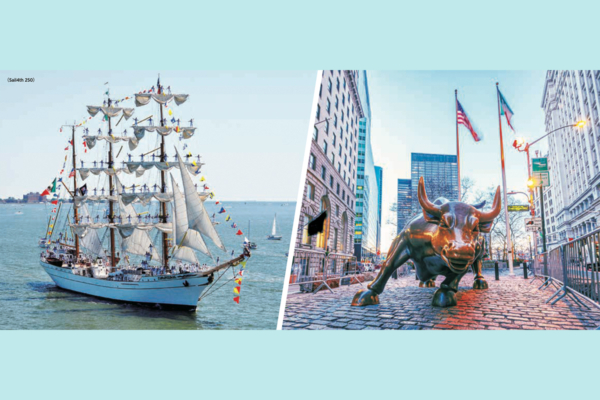
In the early morning hours at New York Harbor, the sea breeze blows gently, the tide lightly taps the docks, and the distant skyline is faintly visible through the thin mist. If we were to turn back time a hundred and forty years, this waterfront would not reflect steel and glass, but rather a dense array of ship masts and white sails. The Wavertree, a tall-masted sailing ship launched in 1885, was one of the many ocean-going merchant vessels that sailed into the port of New York during that era. It traversed the Atlantic carrying cotton, wool, and raw materials, witnessing the golden age of sailing ships and standing at the threshold of the steam era about to unfold.
Today, the Wavertree sits quietly docked at South Street Seaport, becoming a part of the city’s memory, reminding people that before the skyscrapers, New York was first and foremost a port city. Goods were unloaded and redistributed here, immigrants set foot in a new world, and information and capital converged along the waterways. Lower Manhattan is where this city first engaged in dialogue with the world.
In 2026, the United States celebrates its 250th anniversary of nationhood. This symbolic historical milestone chooses to return to the sea. The Sail4th International Maritime Celebration is set to take place from July 3 to 9 at the ports of New York and New Jersey. This event is expected to involve at least 30 traditional sailing ships from countries such as Argentina, France, Germany, Portugal, and will be led by vessels from the US Coast Guard. Over 40 allied and US Gray Hull warships will depart from the Verrazzano-Narrows Bridge, sailing against the current towards the waters of the George Washington Bridge, forming an unprecedented international maritime procession.
This will be one of the largest peaceful maritime gatherings in modern US history, aiming to echo the US’s maritime roots and global connections through ships, cultural activities, and maritime celebrations. At that time, tall-masted sailing ships and navy vessels from around the world will gather to sail past the waters surrounding the Statue of Liberty and dock at major piers for the public to visit up close.
This is not just a visual spectacle, but also a symbolic retrospective. The birth of America was inseparable from the ocean. Trade routes during the colonial period, supplies and communication during the revolutionary era, and the influx of immigrants all happened through the harbor. Sail4th aims to revisualize this history, with sails weaving between modern skylines, reminding us that before finance and technology, America was a nation born from the sea.
For Lower Manhattan, this maritime celebration is more like a “homecoming journey.” South Street Seaport, the East River, and the Hudson River waterfront will once again become the focus of the city, allowing this old port district to reclaim its central stage in the narrative of the 250th anniversary.
If seafaring laid the foundation for New York’s outward-connecting urban character, then Wall Street is where this connection transformed into institutional significance. At the end of the 18th century, Lower Manhattan was still a commercial city centered around the port, with merchants and brokers for shipping services gathering near the docks. They engaged in insurance, lending, and commodity futures trading to spread the risks of transatlantic trade and increase capital utilization efficiency. Finance was initially not a standalone industry but an extension of the port economy.
On May 17, 1792, under a sycamore tree near today’s 68 Wall Street, 24 stockbrokers and merchants signed a simple handwritten agreement, known as the “Buttonwood Agreement,” prioritizing trading among themselves and charging fixed commissions. This document later laid the foundation for the New York Stock Exchange (NYSE) and marked the starting point of Wall Street transitioning from scattered trades to institutionalized operations. No one had foreseen that this agreement made under the shade of a tree would evolve into a financial core with global influence. The neoclassical building of the NYSE, completed in 1903, symbolizes order and trust with its majestic colonnade. From the ringing of the opening bell to company listings, the NYSE transformed the city’s commercial spirit into a financial powerhouse influencing global markets.
As shipping networks expanded and trade scales grew, Lower Manhattan gradually transitioned from a “cargo transfer station” to a “capital transfer station.” The financial system began to replace physical goods and became the central nervous system of economic operations. Risks were quantified, futures were priced, and capital flowed faster than ever before. After the completion of the Erie Canal in 1825, New York became the most significant trade port in the United States, providing fertile ground for the rapid growth of Wall Street.
Entering the 19th century, wars and industrialization further propelled Wall Street’s rise. During the American Civil War and the two World Wars, the government issued national debt and mobilized capital, tightly linking the financial market to the nation’s destiny. With European financial centers devastated by wars, New York gradually replaced London as the heart of global capital operations.
The Charging Bull sculpture in Wall Street was created by Italian-American artist Arturo Di Modica and appeared in 1989. Born shortly after the stock market crash of 1987, the artist aimed to convey a spirit of strength, recovery, and optimism to New York and American society through this magnificent bronze sculpture. Di Modica funded the creation of this 3.2-ton piece himself and, without official permission, placed it in front of the NYSE on a Christmas morning as a “gift to the people of New York.”
Although initially removed by the city government for being unauthorized, strong public support ultimately led to its reinstallation on the north side of Bowling Green Park, where it remains permanently. The Bull’s head-down charge and tense muscle pose symbolize the bullish spirit and the power and confidence of capitalism. Over time, it has become one of the most iconic financial symbols globally and one of New York’s most well-known and beloved landmarks.
Transitioning from the harbor to the streets, the historical narrative of Lower Manhattan also shifts indoors. Fraunces Tavern on Pearl Street in the financial district is one of the few buildings that still exudes the atmosphere of the Revolutionary period. Built in 1719, this red brick structure was not just a tavern in the 18th century but a vital hub for political, military, and social activities. Merchants, officers, and politicians exchanged messages and discussed matters here, shaping the fate of the city around the dining tables.
About 250 years ago in April, the American Revolutionary War ignited in Lexington and Concord, quickly spreading to New York. As tensions mounted, Fraunces Tavern gradually became a critical location during the revolutionary era. It was where George Washington negotiated with the British Army and briefly housed the early administrative functions of the newborn nation in the 1780s—the US’ first interim departments of foreign affairs, treasury, and war were all located here, earning it the title of the “first capital of the United States.”
After the end of the American Revolutionary War, George Washington bid farewell to his subordinates at Fraunces Tavern, leaving a deep-rooted and humane footnote of the Revolutionary era. It symbolized not only the end of a war but also the birth of a new nation, underscoring the core position of public discourse in American political culture.
In an era without a formal congressional building, taverns nurtured the spirit of democracy. To commemorate the 250th anniversary of America’s founding, Fraunces Tavern, through special exhibitions, lectures, and historical reenactments, reinterprets New York’s role in the independence movement, allowing audiences not just to read history but to step into historical scenes and understand how democracy blossomed in everyday life. Lower Manhattan is not just an economic center but a significant starting point for American political culture.
Bowling Green Park, at the southern end of Broadway in Lower Manhattan, is New York City’s oldest public park, with its origins tracing back to March 12, 1733. According to a resolution by the city council at the time, this land facing the fortress at the end of Broadway was leased to local residents for a token annual rent paid symbolically with “one peppercorn.” It was then enclosed as a grassy lawn for playing lawn bowls, and pathways were planned as street decorations and space for citizens to relax and enjoy.
In the 18th century, an equestrian statue of King George III stood here, symbolizing British royal authority. After the reading of the Declaration of Independence in New York in 1776, angry citizens toppled the statue and melted it down into bullets, marking a representative incident of the eruption of revolutionary sentiments in the city’s public spaces. The 1771 cast-iron fence that remains today is believed to have had its crown topper removed, serving as a subtle imprint left by the revolution.
From an English-style leisure space in colonial times to a symbolic site of the American Revolution, and then to a historical green space in the financial district, Bowling Green Park encapsulates key memories of New York and America’s birth.
In the early 21st century, Lower Manhattan faced its most severe test. The terrorist attacks of 2001 led to the collapse of the Twin Towers of the World Trade Center, plunging this area into extended periods of reconstruction and reflection. Years later, the new One World Trade Center reemerged in the skyline, with the 9/11 National Memorial now situated above the site, preserving memory through two reflecting pools.
Today, the surroundings of the World Trade Center have developed into a new urban area combining business, transportation, and public spaces. The Oculus transportation hub, inaugurated in 2016, with its pure white bone-like form symbolizing “birds taking flight,” integrating subway transfers, PATH trains, and retail spaces, stands as an essential landmark for transportation and public architecture in Lower Manhattan. High-end offices, retail spaces, and transit hubs have revitalized Lower Manhattan, filling it once again with foot traffic and vitality.
From the wind sails of South Street Seaport to the capital waves of Wall Street, from revolutionary-era tavern dining tables to the urban squares rejuvenated after the reconstruction of the World Trade Center, Lower Manhattan has constantly stood at the forefront of history. It was the first port of call for ships, the site of intellectual debates, the hub of capital flow, and, after the storms, a place that learned to coexist with memories and move forward towards the future.
Amid the 250th anniversary of America’s founding, as tall-masted ships sail into New York Harbor once again, it is not a return to the past but a revival of the power for the next generation through history, hoping to raise sails here and embrace a new era. ◇