
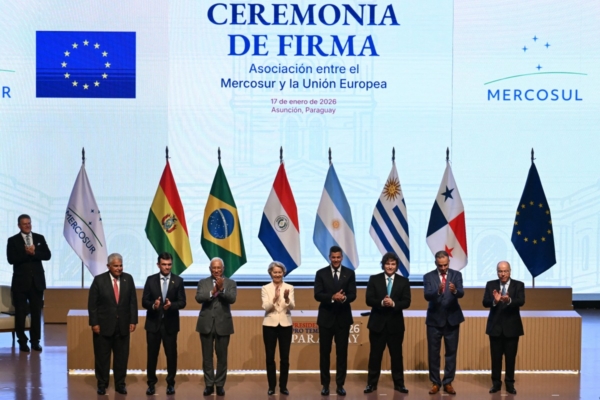
After 25 years of negotiations, the European Union and the South American regional organization Mercosur officially signed a free trade agreement in Asuncion, the capital of Paraguay, on Saturday (January 17). This agreement paves the way for the largest trade agreement the EU has ever had.
The aim of the agreement is to reduce tariffs and expand market access for both sides. It still needs approval from the European Parliament and legislative bodies of Mercosur member countries such as Argentina, Brazil, Paraguay, and Uruguay before it can take effect.
At the signing ceremony, European Commission President Ursula von der Leyen and European Council President Antonio Costa attended along with presidents from multiple Mercosur countries. Brazilian President Luiz Inácio Lula da Silva was unable to attend and was represented by the Foreign Minister.
Von der Leyen stated that the agreement will create “the world’s largest free trade area,” sending a clear signal to the world in support of fair trade and against tariff barriers.
Data shows that the EU and Mercosur combined cover around 700 million people, with bilateral trade reaching 111 billion euros in 2024. The EU primarily exports machinery, chemicals, and transportation equipment, while Mercosur focuses on agricultural products, minerals, pulp, and paper products.
Although the agreement was approved by most European countries last week, some farming groups and environmental organizations still express concerns, fearing a large influx of cheap South American agricultural products and the potential exacerbation of deforestation risks.
In response, the EU emphasizes that the agreement will help strengthen economic security in a turbulent international political and trade environment while upholding core values. Costa pointed out that this marks a milestone in a long-term partnership.
While Mercosur still has reservations about some regulatory provisions, Lula recently stated in Rio de Janeiro that the agreement will bring more trade and investment opportunities for both sides.
The Brazilian government also sees this agreement as a symbol of its efforts to promote market diversification. Brazil is simultaneously negotiating with the United Arab Emirates, Canada, and Vietnam, and expanding tariff preferences with India.
Established in 1991, Mercosur is one of the most influential regional trade groups in South America, consisting of Argentina, Brazil, Paraguay, and Uruguay, with Brazil being the core economic power. Its goal is to promote trade among member countries by reducing tariffs and establishing a common market, ultimately enhancing South America’s overall external economic and trade cooperation and negotiation influence.
(Reuters contributed to this report)