
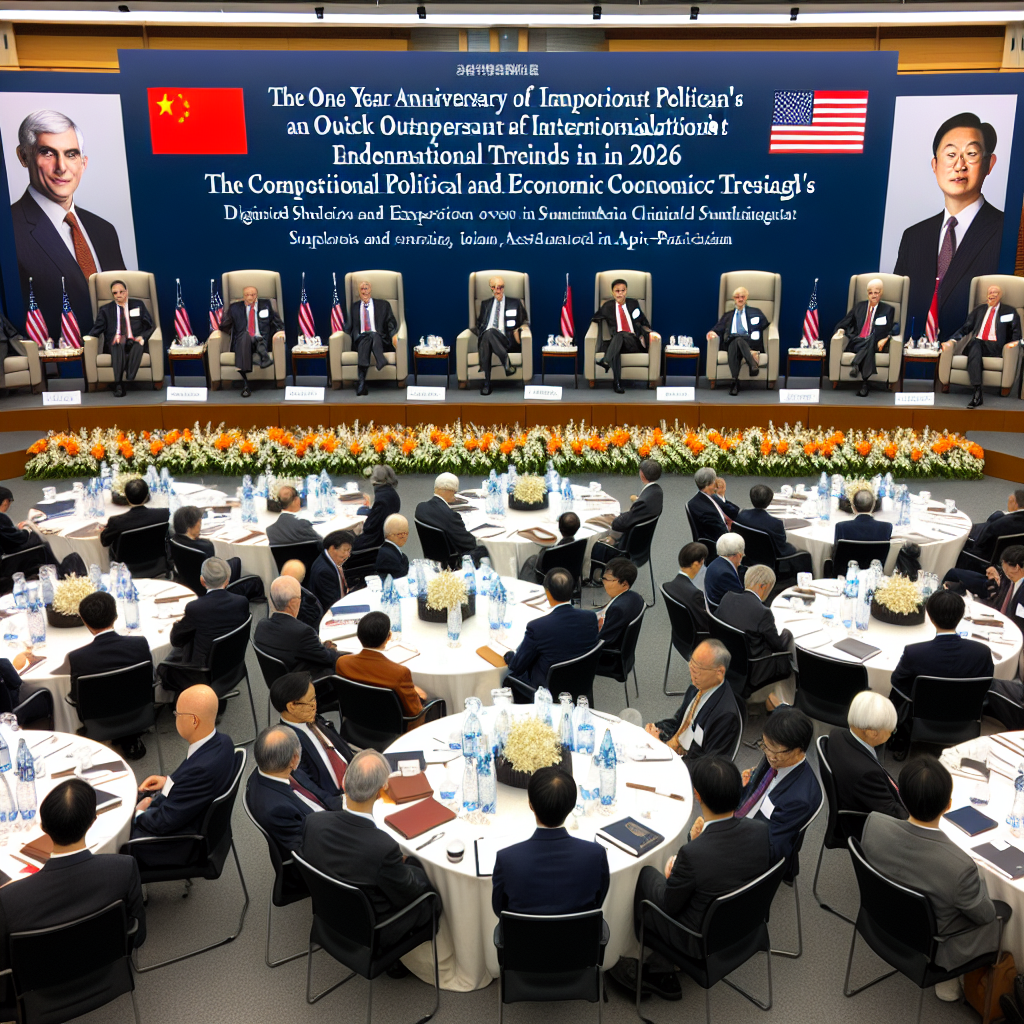
Taiwan National Policy Research Institute held a symposium on January 15 to discuss “Trump’s One-Year Anniversary in Office and Outlook on International Political and Economic Trends in 2026,” inviting scholars and experts to analyze. The experts focused on U.S.-China competition and Taiwan Strait security, emphasizing that the U.S. sees the CCP as a primary threat; Taiwan plays a crucial role in the semiconductor supply chain and the First Island Chain as a defense line. The U.S. is establishing an international alliance in the First Island Chain to enhance collective security.
Research Fellow Lin Zhengyi of the Institute of European and American Studies at Academia Sinica said that President Trump emphasizes “America First” and strives for U.S. advantage in competition with China. The Trump administration perceives the CCP as a threat, jeopardizing core interests of the U.S. and its allies. Despite short-term truces in U.S.-China economic and trade negotiations, relations between the two remain fragile. Following the U.S. military actions in Venezuela in 2026, U.S. Secretary of State Marco Rubio emphasized that the Western Hemisphere would not be allowed to become a base for U.S. adversaries, clearly targeting the CCP.
Lin Zhengyi stated that in late 2025, the CCP conducted high-intensity military exercises around Taiwan, with Trump’s response relatively restrained but emphasizing that if Xi Jinping changes the status quo, he would be “very unhappy.” Trump believes that Xi Jinping will not use force against Taiwan during his tenure (until 2029).
Former U.S. Department of Defense official Hu Zhendong stated that the latest version of the U.S. “National Security Strategy” under the Trump administration demonstrates a focus on the Indo-Pacific region under the “America First” principle, highlighting Taiwan’s critical role in the semiconductor supply chain and the First Island Chain defense line. The U.S. hopes allies will shoulder more self-defense responsibilities to seek peace through strength.
Hu Zhendong mentioned that the U.S. is forming an international alliance in the First Island Chain to enhance collective security through admission agreements and cross-service agreements among countries, offering logistical support to each other in natural disasters and wars. The U.S. has military presence in South Korea, Japan, the Philippines, Guam, Hawaii, as well as deploying forces in Alaska and the U.S. mainland to maintain Pacific security.
He pointed out that the U.S. possesses a powerful 5th-generation air force in Alaska, only hours away from the Pacific theater. To support naval operations, the U.S. has a substantial number of submarines and an aircraft carrier strike group at naval bases in Washington state; three aircraft carrier strike groups are based in San Diego. Many Air Force squadrons in the western U.S. also have missions supporting the Pacific region.
Director Zhang Wuyue of the Mainland China Relations Research Center at Tamkang University stated that massive personnel purges have occurred within the CCP, revealing fractures in the military and diplomatic systems. As Xi Jinping ages, other Politburo members increasingly handle his foreign trips. The 2026 Taiwan work conference, chaired by Wang Huning, will focus on the “15-year plan” initiation, emphasizing “anti-independence and reunification” efforts and attempting to implement policies internally in Taiwan to prepare for the future.
Zhang Wuyue remarked that in 2026, the CCP faces challenges including setting critical economic indicators for the start of the “15-year plan,” Sino-U.S. competition, structural contradictions between China and Japan, and the effects of Taiwan’s nine-in-one elections. Recent political activities of CCP senior officials have shown a renewed emphasis on political security, tightening ideological and social discourse further to solidify Xi Jinping’s leadership position.
Associate Research Fellow Li Chun of the WTO and RTA Center of the Institute of Chinese Economic Studies mentioned that the U.S.-China economic and technological competition has become a national security issue. The U.S. aims to achieve economic victories to deter military conflict, with strategies including accelerating disengagement from strategic technologies and building a high wall around alliances with Taiwan, Japan, South Korea, and the EU, while reducing dependencies on key resources like rare earths and energy. On the other hand, China is accelerating its drive for strategic technological self-reliance and loosening ties with the U.S. and Europe while expanding market access beyond the U.S.
Li Chun stated that the U.S. leads in American security in the Pacific, working with allies to deter China, while European security is gradually shifting to NATO’s responsibility. To adjust to the global security framework, Taiwan must establish and implement a consensus of “strength for peace.” Taiwan’s GDP growth rate is estimated to reach 7.37% in 2025, once again demonstrating Taiwan’s economic strength and resilience, necessitating the preservation of Taiwan’s indispensable position in the global supply chain.
Executive Director Dong Liwen of the Asia-Pacific Peace Research Foundation stated that the U.S. sees China as a primary security threat. In 2025, China faced significant setbacks since the launch of the Belt and Road Initiative, with challenges in the Middle East and Central and South America leading to investment losses and threats to oil supplies, disrupting its strategic deployments. China’s major challenges in 2026 include economic decline and purges within the party, government, and military ranks, contributing to internal turmoil.
Dong Liwen added that the Ukraine-Russia conflict remained deadlocked with no new dynamics, with repercussions in Central and South America potentially creating a domino effect and Southeast Asia facing production relocation issues that will reduce reliance on China. Core areas of religious extremism centered around Iran, Iraq, and Syria are on the decline, losing the impetus to disrupt global order.
Professor Fan Shiping of the Department of East Asian Studies at National Taiwan Normal University mentioned that Trump’s withdrawal from various UN and non-UN organizations implies Taiwan is no longer isolated internationally, potentially leading to new diplomatic opportunities. The U.S. announced a $11 billion arms sale to Taiwan by the end of 2025, highlighting its support for Taiwan’s security. Heightened tensions between the U.S. and China are increasing pressure on countries to choose sides.
Fan Shiping noted that China’s efforts regarding Taiwan focus more on internal propaganda than tangible benefits, as evidenced by a historic-scale military exercise around Taiwan at the end of 2025, which unexpectedly led to a surge in the Taiwan stock market. China’s Taiwan Affairs Office released a sanction list that included Taiwanese prosecutors from a neutral bureaucratic system, drawing mixed reactions. Fan Shiping predicted that the 2026 nine-in-one elections would see an increase in local elected officials from the Democratic Progressive Party, potentially impacting the 2028 general elections, dispelling doubts over “suspicions of the U.S.” or “Taiwan’s decline.”
Deputy Director Guo Yuren of the National Policy Institute said that within a year, Trump initiated seven military actions internationally, credited to the effectiveness of U.S. intelligence agencies, successfully turning 39 Iranian military officials and 42 Venezuelan political figures against their governments, showcasing the prowess of U.S. intelligence operations compared to China’s. He anticipated that China’s gray zone actions against Taiwan would increase in frequency and intensity this year, and the U.S. and other countries would respond appropriately with military exercises near Taiwan.
Guo Yuren stated that Japanese Prime Minister Sanae Takai demonstrated a flexible diplomatic style and impressed many with his international performances at the beginning of his tenure. Takai motivates his people with the slogan “working hard to invest in Japan’s future,” garnering significant support, especially from young people and women under 25. Takai made remarks about the Taiwan Strait situation and proposed a defense budget of up to 22 trillion yen (approximately $570 billion), signaling his determination. Guo Yuren suggested that Japan should elevate top-level exchanges with Taiwan through legislation resembling the U.S.’s “Taiwan Assurance Act.”
Director Tian Hongmao of the National Policy Research Institute stated that the latest U.S. “National Security Strategy” indicates a focus on the Western Pacific, establishing a global alliance to deter Chinese military expansion, effectively debunking the few individuals in Taiwan who harbor doubts about U.S. commitment. He emphasized the critical importance of Taiwan-Japan relations, with Takai Sanae following the pro-Taiwan stance of former Japanese Prime Minister Shinzo Abe likely resurrecting the Liberal Democratic Party in Japan, suggesting expanded economic, trade, and security cooperation between Taiwan and Japan.
Tian Hongmao remarked that the Ukraine-Russia conflict entering its fourth year remains a significant international issue characterized by historical animosities and complexities. Taiwan’s nine-in-one elections at the end of this year are likely to face political turmoil, with external interference posing a notable concern. President Lai Ching-te’s proposed special national defense budget has failed seven times in the legislature, raising U.S. concerns about Taiwan’s political operations. The upcoming November midterm elections in the U.S. must be factored into promoting Taiwan-U.S. relations in light of various American political variables.