
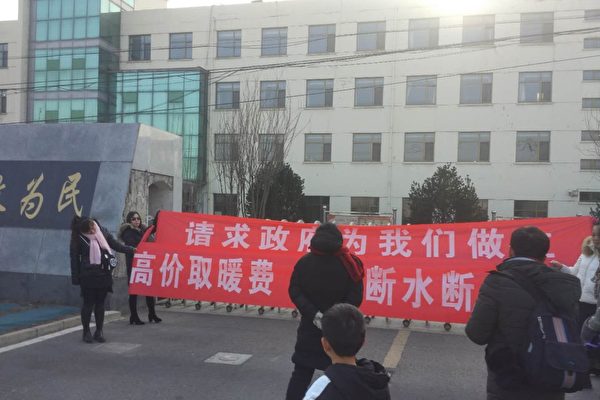
In the dry and cold winter air enveloping Baoding, Hebei, 72-year-old farmer He Wenxiang sat on his bed, wrapped in layers of clothing, including a black woolen coat and a hat. He took a thermometer from the wall, showing around 14 degrees Celsius (57 degrees Fahrenheit). Despite the outdoor temperature dropping to -1 degree Celsius (30 degrees Fahrenheit), he only occasionally turned on the gas boiler to warm up through the bedroom radiator.
“Life is not easy,” he told Reuters, “I can’t bear it if it gets any colder.”
He Wenxiang is a villager in a village on the outskirts of Baoding. Due to the Chinese government cutting subsidies aimed at promoting clean energy transition, natural gas prices have risen, prompting him to minimize heating as much as possible.
In another nearby village, a woman surnamed Song stood in the sunlight in a small alley, selling second-hand electronic products. She said that her family spends 8000 Chinese yuan (about 1148 US dollars) on heating in winter. According to data from 2024, this cost exceeds one-third of the average annual income of rural residents in Hebei Province, which is 22,022 Chinese yuan.
Her family now only turns on the heating when their children come home.
The Chinese government’s financial constraints, energy market reforms, and stagnant economy have led to sluggish growth in agricultural income, forcing many rural Chinese families to make difficult choices regarding essential needs such as heating.
The official Chinese government first proposed accelerating the “coal-to-gas” and “coal-to-electricity” clean energy replacement projects in 2013, which were widely implemented in the Beijing-Tianjin-Hebei region by 2017. The project was promoted in a “one-size-fits-all” manner, with authorities banning coal burning in the name of “environmental protection.” Drones were even used for surveillance, with personnel visiting homes upon detecting smoke, either destroying coal stoves or imposing fines. However, due to demand surpassing natural gas supply, along with rising infrastructure costs, natural gas prices (which were already higher than coal) soared.
The natural gas pricing marketization reform implemented by the Chinese government in 2023 aimed to increase profits for regional gas distributors, but instead exacerbated price increases. Local governments initially provided subsidies to consumers, but He Wenxiang stated that these subsidies were canceled one or two years ago, though Hebei Province has not officially announced subsidy reduction yet.
Hebei Province’s economy relies mainly on agriculture and heavy industry, facing increasingly severe financial pressures in recent years. Public spending in 2024 reached the highest level in ten years, accounting for 139.5% of fiscal revenue.
The Hebei Provincial Government’s Information Office has not responded to Reuters’ fax for comments.
On January 1st, Weibo influencer “Investment Notes of Tao Zhu Gong” also posted, mentioning that in the cold winter month, most households in rural Hebei have heating but dare not use it, enduring the winter with great difficulty.
The article pointed out that in previous years, Hebei vigorously promoted coal-to-gas conversion, banning coal burning for heating in rural areas, with every household installing natural gas. However, in reality, many could not afford to use it, despite having gas available. It’s not that they can’t use it, but that they truly cannot afford it.
70-year-old Mrs. Li felt no benefits from the coal-to-gas conversion. She only disclosed her surname to Reuters. She and her husband have to spend half of their annual salary of 8000 Chinese yuan to pay for heating in a brick house near Baoding village, usually only heating the bedroom. They keep the indoor temperature at no more than 13 degrees Celsius, while the World Health Organization recommends a safe indoor temperature of at least 18 degrees Celsius (64 degrees Fahrenheit) for adults, with higher temperatures needed for the elderly and children.
He Wenxiang and his friends stood outside smoking, reminiscing about how in the past, they only needed 500 Chinese yuan for coal heating throughout the whole winter.
“I support environmental protection, but at this price, I can’t afford to burn natural gas,” He Wenxiang said.