
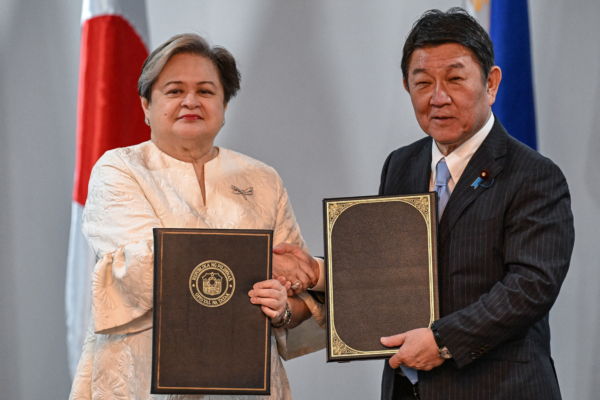
The Philippines and Japan have officially signed a new defense agreement in Manila, including a key agreement that allows the exchange of goods and services between the two countries’ forces. With regional tensions escalating, these two American allies in Asia are strengthening their security cooperation to jointly address the growing threats posed by the Chinese Communist regime in the Indo-Pacific region.
On Thursday, January 15, Japanese Foreign Minister Toshimitsu Motegi and Philippine Foreign Secretary Theresa Lazaro held talks in Manila. During the meeting, the two signed the “Acquisition and Cross-Servicing Agreement” (ACSA), aimed at ensuring that the two countries’ forces can quickly provide supplies and services to each other.
According to the agreement, both sides can provide ammunition, fuel, food, and other necessities tax-free during joint exercises to enhance deterrence and respond to natural disasters.
This agreement still needs approval from the Japanese Parliament to take effect formally.
Following the signing ceremony, Philippine Foreign Minister Lazaro stated, “We both recognize the value of promoting the rule of law, including freedom of navigation and overflight, especially in the South China Sea region.”
She emphasized that Japan is always a crucial strategic partner for the Philippines.
Japanese Foreign Minister Motegi mentioned during a joint press conference, “Facing an increasingly severe strategic environment, Minister (Lazaro) and I also reaffirmed the importance of trilateral cooperation among Japan, the Philippines, and the United States.”
Motegi further stated that both sides oppose any attempt to unilaterally change the status quo in the East China Sea and South China Sea through the use of force or coercion.
The visit to the Philippines is part of Motegi’s nine-day trip to the Middle East and Asia, including Israel, the Palestinian territories, Qatar, and India, reflecting Tokyo’s active expansion of strategic influence.
Apart from military logistics cooperation, Japan also announced providing $6 million in funding to the Philippines for infrastructure development under the framework of “Government’s Support for Strengthening Security Capabilities,” to store the Japanese-donated “Rigid-Hull Inflatable Boats” (RHIB) to further enhance Manila’s maritime patrol capabilities.
Additionally, Japan’s assistance extends to the economic realm, including funding network infrastructure expansion in economically disadvantaged provinces in southern Philippines.
This cooperation comes at a highly sensitive time in the region.
Japanese Prime Minister Sanae Takichi had previously warned that a Chinese attack on Taiwan could constitute a “survival-threatening situation,” triggering a military response from Japan, a statement that led to strong retaliation from Beijing.
Meanwhile, conflicts between China and the Philippines in the South China Sea are intensifying, with instances of Chinese coast guard ships repeatedly using water cannons against Filipino fishing vessels and firing flares.
The “Acquisition and Cross-Servicing Agreement” follows the significant progress of the “Reciprocal Access Agreement” (RAA) signed in 2024 and implemented in September of the same year, marking another milestone in the Japan-Philippines security alliance.
Currently, the two countries are in final negotiations on another agreement concerning the sharing of highly classified defense and military intelligence.