
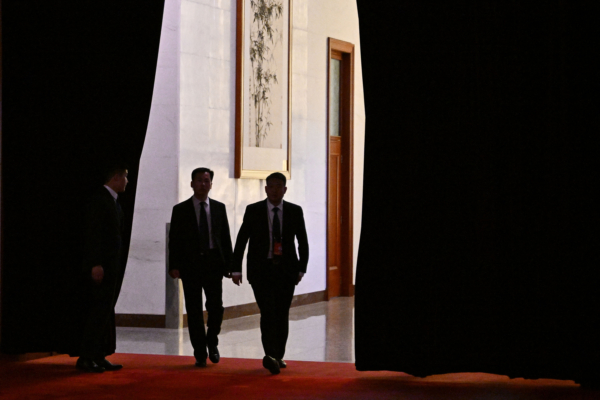
The 20th Central Commission for Discipline Inspection of the Communist Party of China recently held its fifth plenary session in Beijing. Several mainland Chinese sources told the Epoch Times that the meeting continues to uphold official expressions such as “comprehensively and strictly governing the Party” and “maintaining a high-pressure anti-corruption stance.” However, the key message being conveyed internally is to further push anti-corruption investigations to the local level, conducting more systematic inspections and checks on key officials at the city and district levels as well as recently promoted cadres.
Amid internal and external pressures, the continued imbalance of power structures within the Party, and the continuous accumulation of factors contributing to social instability, the Party has convened this meeting in an attempt to package “anti-corruption” as a governance solution, while it is essentially being used as a political tool to reorganize the bureaucratic system and solidify existing power structures.
A mainland Chinese insider familiar with the discipline inspection system revealed to the Epoch Times that unlike previous instances of focusing on individual cases, this meeting emphasizes “systematic supervision” and “preventing risks in advance”. He stated, “The discussion at the meeting is about systems, oversight, and the operation of power. But the signal is clear when it is implemented at lower levels – the message is that the local levels need to be revisited.”
The insider mentioned that the downward reach of anti-corruption efforts is not simply extending to the grassroots level but is targeting key nodes in local power structures, especially positions that control personnel, finances, engineering projects, and the public security system. He stated, “Many of the issues are not new but have accumulated over the past few years, and now they need to be systematically reviewed.”
The source also noted that the so-called core task of the meeting is not about institutional-level anti-corruption reform, but to set the tone for continuing and strengthening the high-pressure discipline inspection and supervision line in 2026. The meeting deliberately reiterated that the “anti-corruption struggle situation remains severe and complex,” continuously reinforcing tension internally by repeatedly emphasizing these points during the meeting.
Scholar Yu Youliang, interviewed under a pseudonym, pointed out that the authorities’ continuous portrayal of a “severe situation” is not due to individual officials’ misconduct but rather a systematic outcome resulting from highly centralized power operations and a long-standing lack of independent, effective external oversight. Yu stated, “The current anti-corruption efforts are essentially excuses for the highest levels of power to buy time and dodge issues, not aiming to solve problems. Without changing the system itself, they can only keep catching and purging individuals to maintain operations. This itself demonstrates that the system has lost the ability to correct itself and can only barely survive through internal purges.”
Several interviewees also pointed out that the Chinese authorities are targeting recently promoted young cadres and key officials at the city and district levels not solely for anti-corruption considerations but as part of a systematic control over power nodes. Positions such as mayor and public security bureau chief wield significant power in local governance, controlling project approvals, fund allocations, and law enforcement resources. Once these individuals are targeted for investigation, it often affects the entire local power structure, creating a deterrent effect. A source within the system told reporters, “It’s not about waiting for someone to make a mistake; it’s about first assessing where you are positioned, who you rely on, and whether your background can withstand scrutiny. Being in the wrong position makes you a target.”
In fact, this trend has already been evident at the local level. An insider report published by Epoch Times revealed that following New Year’s Day, a new round of so-called anti-corruption investigations has been continuously extending to the city level, focusing on deputy mayors and public security bureau chiefs, not limiting investigations to provincial and ministerial-level officials.
The report quoted insiders stating that several regions have been asked to provide supplementary materials, reconcile accounts, and some officials have been repeatedly asked to explain the sources of their personal and family assets, “It’s not about immediately arresting individuals but first understanding the situation clearly to see who can withstand scrutiny.” Some regions have also been asked to reorganize the resumes and financial situations of key newly appointed officials in recent years.
An anonymous individual in the local procuratorial system of the Communist Party of China told reporters that these practices align closely with the signals released during the meeting, indicating that anti-corruption has clearly shifted towards a “preventive cleansing” mechanism. The person stated, “It’s no longer about waiting for problems to surface before dealing with them; it’s about screening out potential problems in advance.”
The source revealed that many regions have initiated broader internal checks. “Many counties and cities in Guangdong, Jiangxi, Shandong, and other places are synchronously advancing asset checks and probing for issues, not just looking for specific cases but investigating how these officials rose to their positions, whether there were situations of buying and selling official positions or benefit transference.”
He added, “This time, it’s not about investigating a single point but an entire network of relationships, with the coverage this year being broader than before.”
On January 6, the Communist Party of China officially released anti-corruption data, indicating that disciplinary inspection and supervision agencies inspected and investigated approximately 65 central-level cadres in 2025, mainly focusing on deputy ministerial-level officials and above, marking a record high number. The subjects under investigation were mostly distributed in fields where power and resources are highly concentrated, such as finance, energy, tobacco, and infrastructure. The authorities also reported that hundreds of individuals who had fled abroad were repatriated to face scrutiny.
Some interviewees disclosed that this round of anti-corruption measures is significantly impacting young cadres who have been rapidly promoted in recent years. A mainland civil servant Mr. Ma, who has worked in the local government system for a long time, said, “Previously, promotion of young officials was a plus; now it has become a focus of scrutiny, the faster you rise, the closer you are watched.”
Ma mentioned that many officials who have been swiftly elevated to critical positions are mostly intertwined within complex personnel and interest networks. With the inspection thresholds continuously rising and standards tightening, individuals have almost no “safe zones”. “It’s not about whether you have issues now but about the possibility of old matters resurfacing and source tracing at any time.” He added, “Many people are aware of this; it’s just that they have not been targeted yet.”
Since the beginning of 2026, the Central Commission for Discipline Inspection of the Communist Party of China and the National Supervisory Commission have successively publicized numerous inspection and investigation reports, involving officials in the city and district levels as well as in institutions such as colleges and the healthcare system. Official reports showed that Xue Bing, the deputy mayor of Bozhou City in Anhui, is currently undergoing disciplinary review and investigation for serious violations of discipline and the law; Xu De, the Secretary of the Party Committee of Suqian College, and Gong Jianping, the Secretary of the Party Committee and Director of the Jiangxi Provincial Health Commission, are also under relevant scrutiny. These reports generally use vague terms like “suspected of serious violations of discipline and law,” with specific case details and responsibilities not disclosed to the public.
Regarding the direction of this round of anti-corruption efforts, there are different interpretations in mainland public opinion. Some insiders in the Beijing political circle believe that extending investigations downwards helps deter the operation of local power. Conversely, some opinions suggest that without addressing the institutional issues in the operation of Communist Party power, anti-corruption efforts may fall back into a cycle of repetition, possibly leading to an inescapable “vicious cycle”.