
China’s tourism platform giant Ctrip Group is under investigation for alleged monopoly behavior. If the monopoly is confirmed, the operator could face a fine of up to 10% of the previous year’s turnover. On January 15, Ctrip Group’s stock price plummeted by over 18%.
The news of Ctrip Group being under investigation quickly caused a market shock. Ctrip’s Hong Kong stock had shown significant movement on the afternoon of January 14, affected by the news of the investigation, with the stock price plunging straight down and ultimately closing down by 6.49%. In overnight trading in the US, Ctrip’s stock also fell by more than 17%.
On January 15, when the Hong Kong stock market opened, Ctrip Group opened significantly lower at HK$484.2, with a drop of 14.98%. Subsequently, Ctrip’s stock price further declined to HK$463, a decrease of 18.6%, with a trading volume exceeding HK$7.6 billion, turnover rate rising to 2.4%, and a total market value of HK$303 billion.
Established in 1999, Ctrip Group is a Chinese travel platform that went public on Nasdaq in the United States in 2003 and in Hong Kong in 2021. Its brands include Ctrip, Qunar, Trip.com, and Skyscanner, and it is the largest shareholder of Tongcheng Travel.
Since 2025, Ctrip has been summoned multiple times by regulatory authorities in Guizhou, Zhengzhou, Yunnan, and other places due to violations of regulations, with issues mainly revolving around unfair competition and technological interference in pricing by merchants. In August, the Guizhou Provincial Market Supervision Bureau stated that Ctrip had problems including “either/or” choices, using technical means to interfere with pricing, and price fraud, and demanded immediate rectification. In September, the Zhengzhou Municipal Market Supervision Bureau determined that Ctrip had unilaterally modified hotel room prices through its “price adjustment assistant” function, infringing on the merchants’ autonomy in pricing, which violated relevant regulations and ordered it to complete rectification within a deadline. In December, the Yunnan Province Tourism Homestay Industry Association accused Ctrip of using its dominant market position to implement unfair competition practices such as imposing unfair terms and unilaterally raising commissions.
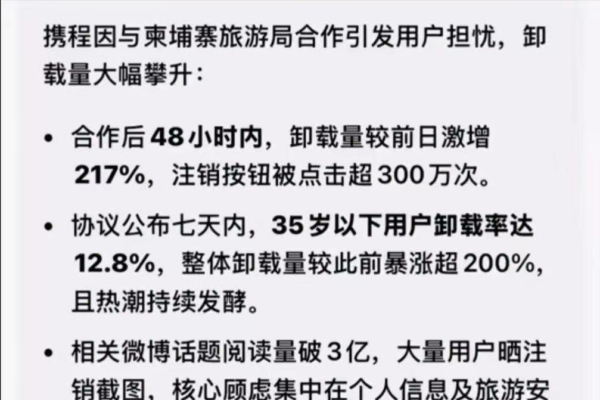
Additionally, in September 2025, Ctrip signed a marketing cooperation agreement with the Cambodia National Tourism Authority to promote tourism in Cambodia. In December, this sparked strong doubts among Chinese users about the safety of tourism in Cambodia, with concerns that Ctrip might leak personal information to the local gray and black industry chains, leading to customers falling victim to online fraud.
Furthermore, Ctrip’s massive profits are also seen as the main reason for the investigation.
Ctrip’s latest financial report shows that in the first three quarters of 2025, Ctrip achieved a revenue of 18.3 billion yuan, a 16% year-on-year increase. The net profit was 19.9 billion yuan, an increase of 192.6% year-on-year, and the adjusted EBITDA was 6.3 billion yuan. Looking at a single quarter, in the third quarter of 2025, Ctrip’s net profit increased by 192%, reaching 19.9 billion yuan (approximately 2.8 billion US dollars).
According to calculations by Bank of Communications International, in terms of GMV (Gross Merchandise Volume) in 2024, Ctrip’s market share in the hotel and travel market reached 56%, far surpassing Meituan (13%), Fliggy (8%), and Douyin (3%). If combined with Tongcheng’s 13% market share, the “Ctrip System” virtually occupies 70% of the OTA market share.
In comparison, the net profits of mainland China A-share tourism industry sectors in the first three quarters of 2025 were approximately 1.5 billion yuan for hotels, 2.6 billion yuan for tourist attractions, and 14.9 billion yuan for air transport, totaling about 19 billion yuan, which is still less than the profit of Ctrip alone.
Some mainland media have mocked this situation as “the entire tourism industry working for traffic.”