
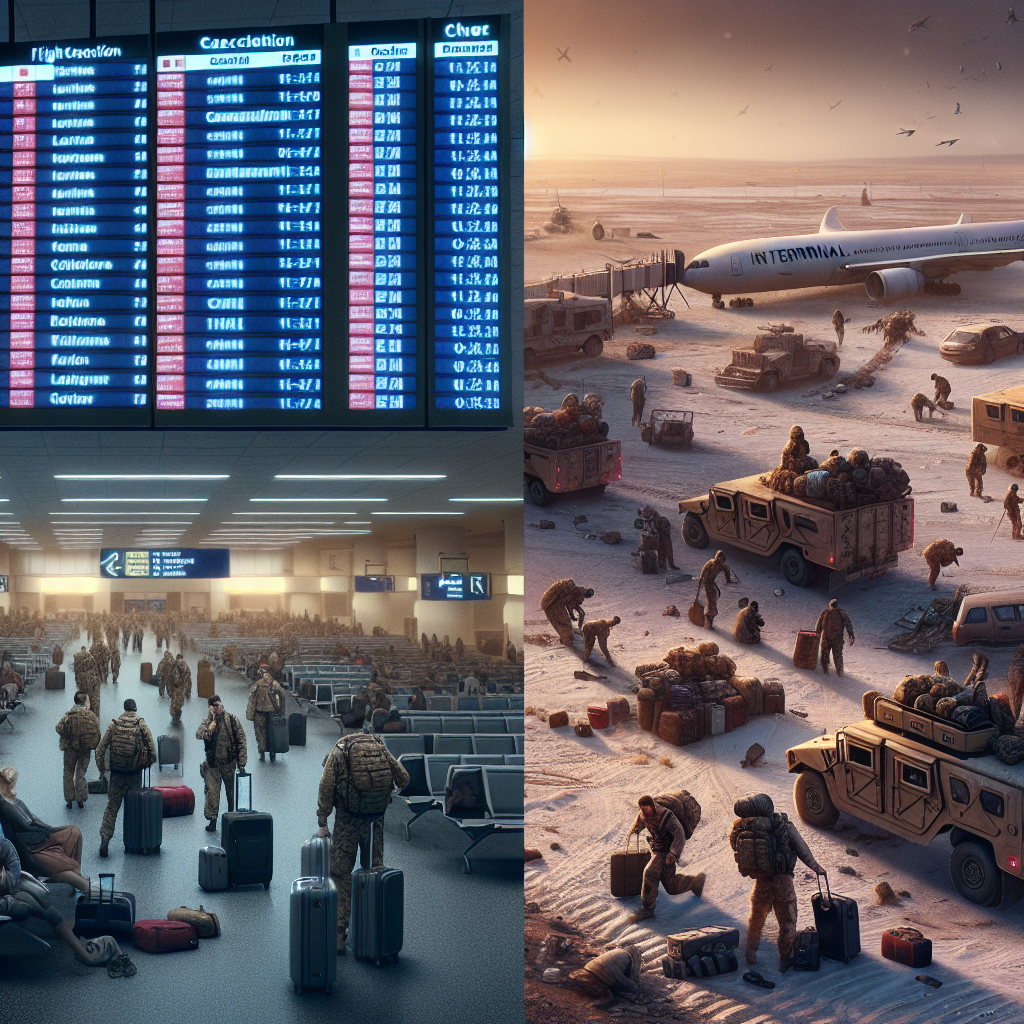
On Wednesday, January 14th, Iran abruptly announced the temporary closure of its airspace, leading to the cancellation or diversion of dozens of flights worldwide. At the same time, the United States is evacuating some personnel from multiple bases in the Middle East as a precautionary measure. The international community is closely monitoring whether the U.S. will take military action in response to Iran’s recent turmoil.
According to a notice issued by the Federal Aviation Administration (FAA) of the United States, Iran temporarily prohibited most flights from passing through its airspace starting at 5:15 p.m. Eastern Time on Wednesday, unless they obtained official permission for international flights to enter or depart Iran, all flights were not allowed to pass through Iranian airspace.
The ban was originally supposed to last for over two hours until approximately 7:30 p.m. Eastern Time, but it was later extended until 10:30 p.m. Eastern Time.
Flight tracking website Flightradar24 showed minimal commercial aircraft activity in Iranian airspace during the closure. There was only one Mahan Air flight en route from Shenzhen, China to Tehran.
Several airlines have had to adjust their services accordingly. India’s largest airline, IndiGo, stated that some international flights were impacted. Air India mentioned that its flights were being rerouted via alternative routes, potentially causing delays or cancellations.
A Russian airline flight bound for Tehran turned back to Moscow after the ban took effect.
The German government also issued new directives urging its airlines to avoid entering Iranian airspace. Lufthansa announced that they would avoid Iranian and Iraqi airspace until further notice and for the safety of their crew members, they would also suspend overnight flights to and from Tel Aviv and Amman.
The United States had already prohibited all U.S. commercial flights from flying over Iranian airspace, and there were no direct flights between the two countries.
The aviation safety website, Safe Airspace, warned that airspace closures could indicate missile launches or strengthened air defense systems, increasing the risk of commercial aircraft being misidentified.
Currently, Iran is experiencing the most intense anti-government protests since 1979, and the U.S. has been weighing its response to the situation in Iran.
A U.S. official stated on Wednesday that the U.S. is withdrawing some personnel from bases in the Middle East. Earlier, a senior Iranian official warned neighboring countries that if Washington launched an attack, Iran would target U.S. military bases.
Qatari officials also confirmed that personnel reductions are taking place at Al Udeid Air Base, the largest U.S. base in the Middle East, in response to the current tense regional situation.
An anonymous Western military official informed Reuters that all signs suggested a U.S. attack was imminent, but it was also a way for the U.S. to keep everyone alert, as “unpredictability” is part of its strategy.
President Trump indicated that he had received information from “important sources” that the crackdown on protest activities in Iran had eased and there were currently no plans for large-scale executions. The U.S. would continue to monitor the situation.
On Tuesday, during an interview with CBS News, Trump stated that if Iran executed protesters, he would take “very strong actions.” He also urged Iranians to continue protesting, saying that “help is on the way.”
On Wednesday, Iranian Foreign Minister Abbas Araghchi responded to questions about anti-government protests by stating that Iran had “no plans” to use hanging as a punishment for protesters.
During an interview with Fox News, the Foreign Minister stated, “There is absolutely no plan for hanging. It is not possible.”
However, the Iran Human Rights Society, based in Norway, stated that hangings are quite common in Iranian prisons.
Two European officials mentioned that U.S. military intervention could occur within the next 24 hours. An Israeli official also suggested that the Trump administration seemed to have decided to intervene, but the scale and timing of the intervention were still unclear.