
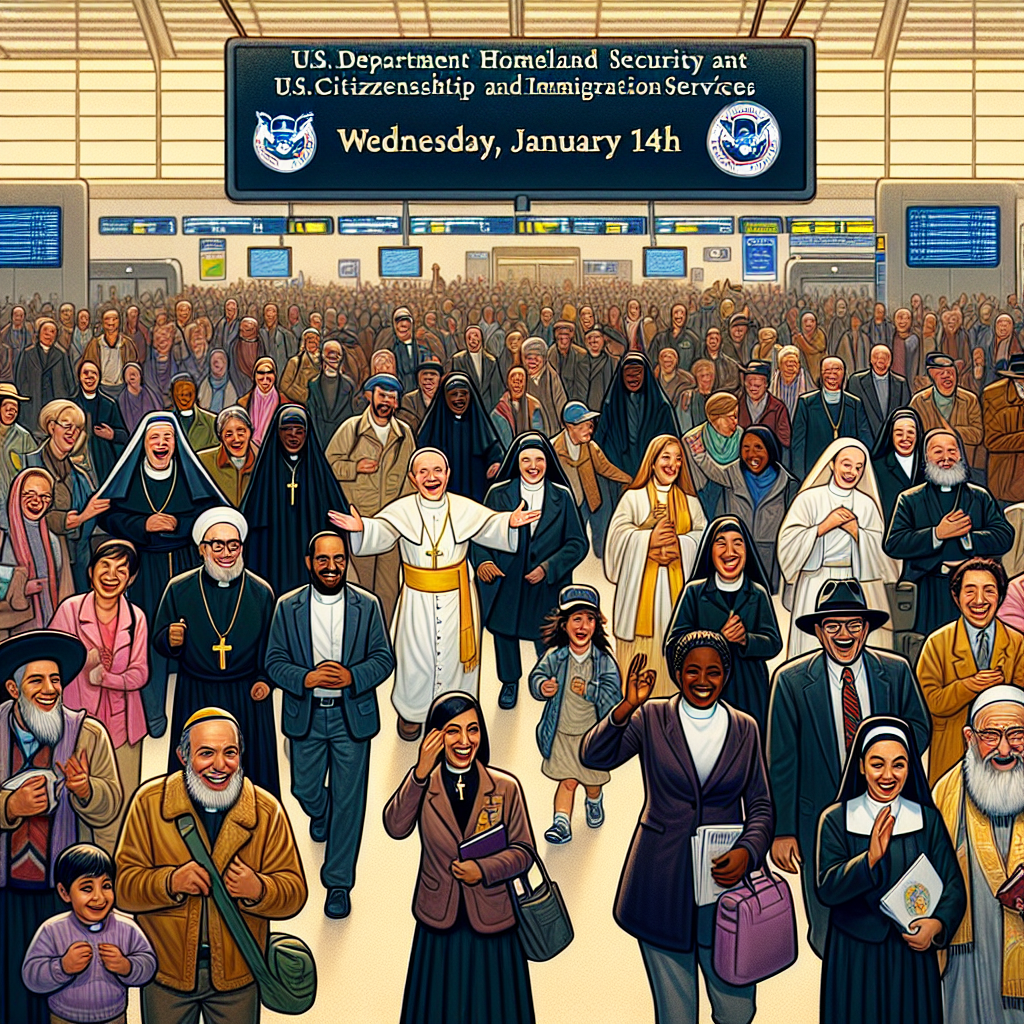
The U.S. Department of Homeland Security (DHS) announced a temporary final rule on Wednesday, January 14th, under the U.S. Citizenship and Immigration Services (USCIS), allowing thousands of religious workers, including priests, nuns, and rabbis, to re-enter the United States after a short stay abroad, restoring their essential services.
This new rule is in accordance with President Trump’s Executive Order 14205, “Establishment of the White House Faith Office,” which eliminates the requirement for religious workers on R-1 visas to reside outside the U.S. for one year after reaching the statutory maximum stay of five years.
While religious workers on R-1 visas still need to depart the U.S., the new rule specifies that they no longer have to reside or physically stay outside the U.S. for at least one year before reapplying for R-1 status.
The new rule significantly reduces the waiting time for these individuals outside the U.S., providing stability for religious communities and minimizing disruptions.
The announcement stated that over the years, the supply of EB-4 visas in the category that professional religious workers can apply for has not been able to meet the needs domestically in the United States.
Policy changes implemented by the U.S. Department of State in 2023 significantly extended the lengthy waiting time for EB-4 immigrant visas (including for religious workers) from certain countries, leading many religious workers to reach the maximum stay period on R-1 visas.
The DHS spokesperson mentioned that under Secretary Noem’s leadership, the department is committed to protecting and upholding religious freedom and freedom of expression, taking necessary steps to ensure that religious organizations can continue to provide essential services to the American people.
The spokesperson further emphasized the importance of pastors, priests, nuns, and rabbis to the social and moral fabric of the United States, stating that efforts will continue to support and empower these organizations in their critical work.
The interim final rule is effective immediately. The USCIS invites the public to submit written comments and relevant information within 60 days from the publication of the new rule in the Federal Register.
The R-1 nonimmigrant religious worker visa allows certain religious workers, such as Catholic priests and nuns, residing abroad, to legally enter the United States and serve their faith communities. The initial period for such visas is 30 months, renewable once, allowing a total maximum stay of 5 years for them to engage in pastoral work in the U.S.
During this period, they can apply for employment-based EB-4 status, enabling them to stay legally uninterrupted in the U.S. However, there is a significant backlog of such visas, with demand far exceeding the number issued, posing a serious impact on American churches. A study by the U.S. Catholic University’s Catholic Project in 2022 revealed that 24% of priests serving in the U.S. are foreign nationals, many of whom also face visa renewal issues.
The new rule for R-1 visas eliminates the requirement to reside outside the U.S. for one year before reapplying, expecting to prevent these religious workers serving faith communities in the U.S. from being forced to leave the country.
The EB-4 immigrant visa is part of the Employment-Based Immigration, Fourth Preference category, offering green cards to professionals and special groups providing services for specific religions, as well as special young people, international organization employees, U.S. government overseas employees, specific broadcasters, translators, etc. This visa category requires employer or specific institution sponsorship, applicants need to have two years of religious work experience, and usually do not require a labor certification from the Department of Labor.