
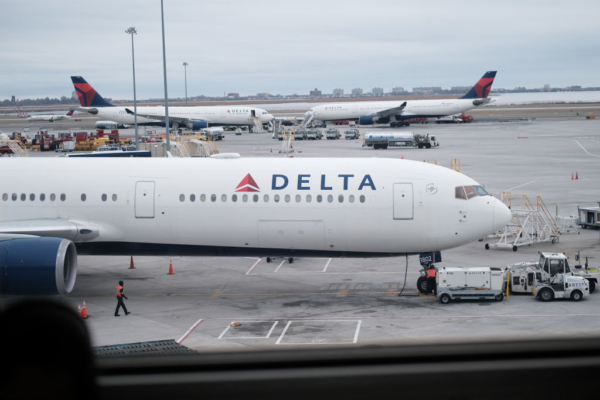
Delta Air Lines released its financial report for the fourth quarter and full year of 2025 on Tuesday (January 13th). The fourth quarter revenue was $14.61 billion, slightly below market expectations, while the full-year revenue reached a record high of $58.3 billion. The company predicts a profit growth of around 20% in 2026, mainly driven by the demand from high-income individuals and business travelers.
The Atlanta-based airline has ordered 30 Boeing 787 wide-body jets, including options to purchase an additional 30, to enhance its long-haul fleet. The design of the 787 aircraft emphasizes quieter, more comfortable cabin pressure and humidity, making it suitable for a large number of premium cabin seats (business class, premium economy).
The airline’s vision reflects the K-shaped structure of the U.S. economy, where high-income consumers continue to spend freely while price-sensitive travelers are reducing their expenses.
On Tuesday afternoon, Delta Air Lines’ stock price fell nearly 3% to $68.94, as the company’s median full-year and quarterly profit forecasts were lower than analysts’ expectations.
Despite softening demand from domestic leisure travelers and low-income groups in the U.S., strong demand for premium cabin seats, international routes, and co-branded credit cards continues to support the airline industry’s profitability and revenue growth.
Currently, nearly 60% of Delta Air Lines’ revenue comes from premium products, frequent flyer programs, and other non-ticket revenue sources, including its partnership with American Express.
In October of last year, when Delta Air Lines announced its third-quarter financial results, it projected for the first time in history that sales of luxury seats, traditionally considered luxury items, would surpass traditional economy class in 2026, a full year earlier than previously expected.
Similar trends are also impacting industries such as clothing, automotive, and tourism, as companies shift their focus to more profitable customer segments.
Ed Bastian, the CEO of Delta Air Lines, stated that “the strong momentum in the consumer sector is evident in the high-end market, while lower-end consumers are facing challenges.”
This differentiation was particularly pronounced in the performance of the airline in the December quarter, with overall passenger revenue increasing by only 1%, masking the widening gap within cabin classes: economy class ticket revenue decreased by 7%, while revenue from premium products grew by 9%.
The impact of imbalanced consumer spending is now affecting the entire U.S. airline industry. Low-cost and ultra-low-cost carriers that heavily rely on price-sensitive travelers have long struggled with low profitability and excess capacity, leading to consolidation and layoffs.
“Allegiant Air” has announced plans to acquire a low-cost airline, “Sun Country Airlines.” Meanwhile, “Spirit Airlines” has filed for bankruptcy for the second time.
(Adapted from Reuters reports)