
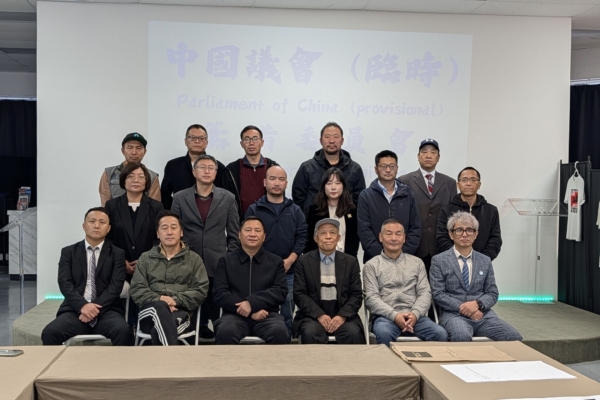
Since the beginning of the year, the rapidly changing situation in China and the world has sparked a wave of public opinion, with Chinese people both at home and abroad expressing their expectations for the changes in Chinese society. On January 4th, the ad-hoc preparatory committee of the Chinese parliament was established at the “June Fourth Memorial Hall” in Los Angeles, signaling a new wave of efforts towards meeting these expectations.
Attendees at the establishment ceremony of the Chinese parliamentary preparatory committee included Wang Dan, former leader of the 1989 student movement, Liu Yinquan, Chairman of the China Social Democratic Party, Geng Guanjun, Executive Committee member of the China Democratic Party, and all members of the committee’s secretariat. Yang Chunhua from Australia and activists from Germany participated online.
During the ceremony, the draft of the temporary constitution of the Chinese parliament was first read out. The constitution consists of a total of 8 chapters and 20 articles, outlining the nature, purpose, basic principles, responsibilities, powers, organizational structure, transfer, and dissolution of the ad-hoc preparatory committee of the Chinese parliament.
According to the announcement issued by Wang Dan, the chief convener of the committee, the establishment of the temporary preparatory committee of the Chinese parliament aims to provide a institutionalized and sustainable platform for democratic politics for the Chinese people, to explore a constitutional path for China’s future core parliamentary democracy; and to nurture a mechanism of citizen representation through open, transparent, and verifiable means, accumulating institutional experience and consensus for peaceful transformation and political reconstruction of Chinese society.
The announcement listed the phase-specific tasks of the committee and called on Chinese citizens (under the premise of safety) and overseas Chinese to register as founding voters and participate in the election of members of parliament. The voter registration process is based on voluntary participation, opt-out options, and privacy protection principles.
In his speech, Secretary General Geng Guanjun thanked the preparatory working group for their hard work and expressed the committee’s commitment to actively engage in external relations, urging staff to be “pragmatists” and move forward with various tasks as soon as possible.
During the stage of voting on the constitution and seeking opinions, Wang Dan emphasized the need for a highly professional approach in the operations of the Chinese parliamentary preparatory committee, noting the high level of professionalism in the documents presented, which received widespread and positive feedback from external sources. He expressed gratitude to all the staff for their efforts, emphasizing the importance of perseverance and persistence in achieving ultimate victory.
Drawing lessons from overseas democracy movements, Wang Dan highlighted the need for unity and collaboration in the face of challenges, cautioning against personal conflicts and emphasizing the importance of compromise and teamwork in democratic politics.
Over the years, overseas democracy movements have faced infiltration and disruption by Chinese communist spies. Liu Yinquan reflected on the losses suffered by the China Social Democratic Party and hoped to provide valuable insights for the operation of the Chinese parliamentary preparatory committee.
Former Chinese entrepreneur Qu Chengsong, reflecting on the legal accountability and order in the United States, emphasized clarity and respect for the rule of law, contrasting it with the lawless behavior of the Chinese Communist Party. He pledged full dedication to the preparation work of the Chinese parliament, expressing optimism and determination in the pursuit of hope through concerted efforts.
Deputy Secretary General of the preparatory committee, former Chinese history teacher Yuan Jue, emphasized the need for an open platform to attract participants from diverse ideologies and political beliefs, viewing participation in this platform as an opportunity to enhance democratic literacy and undergo democratic training.
Quoting from Zhuangzi, Yuan Jue emphasized the importance of a strong start leading to significant achievements. Despite the relatively small number of participants at the event, he believed in the potential for positive outcomes with collective efforts and collaboration.