
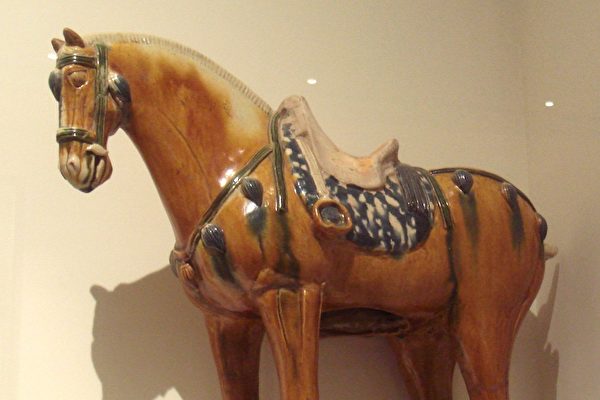
Recently, a Tang Dynasty painted pottery horse in the Luoyang Museum toppled over in its display case, sparking public attention. There have been longstanding criticisms that the situation of cultural relics damage in mainland China is very severe, yet it has not received enough attention.
On the evening of January 1st, the Tang Dynasty “painted pottery horse with raised leg” displayed in the exhibition hall of the Luoyang Museum toppled over in its display case. The Luoyang Museum later issued a statement indicating that the artifact toppled due to the aging and cracking of the adhesive used in the original restoration.
Earlier, a netizen posted on social media claiming that a Tang Dynasty painted and gilded pottery horse in the Luoyang Museum had fallen onto the display platform, with one of the horse’s legs showing signs of breakage. Photos from the scene showed the artifact lying on its side on the display case, with parts like the hooves already shattered.
Public records show that this painted horse with raised leg was unearthed in 1988 at the site of the Yanshi City Government Guest House in Henan Province, measuring approximately 40 centimeters in height. Its dynamic posture, depicting one hoof raised and three hoofs grounded, is painted and partially gilded throughout, representing high historical, artistic, and research value as a significant example of Tang Dynasty funerary customs, social life, and ceramic production techniques.
On January 2nd, the Luoyang Museum released an update stating that the “painted pottery horse with raised leg” tipped over on January 1st due to the aging and cracking of the adhesive at the original restoration site. The artifact has since been relocated to the restoration center for storage, and professional restoration work will follow.
In fact, in mainland China, cases of cultural relics damage due to factors such as material aging and environmental changes are not isolated incidents. Numerous precious cultural artifacts silently face destruction, yet they have not garnered sufficient attention.
According to Shan Jixiang, former director of the Palace Museum in mainland China, in recent years, the cultural relics authorities have organized a nationwide special investigation on the corrosion and loss of collection items in museums. The results show an unfavorable situation of corrosion and damage to national museum collections, with approximately 50.66% of the collection items suffering from varying degrees of corrosion and damage. However, the funding allocated for museum collection protection accounts for only 5% of museum operating expenses.
Shan Jixiang expressed that numerous valuable cultural artifacts in museums are quietly deteriorating, yet they have not received enough attention.
Some industry insiders have pointed out in Chinese media that as one of the world’s ancient civilizations, China has not only left a brilliant and rich cultural treasure for the Chinese nation but also preserved a vast amount of irreplaceable common cultural heritage for humanity. Safeguarding these irreplaceable cultural riches is not only a historical mission but also a responsibility for each generation.
The article also emphasizes that while natural disasters causing damage to cultural relics and monuments are lamentable but often unavoidable, cultural symbols that have been passed down for hundreds or even thousands of years, if repeatedly destroyed due to neglectful management and inadequate protection, especially at the hands of contemporary people, would be a disservice to both ancestors and future generations.
The article calls for the improvement of China’s cultural relic protection work by quickly incorporating advanced international experiences in cultural heritage protection and management, enhancing systems and mechanisms to prevent irreversible depletion of the precious cultural heritage left by ancestors for future generations during the processes of economic development and urban construction.