
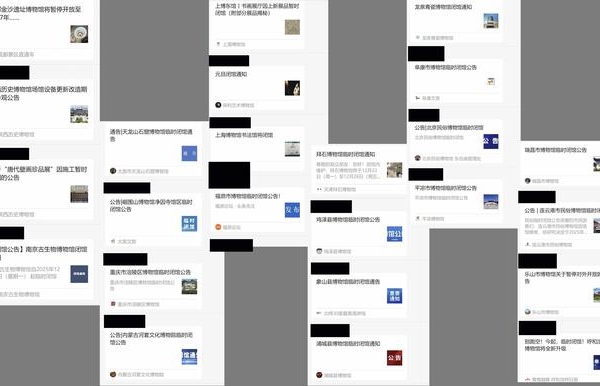
Recently, the news of Nanjing Museum being exposed for selling off its collection illegally and the former director Xu Huping being taken away has led to a series of announcements of closure of museums in various parts of China. This has sparked speculation about “hurrying to destroy evidence” among the public. According to incomplete statistics, as of December 25 last year, more than thirty museums have announced closures or suspensions citing reasons like renovation, with some museums closing for as long as 1 year and 5 months.
Museums that have announced closures or suspensions include Chengdu Jinsha Site Museum in Sichuan, Shaanxi History Museum, Nanjing Museum of Paleontology in Jiangsu, Tiangongshan Grottoes Museum in Taiyuan, Jueweisshan Museum in Taiyuan, Fuling District Museum in Chongqing, Shanghai Museum, Poly Art Museum, Fuding City Museum in Ningde, Jize County Museum in Handan, Xiangshan County Museum in Ningbo, Pucheng County Museum in Nanping, Longquan Celadon Museum in Lishui, Yongchun County Museum in Quanzhou, Fukan City Museum in Xinjiang, Folk Museum in Beijing, Pingliang City Museum in Gansu, Ruichang City Museum in Jiangxi, Folk Museum in Lianyungang, Museum in Leshan City, Hohhot Museum, Tianzhu County Museum in Wuwei, and Hekou County Museum in Honghe Prefecture, etc.
Internet users have compiled videos of museums recently announcing closures or suspensions.
The closing notices were issued at different times from mid-October to December. Many museum closures coincided with the New Year’s Day holiday and the Chinese New Year holiday in 2026. For example, the Jinsha Site Museum in Chengdu announced on November 7th that it would undergo comprehensive upgrades from December 5, 2025, to April 30, 2027. During the project implementation period, all areas of the Jinsha Site Museum will be temporarily closed to the public for a period of up to 1 year and 5 months.
Many museums have only announced temporary closures without disclosing the specific duration, such as the Folk Museum in Lianyungang, Ruichang Museum, and Longquan Celadon Museum.
Prior to this, on December 17, 2025, the Nanjing Museum was embroiled in a controversy over missing cultural relics. The painting “Spring in Jiangnan” by the Ming Dynasty painter Qiu Ying, which was donated to the Nanjing Museum by a private collector in the 1950s, was treated as a fake by the Nanjing Museum in the late 1990s. In May of this year, it unexpectedly appeared at an auction preview in Beijing with an estimated pre-sale price of 88 million yuan. Following media reports on this incident, the Nanjing Museum came under fire.
Subsequently, a retired employee of Nanjing Museum publicly accused former director Xu Huping of large-scale theft of cultural relics, gifting them to government officials at all levels, and smuggling cultural relics. On the evening of December 23rd, the “Asian Weekend” released a video showing that Xu Huping, along with his wife and maid, were taken away by police after being surrounded for more than ten hours.
At the same time, the insider selling of cultural relics within museums of varying sizes in China and the involvement of Communist Party officials in receiving or even demanding cultural relics have garnered public attention.
The official investigation results of the cultural relics loss incident at the Nanjing Museum have not been disclosed by the Chinese Communist Party. Meanwhile, the authenticity of the North Song calligrapher Mi Fei’s work “Three Postscripts in Running Script” exhibited at the Jiangxi Provincial Museum has also been questioned, adding to the mystery of the whereabouts of genuine artifacts.
The simultaneous announcement of closures of museums in many regions of China has raised speculations among mainland internet users as to whether, following the incident at the Nanjing Museum, other museums are closing under the guise of renovation to urgently handle or destroy key evidence:
“Quickly deal with the evidence.” “Museum closures for construction, accidental fires occur, causing damage to most exhibits, report the losses, and balance the accounts.” “Don’t let them catch fire. These guys are too unreliable.” “Those things sold will definitely not be bought back, can only choose to flee.” “Planning to close for half a year, first get the accounts in order.” “Isn’t this a typical self-exposure of their flaws?” “Pull out the radish of the Nanjing Museum and uncover the dirt nationwide.” “The British Museum has never closed.”