
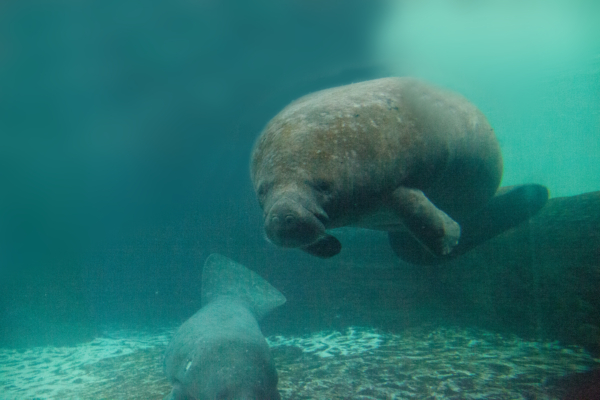
Archaeologists in Qatar, located in the Middle East on the Arabian Gulf, have made a groundbreaking discovery of the most densely packed small dugong fossils known to date. These findings suggest that these ancient marine mammals once thrived in abundant seagrass beds, exhibiting ecological roles similar to modern dugongs. This discovery could potentially provide scientists with insights into seagrass ecosystems and how they have adapted to long-term environmental changes.
Dugongs, also known as “sea cows”, are similar to manatees, both being marine mammals with robust bodies, downward-curving snouts covered in stiff hairs that aid in food detection. The main difference lies in the shape of their tails – manatees have paddle-shaped tails while dugongs have tails similar to dolphin fins.
These herbivorous animals are primarily found in West Africa, the Indo-Pacific region, and northern Australia, inhabiting extensive shallow coastal waters. The largest population of dugongs is found in the Arabian Gulf, where they continuously stir up the seabed sediment while foraging, releasing nutrients that benefit the surrounding marine ecosystem.
Collaborating scientists from the Smithsonian National Museum of Natural History and the Qatar Museum have unearthed ancient dugong fossils dating back approximately 21 million years in Qatar. Although these ancient dugongs were much smaller in size compared to their modern Gulf-dwelling counterparts, they shared a diet of seagrass and exhibited behaviors that contributed to the local marine environment’s well-being.
The fossils were discovered at the Al Maszhabiya site in southwestern Qatar, where in the 1970s, geologists had initially mistaken them for reptilian skeletal remains during mining and oil exploration activities.
It wasn’t until 2023 that the research team obtained the necessary permits to extensively survey the site, leading to the discovery of a high-density concentration of dugong fossils at over 170 different locations nearby.
The surrounding rock layers in the region indicate that these fossils date back to the “Early Miocene” period around 21 million years ago. At that time, this area was a shallow sea teeming with sharks, ray-finned fish, prehistoric dolphins, and sea turtles.
The research team identified the bones as belonging to an unknown ancient dugong species, officially naming it “Salwasiren qatarensis”, combining “Salwa Bay” and “Siren” with “qatarensis” as a tribute to the discovery location in Qatar.
Although “Salwasiren qatarensis” shares similarities with modern dugong skeletons, there are distinct differences. For instance, the ancient animals had straighter snouts, smaller tusks, preserved hind limb bones like the femur, features that are almost absent in existing dugongs and manatees.
Researchers estimate the weight of “Salwasiren qatarensis” to be around 250 pounds (113 kilograms), similar to that of an adult panda or a heavyweight boxer. However, compared to some massive modern dugongs, it still appears relatively small, as some of these dugongs can weigh several times more.
Due to the scarcity of soft seagrass leaf remnants in geological records, archaeologists rely heavily on the fossilized bones of “Salwasiren qatarensis” to understand the environments of the past. They infer that the region once boasted abundant seagrass beds, fostering high biodiversity with millions of years of dugong ancestors feeding on aquatic plants, aiding in maintaining the ecological balance of underwater meadows through grazing and sediment disturbance.
The research team further points out that dugong fossils often appear in mixed populations, indicating the potential discovery of more relatives of dugongs at the site through additional study.
The team hopes for international cooperation to uncover more discoveries at the Al Maszhabiya site and its vicinity. The protection of this site is crucial, with plans to nominate it as a UNESCO World Heritage Site.
They have digitized several fossil sites and specimens of new fossil species, including bones, vertebrae, teeth, and other skeletal parts, with the intention of making these open-source 3D model data accessible to a wider audience, potentially becoming part of future museum virtual tours and interactive educational materials.
One of the lead researchers, Nicholas D. Pyenson, the Curator of Fossil Marine Mammals at the Smithsonian National Museum of Natural History, emphasized, “This bay is a major habitat for dugongs today. We found a distant cousin of the dugong in rocks less than 10 miles (about 16 kilometers) away from modern seagrass beds.”
He added, “For the last 21 million years, this region has been a primary habitat for dugongs. Over time, their role has been replaced by different species.”
Ferhan Sakal, a co-author of the study and the head of excavation and site management at the Qatar Museum, expressed, “Previously, museum researchers referred to this area as a ‘graveyard for dugongs,’ but we didn’t realize just how rich and extensive this bone bed was.”
The region’s rock records hold vital information about past seagrass environments. He stressed, “By understanding how past seagrass communities survived climate pressures like sea level and salinity changes from the rock records, we may set goals for better conservation of the Arabian Gulf’s future.”
This work received support from a cooperative agreement between the Smithsonian Institution and the Qatar Museum and additional funding from the National Museum of Natural History and the Qatar National Research Fund.