
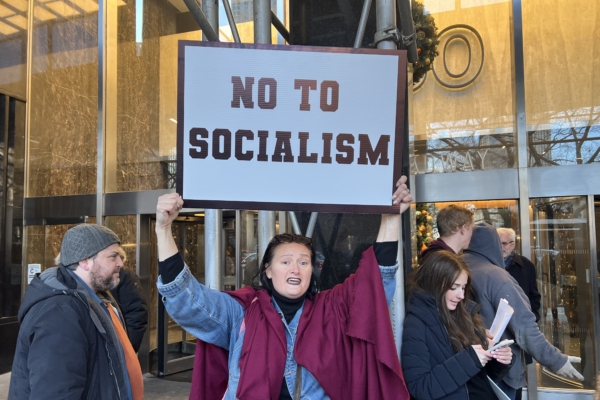
On December 18th, before the last annual meeting of the New York City Council, New York State Chinese Republican Senator Chen Xueli and State Assemblyman Zheng Yongjia stood in front of the City Hall at 250 Broadway, leading property owners in New York City to protest a proposed bill that was scheduled to be voted on – the Community Opportunity to Purchase Act (COPA).
“This is my house, bought with my hard-earned money from taxes. Now you’re telling me what I can and cannot do with my own house,” Chen Xueli exclaimed loudly to the media. “Does my house still belong to me? Does it really belong to me? Or does it already belong to the government? This is absolutely absurd!”
The COPA bill was introduced by New York City Councilor Nurse in May of last year, with bill number 902-2024. This proposal aims to give backing to non-profit organizations (NPOs) and Community Land Trusts (CLTs) affiliated with the city government priority purchasing rights for community housing, with the goal of keeping affordable housing in the community and preventing residents from losing their homes and becoming displaced.
The core concept of COPA requires owners of buildings with more than 4 units or owners living in buildings with 6 units or more, to notify qualified NPOs or CLTs before selling the property; these organizations would then have up to 180 days to submit an offer and secure financing before the property can be sold on the private market. Owners who violate this rule could face civil penalties of up to $30,000.
Subsequently, the City Council added an amendment to exempt 3-family homes, aiming to address concerns of brownstone and other small property owners in Brooklyn.
Representing the real estate industry in New York City, stakeholders such as property owners, developers, brokers, investors, among others, the Real Estate Board of New York (REBNY) strongly opposes the framework proposed by COPA. The organization argues that COPA first “unduly interferes” with private property transactions, prioritizing a certain business model while neglecting others, leading to a series of legal issues.
“The legal problems triggered by this bill are strikingly similar to those that arose when the Tenant Empowerment Act was passed by the City Council in 2005 – found to be invalid by state and federal laws due to its broad scope and failure to account for certain statutory first refusal rights,” said REBNY’s Vice President for Government Affairs Dev Awasthi in a statement.
Furthermore, if non-profit organizations incur fees from unwilling tenants or third parties to facilitate transactions, they would also violate the Martin Act, which regulates “partner acting” and “conflict of interest”, potentially facing enforcement actions from the State Attorney General.
“The bill also presents serious scope and implementation issues. The wide range of properties involved in the plan, extended purchase deadlines, and enforcement difficulties could disrupt people’s reasonable expectations of property transfer,” REBNY stated. “In addition to intervening in the private market, these measures are also not conducive to non-profit organizations, as their timing for negotiating necessary tax incentives and financing to complete purchases does not align.”
Many believe that New York City’s COPA mirrors a similar ordinance in San Francisco. However, numerous opponents argue that the legislation falls short in achieving its original goals in several aspects, even compared to COPA in San Francisco, with a significant flaw – funding. Where will the funding for community organizations to purchase housing come from? Unlike San Francisco, New York City lacks dedicated funding for this, and the Department of Housing Preservation and Development (HPD) behind it is resource-scarce, making it challenging to implement the bill, essentially forcing non-compliant private owners to face penalties.
The New York Apartment Association, representing stabilized rent apartments, stated that COPA has not yielded the desired results in other cities, aside from prolonging the sales cycle for owners and increasing regulatory burdens, stating there are “no benefits” to it.
During the City Council Housing Committee’s announcement of the passage of the COPA proposal on the 18th, property owners present shouted, “You have tricked us!”
“This is truly absurd!” Senator Chen Xueli told this newspaper, questioning what COPA implies. “Does this mean that I cannot sell my house to my own sister? Because certain organizations have priority purchasing rights? They can purchase it, but I can’t sell it to my niece or nephew, or my father can’t sell the house to my son? Who designates these community organizations? Are they government-funded non-profits or state-funded non-profits? So, when they buy houses, they are essentially using taxpayers’ money to buy taxpayers’ houses!”
Senator Chen Xueli went on to passionately query, if the government decides who lives in a house, then whose house is it really?
“This is like taxpayers donating their houses to the state government or to an organization, and allowing them to decide who lives there. If a community organization takes over a building with three units, what happens next? What about when my daughter gets married, will someone have priority to marry my daughter? To what extent does the government want to control our freedom? This is a purely leftist, socialist, communist agenda!” Chen Xueli said. “I will do everything in my power to fight for my district, Brooklyn, New York City, and the state of New York!”
Assemblyman Zheng Yongjia mentioned that the implementation of COPA in San Francisco resulted in falling housing prices.
“Let market forces solve the problems, that is the best solution. Let non-profits compete directly with the market is the best approach,” Zheng Yongjia said. “The population is declining, new housing is built every year, so where is the housing shortage? I can tell you, it’s because people are hoarding houses, not renting out, due to unfair housing courts; so if the government forces the sale of 3 or 4-family homes, developers will no longer build such housing units, because once non-profits buy them, the houses will fall under rent control, and you can no longer sell them.”
Minority Leader of the City Council and Republican Councilwoman Joann Ariola told the media that COPA is another attack on private real estate ownership in New York City.
“We are falling headlong into a communist dystopia where the government and its bureaucratic developers will own all the properties,” she said. “The rest of us will be compelled to rent forever, and this bill will only hasten this process.”
On December 18th, the COPA bill was passed by a vote of 30 to 10, but this margin might not be sufficient to prevent a potential mayoral veto. Therefore, some Chinese property owners expressed hopes that outgoing Mayor Adams would veto the bill.
“I heard that at least Adams doesn’t want to sign this bill during his term,” a Chinese property owner with the surname Lin revealed to this newspaper. “Unless he vetoes it, the bill will be brought up for discussion in the next year’s council; if he doesn’t veto it, the new mayor Mamdani will definitely sign the bill, it’s just a matter of sooner or later.”
In addition, lawyer Jim Walden, who previously ran for mayor of New York City and has focused on helping property owners and developers litigate, stated that there might be a class-action lawsuit against COPA.
“The City Council’s actions are entirely unconstitutional. Depriving property rights without compensation is illegal, and this is bad policy,” Walden said in a statement received by this newspaper. “It will only drive more real estate capital to other states and cities. For far too long, New York legislators have preferred to oppress property owners, developers, and builders rather than incentivize what we truly need – more housing supply. COPA is another step towards a dark future.”