
A severe storm triggered by an atmospheric river has wreaked havoc across California, leading to at least four deaths and a series of ongoing car accidents. Although the rainfall has been gradually weakening, some areas remain under flood and mudslide alerts. The sudden disaster has posed safety risks and inconveniences for millions of residents who had originally planned self-driving trips.
Since last weekend, the storm first swept through Northern California, causing sudden floods in many areas. Subsequently, Northern California entered flood and strong wind alert status. The storm then moved southward, bringing continuous heavy rain to Southern California, triggering floods, mudslides, rockslides, as well as numerous water and even aerial rescue operations.
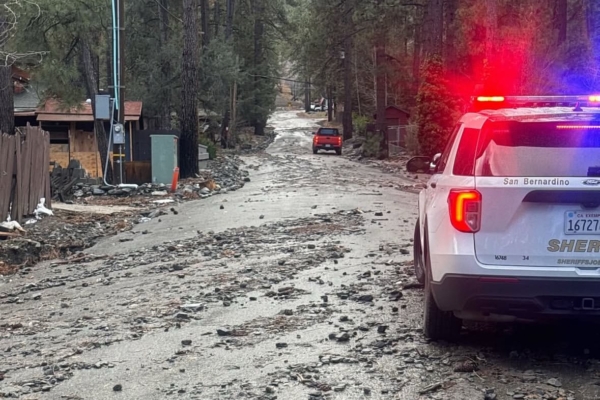
For example, the San Bernardino County Fire Department confirmed that a large amount of mud and debris surged onto the road leading to the mountain resort town of Wrightwood, trapping multiple people in their vehicles, prompting firefighters to immediately launch rescue operations.
On Christmas Eve, California Governor Gavin Newsom declared a state of emergency for Los Angeles County, Orange County, Riverside County, San Bernardino County, San Diego County, and Shasta County in Northern California.
On the same day, the National Weather Service (NWS) issued multiple warnings to Southern California residents, stating, “A flash flood warning has been issued in your area. This is a very dangerous situation that could be life-threatening.” Residents in communities previously affected by wildfires at the beginning of the year received evacuation alerts, while several hundred households were issued evacuation orders.
As of Friday afternoon, the flood warnings have been canceled by the meteorological agency, but the public is reminded that dangers still persist. A spokesperson for the San Bernardino County Sheriff’s Office also told reporters that evacuation alerts in many areas remain in effect.
Moreover, multiple key highways and mountain passes leading to popular destinations have been successively closed during the heavy rain, with some sections still not reopened.
By Friday, at least four storm-related direct or indirect deaths have been reported in California. On Sunday, Mike Littau, the mayor of Redding in Shasta County, confirmed on social media that a resident had died due to heavy rain and severe flooding in the area.
The following day, Mendocino County Sheriff’s Office in Northern California announced that a woman around 70 years old was swept into the sea at MacKerricher Beach by a giant wave while standing on a rock. By the time witnesses rescued her and brought her back to the shore, she had lost consciousness. Despite immediate medical assistance by rescue personnel, the woman was pronounced dead on the scene.
According to the weather forecast, the peak of the storm was expected on the 24th. That same day in Sacramento, the capital of California, the police department released a statement on social media mourning the death of Deputy James Caravallo, who tragically lost his life in a single-vehicle accident while driving to work that morning.
The police department noted Caravallo’s 19 years of dedicated service to the community. The California Highway Patrol (CHP) attributed the accident primarily to extreme weather conditions, with the road being too slippery, causing Caravallo’s vehicle to lose control.
Also on the 24th, a man in San Diego, Southern California, was reportedly killed by a falling tree. In addition to these fatalities, several traffic accidents were reported in various areas during the storm.
Meteorologists further warned that the heavy snow and strong winds expected in the Sierra Nevada Mountains within the next few days could result in extremely poor visibility, making mountain travel highly perilous.
According to reports from the National Weather Service at Los Angeles/Oxnard station, many areas in California broke rainfall records during Christmas Eve and Christmas Day. Near Van Nuys Airport in downtown Los Angeles, the two-day cumulative rainfall reached 2.79 inches (approximately 10.6 centimeters); Santa Barbara recorded a remarkable 5.91 inches (about 15 centimeters) of rainfall over the same period.
In response to the impending extreme weather conditions, the California Department of Transportation (Caltrans) has closed multiple major thoroughfares. As of Friday afternoon, the following roads remained closed:
– The Tejon Pass Rest Area near Gorman.
– The left lanes in both directions of California Street and Seaward Avenue on Highway 101.
– State Route 2 (SR-2) within Angeles National Forest, from Newcomb’s Ranch mountain roadside restaurant and rest stop to east of County Road 138 in San Bernardino County.
– Topanga Canyon Boulevard (SR-27) from the Pacific Coast Highway (PCH) to Grand View Drive, with closure extending until further notice. Images released show mud, debris, and rocks littering the closed sections.
The torrential rain and floods have seriously impacted the busiest travel weekend of the year, disrupting normal flight schedules at San Francisco International Airport and Los Angeles International Airport.
According to forecasts from NWS, rainfall is expected to gradually decrease to scattered light showers by Friday and Saturday until the weather stabilizes on Sunday.