
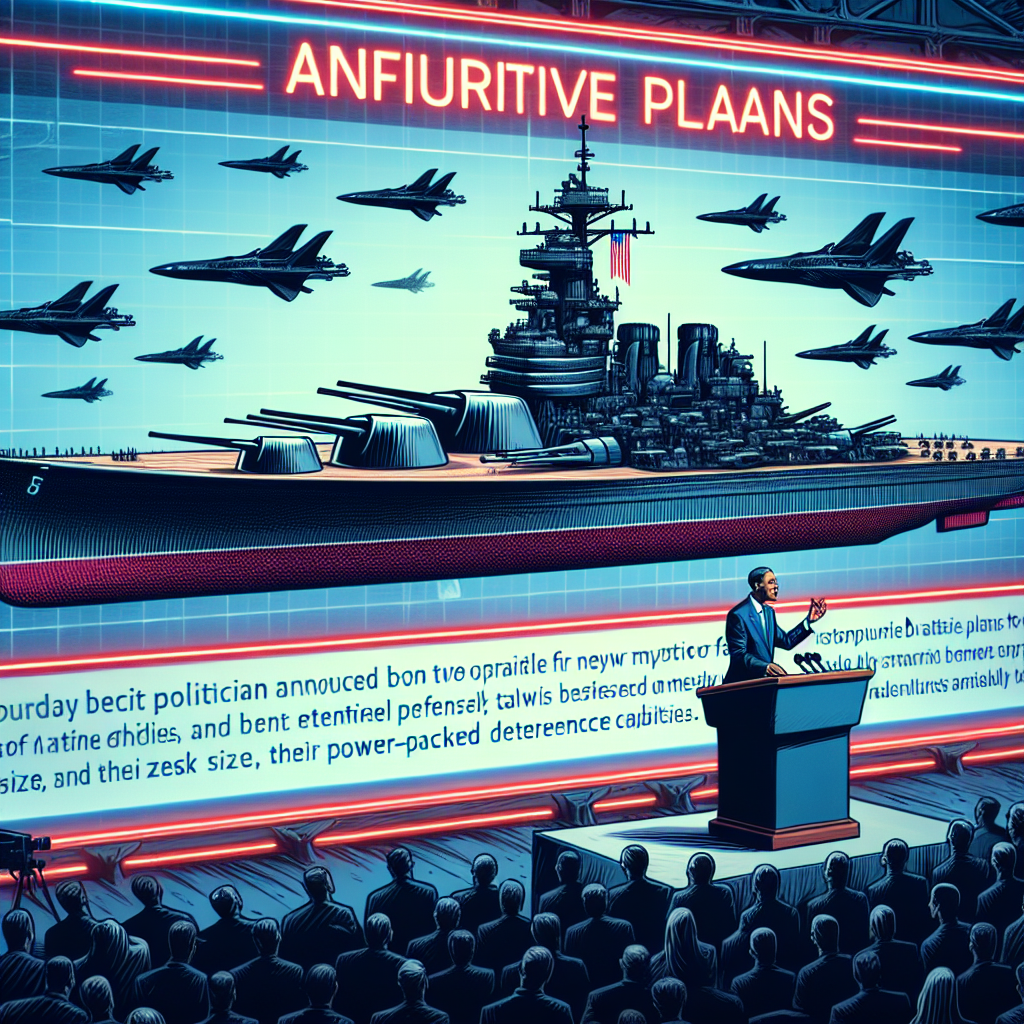
On Monday, December 22nd, President Trump announced the approval of the construction plans for two new types of battleships in the United States. The battleships will be entirely manufactured domestically with faster speed, larger size, and increased deterrence capabilities.
President Trump made this announcement at his Florida Mar-a-Lago estate. The Secretary of Defense Pete Hegseth, Secretary of the Navy John Phelan, and Secretary of State Marco Rubio attended the ceremony.
“As the Commander in Chief, I am honored to announce that I have approved the Navy’s plans to build two brand new gigantic battleships… they will be the fastest, the largest in size, and far more powerful than any battleship in history by 100 times,” President Trump stated.
According to Trump, the U.S. military will start with the construction of two battleships and ultimately reach a total of 20 to 25 battleships.
Battleships are primarily used for fleet engagements, lining up in “battleship formation” for artillery exchanges, symbolizing the pinnacle of a nation’s naval strength, hence often referred to as “capital ships.”
The President mentioned that the new battleships will possess stronger firepower. He introduced that these new warships will be the largest battleships ever constructed, equipped with top-of-the-line cannons and missiles, hypersonic weapons, electromagnetic railguns, cruise missiles, as well as the world’s most advanced laser weapons, and will also carry nuclear-powered sea-based cruise missiles currently under development.
Trump stated that each battleship will have a displacement between 30,000 to 40,000 tons and will be constructed in the United States.
“These cutting-edge ships will be one of the most powerful surface combatants… we expect these ships to be the first batch of a new class of battleships to be built in the coming years,” he said.
Additionally, the U.S. Navy will upgrade aircraft carriers, starting with the Ford-class carriers.
The plan is part of the President’s “Golden Fleet” initiative, aimed at revitalizing the American shipbuilding industry and addressing the recent issue of insufficient numbers of small U.S. naval vessels exposed by global military actions.
The “Golden Fleet” will consist of multiple large battleships equipped with more powerful long-range missiles, possibly including hypersonic missiles, and will also include the construction of a greater number of new small vessels – escort ships.
Currently, the U.S. Navy has 287 vessels, mainly including destroyers, cruisers, aircraft carriers, amphibious vessels, and submarines.
“I want to make it very clear that we will build these ships here… we have excellent shipyards,” the President said, “We will negotiate with some companies that operate these shipyards.”
Several concept design posters at the event label the new vessels as “Trump-class” battleships, with the lead ship named the “USS Defiant.” Trump did not mention naming the battleships after himself in his speech.
“The U.S. Navy will co-lead the design of these battleships with me because I personally value aesthetics,” the President said.
When asked about whether these battleships are aimed at balancing against the military power of China, Trump replied, “This is to balance against everyone, not specifically targeting China.”
Secretary of the Navy Phelan announced the plan in a video on social media platform X last Friday, aiming to deliver the first ship by 2028. He stated that the goal of the plan is to “build intelligent battleships from the beginning and then gradually upgrade and modify them as threats and technologies evolve.”
It is reported that a battleship named FF(X) will be built by HII company in Newport News, Virginia, with the existing Legend-class coastal patrol boats serving as the design basis for the new vessel.
Admiral Daryl Caudle of the Navy’s Operations Bureau posted on X, stating that the Navy’s fleet of small surface combatants is only one-third of what is needed.
Revitalizing the American shipbuilding industry has been a top priority of the Trump administration’s defense-related efforts. According to a recent assessment by the Center for Strategic and International Studies (CSIS), the U.S. accounts for only 0.1% of the global shipbuilding output. The U.S. shipbuilding industry continues to face challenges such as labor shortages, supply chain issues, and a decrease in the number of shipyards.
Under the rule of the Chinese Communist Party, China holds approximately 53% of the global shipbuilding market share.
The U.S. Navy will first build escort ships using all-American workers and components, then expand the construction scale to multiple shipyards through bidding.
Hegseth previously urged that contractors need to accelerate the development of new weapon systems, or they will lose government contracts. Due to cost overruns and project delays, the Navy announced in November a reduction in orders for the new missile escort ships of the “Constellation” class.
According to the Wall Street Journal, early this year, a small group from the White House and the Navy began planning for a new fleet to better address threats posed by China, control the Western Hemisphere, and handle other potential threats.