
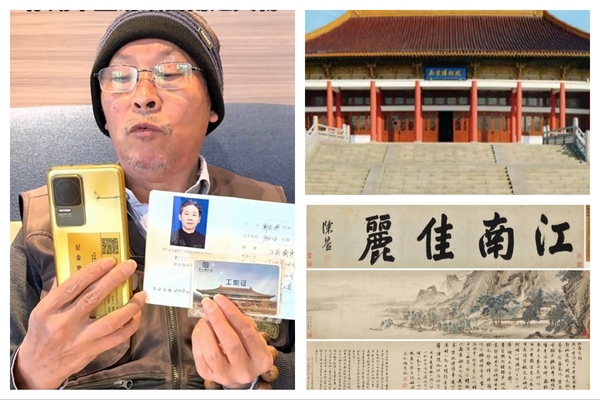
【Epoch Times, December 22, 2025】From the report by Chinese media on December 17th, the Nanjing Museum has been in the spotlight since the Ming Dynasty painter Qiu Ying’s “Southern Spring” scroll from its collection flowed into the auction market. Recently, a video surfaced by a retired Nanjing Museum employee accusing former director Xu Huping of large-scale theft and smuggling of cultural relics has intensified public scrutiny.
On December 21st, retired Nanjing Museum employee Guo Lidian made a public accusation against former director Xu Huping via a video on WeChat platform, alleging him of massive theft and smuggling of cultural relics, particularly the national treasures relocated from the Forbidden City to the South, sparking further discussion on the loopholes in cultural relic protection.
According to the accusation video, there were a total of 2211 boxes of relics from the Forbidden City’s relocation, with over 100,000 items stored in the Chaotian Palace warehouse in Nanjing. Xu Huping, during his tenure as museum director, had reportedly torn off seals from the relic storage boxes dating back to the war period without approval from the State Administration of Cultural Heritage, removed a large number of precious relics, falsified appraisals to label certain items as “counterfeits” including relics from the Forbidden City, and then sold them at low prices to a Jiangsu provincial relic shop where he had influence. These items were then resold to the auction company owned by his son Xu Xiangjiang in Shanghai, and later sold to French businessmen and various antique vendors, turning a hefty profit in the process.
These relics included a large number of official kiln porcelain as well as a significant quantity of national treasures such as unique calligraphy and painting works. Xu Huping allegedly amassed a fortune through the sale of these national treasures, even gifting several calligraphy and painting pieces to various government officials, including the chief prosecutor of Jiangsu Province and the director of the anti-corruption bureau, Han Jianlin. To avoid inspections and to obstruct the rightful return of relocated relics to the Forbidden City Museum, he had long disregarded and resisted demands to return the relics.
Since 2008, over 40 Nanjing Museum staff members have collectively lodged several complaints. In 2008, Xinhua published a report on Xu Huping’s corruption, but due to extensive bribery networks and powerful backers, the matter was eventually swept under the rug.
On December 22nd, Guo Lidian, the whistleblower, told China News Weekly that he had been reporting this issue to multiple departments since 2010, but had not received any effective response. He emphasized, “If I falsely accuse him, I am also willing to bear legal responsibility,” and urged relevant departments to investigate the matter.
Information released by Guo Lidian indicates that he was born in Nanjing in 1956, began working in December 1974, and retired in October 2016 with a professional technical background as a museum curator.
Xu Huping, in response to being reported, told Dahe Daily that he would respond to the matter at an appropriate time, pending the results of the investigation.
In a previous report by “Ongoing News,” Xu Huping stated, “I had no involvement in this matter, and I am not an appraiser of art.” Regarding the “Southern Spring” scroll, further clarification was deemed necessary from the Nanjing Museum, stating, “The Culture Department working group will conduct a factual investigation, and I am not fully informed about the situation. Let’s wait for the investigation results.” This year, at the age of 82 and in poor health, Xu Huping has remained retired and disengaged from external affairs for nearly 20 years.
According to a 2024 report by “Jiangnan Times,” Xu Huping was known for his eloquence and remarkable memory, recalling events from decades past with clarity. This includes the history of the 100,000 relics jointly owned by the Forbidden City and the Nanjing Museum, and the mobilization of social forces to fund the renovation of the Nanjing Museum.
On December 22nd, China News Weekly called the national hotline for reporting violations of cultural relics, and the staff confirmed that a report related to the “Southern Museum incident” had been received last week and was being verified. However, concerning the accusations made by the retired employee mentioned above, the platform had not yet received any related reports and thus could not address them at that time.
Subsequently, attempts were made to contact the anti-corruption supervisory authorities in Jiangsu Province, but they responded that the reported issue needed to be addressed by the Jiangsu Cultural Tourism Department and could not be processed for the time being. Multiple calls to different departments within the Jiangsu Cultural Tourism Department went unanswered.
Honorary Director Gong Liang of the Nanjing Museum commented, “I have nothing to say about this matter, I’m sorry.” An official from the museum advised to stay updated on the latest official announcements from the Nanjing Museum regarding this issue.
The latest reports and responses have reignited discussions online.
A member of the game review team and prominent Weibo influencer “Game Invest” stated, “A retired Nanjing Museum staff member made a public accusation against the former director, alleging that he tore the seals off the relics relocated from the Forbidden City, sold the genuine items through familial channels after falsifying appraisals, and suppressed the accusations.”
“The accused former Nanjing Museum director responded and called for an investigation, claiming that he had not been involved for many years, contradicting the personally signed documents on the relic transfers,” Game Invest continued.
“The Pong family donated the ‘Southern Spring’ painting, which was later falsely appraised and resold at an astronomically higher value. The National Cultural Heritage Administration and Jiangsu Cultural Tourism Department have since formed a special team to investigate, prompting the public to demand a thorough examination of the relics and a deeper investigation into the roots of the issue.”
A user named “Spring Hall, Ten Thousand Scrolls” remarked, “In the 1950s, the Forbidden City transported over 8,000 boxes of relics back from Nanjing in three phases. However, 2,211 boxes of the relics left in the Chaotian Palace warehouse containing over 100,000 items were not returned as per the agreement made with the signing of the transfer agreement with the Forbidden City Museum before the end of 1961. Despite multiple reminders from the Forbidden City, including the guidance from the State Administration of Cultural Heritage, the Nanjing Museum refused on various grounds.”
Weibo influencer “Dipping Salt” added, “the anti-corruption bureau chief mentioned in the report was implicated after the downfall of Xu Guojian, the head of the Jiangsu Provincial Organization Department, in 2004.”
Weibo influencer “Bull’s Eye on the Car” suggested, “Taking advantage of this incident, the Forbidden City Museum should present a request to thoroughly account for and disclose the relocated relics, thereby addressing past issues. If this opportunity is missed, it may be left unresolved for years to come.”
On December 17th, Chinese media outlet “The Paper” published an exclusive article titled “Why has the Ming dynasty painting ‘Southern Spring’ from the Nanjing Museum appeared in the auction market?” After this report, the Nanjing Museum came under scrutiny.
The report mentioned that in 1959, the descendants of the renowned modern Chinese art collector Pang Laichen had donated a significant number of valuable ancient calligraphy and painting works to several state-owned cultural institutions, with some of these works becoming the star attractions of these institutions. The Nanjing Museum received the most donations, totaling 137 sets, including the national treasure “Southern Spring” scroll by Ming dynasty artist Qiu Ying.
At the end of June 2025, Pang Laichen’s granddaughter Pang Shuling walked into the Nanjing Museum’s warehouse as per an agreement in the mediation document to check the status of the 137 donated relics from 1959, only to discover that 132 were present, with 5 missing items.
Aside from the Ming dynasty “Southern Spring” painting that appeared in a Beijing auction catalog in May of this year, the lost items also included the Northern Song Zhao Guangfu’s “Double Horse Painting Scroll,” Ming dynasty Wang Fu’s “Pine Breeze at Xiao Temple,” early Qing dynasty Wang Shimin’s “Imitation of Beiyuan Landscape Scroll,” and Qing dynasty Tang Yifen’s “Ink-washed Landscape Scroll.”
The starting price for the “Southern Spring” scroll was 88 million yuan, and after Pang Shuling’s report, the auction house decided to retract the item from the auction.
On December 18th, a search by Red Star News revealed that on June 18, 2014, Shanghai Jiatai Auction Company sold a standing scroll painting by Zhao Guangfu titled “Double Horse Painting,” bearing the inscription “Song Zhao Guangfu Double Horse. Seals: Pang Yuanji’s Seal (white), Laichen’s Delight (vermilion),” with Pang Yuanji being a descendant of Pang Laichen.