
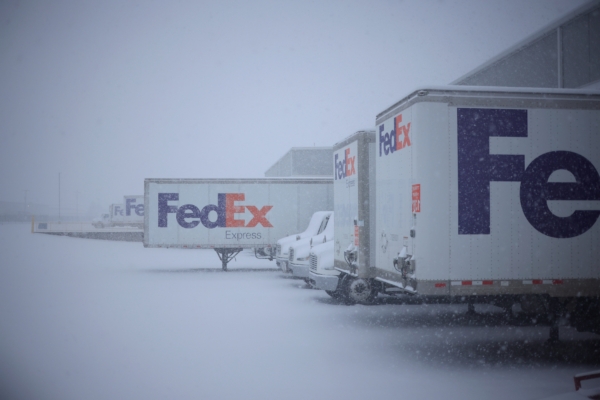
In recent days, the American parcel delivery company FedEx announced that, due to a fatal crash of UPS last month, both companies have temporarily grounded their respective Boeing MD-11 fleets. FedEx is planning to increase its unexpected costs by $175 million during the peak season, searching for trucks and airplanes to address the urgent situation.
On November 4, a UPS cargo plane crashed shortly after takeoff at Louisville Muhammad Ali International Airport in Kentucky, claiming the lives of 3 crew members and 11 people on the ground, while injuring 23. The investigation revealed that the left engine of the aircraft detached due to metal fatigue, leading to the loss of control of the plane.
Following the air disaster, the Federal Aviation Administration (FAA) grounded MD-11 aircraft, with FedEx operating a total of 28 MD-11 planes at that time.
FedEx CFO John Dietrich informed analysts that the third-quarter earnings until February 28 next year will be lower than the better-than-expected results of the second quarter announced on Thursday, December 18.
He mentioned that the grounding of MD-11 aircraft, costs associated with the splitting of freight trucking business in the upcoming summer, and other factors were the main causes of the profit decline.
Dietrich also stated that the company incurred a $25 million loss due to the grounding in November and expects this number to rise to about $150 million in December.
FedEx anticipates that the MD-11 fleet will resume operations by the end of the fourth quarter ending May 31 next year.
On Thursday, FedEx’s stock price closed up less than 1% in after-hours trading at $288.70.
The company announced on Thursday that both profit and revenue for the second quarter exceeded Wall Street expectations, raising the lower end of the full-year profit forecast due to pricing measures during the peak season and cost-cutting measures offsetting weak shipment volumes.
FedEx reported an improvement in the performance of its express business for the second quarter ending November 30, mainly benefiting from higher domestic and international priority package yields in the United States.
Adjusted profit for the second quarter was $1.14 billion or $4.82 per share, higher than the $990 million or $4.05 per share in the same period last year. Analysts had previously anticipated an average earnings per share of $4.11, based on data compiled by the London Stock Exchange Group (LSEG).
CEO Raj Subramaniam expressed confidence in the company’s efforts to turnaround its performance, stating, “We are very pleased with the current momentum of the company, and everything is moving in the right direction.”
Since 2023, FedEx has been undergoing a multi-year cost reform to save billions of dollars by grounding aircraft, closing sites, and integrating its previously separate ground and express businesses into its operating base.
FedEx’s goal is to achieve an additional profit of $1 billion by the end of the fiscal year in May 2026. FedEx has also raised its revenue forecast for 2026, expecting a yearly increase of 5% to 6%, compared to the previous forecast of 4% to 6%.
The current projected annual earnings per share for FedEx are $17.80 to $19.00, an increase from the previous range of $17.20 to $19.00. The updated forecast’s median is also higher than the analysts’ average expectation of $18.22 per share.
(Translated and referenced from Reuters)