
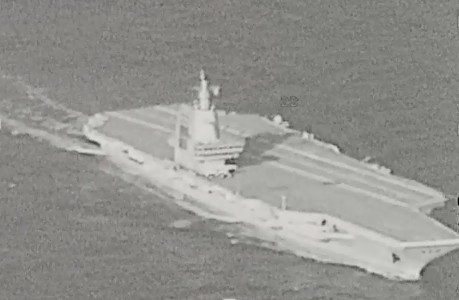
On December 19th, China Central Television (CCTV) quoted Taiwanese reports that the Fujian-class aircraft carrier had crossed the Taiwan Strait, but conveniently avoided the embarrassing situation where the Fujian ship, likely only a month into service, would soon have to return to the shipyard. CCTV also released a series of videos boasting about the three aircraft carriers, only to have their claims debunked by a Chinese military “bricklayer,” who revealed the truth about the radar targeting of a Japanese F-15 fighter jet by a J-15 carrier-based aircraft. As the end of the year approaches, the Chinese navy finds itself in an awkward position.
On December 17th, the Fujian-class aircraft carrier crossed the Taiwan Strait heading north, with images released by the Taiwanese military showing that its deck was not carrying any carrier-based aircraft, indicating that this was not a training mission. The Taiwanese military speculated that the Fujian ship should return to the Shanghai Changxing Island shipyard to address its “deficiencies.”
On December 19th, CCTV’s “Noon Defense Military” program reported on “Taiwanese Media: Fujian Ship Passes Through Taiwan Strait for the First Time Since Joining the Fleet.” Surprisingly, the Chinese Communist Party (CCP) media reported on the Fujian ship based on Taiwan’s sources, as it seems that the CCP military is reluctant to disclose the relevant information publicly. This further validates the Taiwanese military’s assessment, suggesting that the Fujian ship’s current voyage is likely for returning to the shipyard, and the Chinese navy may prefer not to confirm such news.
Over a month ago, on November 5th, the CCP’s Fujian-class aircraft carrier entered service in Sanya, Hainan, with Xinhua News Agency delaying its report by 2 days, and the delivery ceremony noticeably scaled down. Xinhua specifically mentioned that Xi Jinping personally made the decision for the Fujian ship to adopt electromagnetic catapult technology. The report did not provide an overall evaluation of the Fujian ship, only stating that its electromagnetic catapult technology is “at the world’s advanced level,” but did not dare to claim it is “leading the world’s advanced level.”
If the Fujian ship needs to return to the shipyard just over a month after entering service, it indicates significant deficiencies; if the shipyard personnel cannot complete the necessary improvements in Sanya, returning to the shipyard would be the last resort.
The return of the Fujian ship to the shipyard is probably within the CCP’s expectations, evident from the scaled-down delivery ceremony, delayed reports, and the evasion of navy leaders. The delivery of the Fujian ship is estimated to be another political mission, where despite knowing it lacks delivery conditions, a political show must still be staged.
A similar political show was previously staged with the Shandong-class aircraft carrier. On December 17, 2019, the Shandong ship was delivered in Sanya, but 9 days later on December 26, 2019, it returned to the Dalian shipyard after crossing the Taiwan Strait. One year later, on December 17, 2020, the Shandong ship again crossed the Taiwan Strait and returned to its base in Sanya. The Shandong aircraft carrier returned to the shipyard just 9 days after delivery and underwent a year-long transformation.
If the Fujian ship indeed returns to the shipyard this time, it remains unknown how long it will take to complete the modifications, including addressing issues with aircraft takeoff and landing corridors. Amid serious internal turmoil in the CCP’s military, the delivery of the Fujian ship failed to serve its political purposes and instead became another big embarrassment for the Chinese navy.
Before the delivery of the Fujian ship, it underwent sea trials in the South China Sea, with Chinese media reporting that the J-15T, J-15, and KJ-600 carrier-based aircraft conducted their first catapult launches. This should have been the only carrier-based aircraft catapult test at sea before the Fujian ship’s delivery.
On December 18th, CCTV reported in a video titled “Why did China’s aircraft carrier skip steam catapults directly to electromagnetic catapults?” In the video, a technical staff member from the Naval Engineering University claimed that they successfully catapulted multiple types of carrier-based aircraft “faultlessly in one go.” However, the staff did not disclose how many faultless operations the Fujian ship’s electromagnetic catapult system could truly achieve.
After the delivery of the Fujian ship, another catapult launch with J-15T, J-15, and KJ-600 carrier-based aircraft was conducted in the South China Sea, most likely successfully launching three different types of aircraft “faultlessly in one go.” However, the video did not reveal how many consecutive faultless catapult launches could be conducted, and there may not have even been arrangements for similar durability tests.
On November 8th, a spokesman for the Chinese navy stated that the Fujian ship would “continue testing after entering service before being fully manned.” This statement indicates that the testing of the Fujian ship has not been fully completed, especially concerning the electromagnetic catapult system, which may not have undergone consecutive launch testing out of potential risks or due to the lack of sufficient carrier-based aircraft available for testing.
The most significant difference between the Fujian ship and the Shandong-class and Liaoning-class ships is the elimination of ski-jump decks in favor of flat decks and aircraft catapult launches, making the core of Fujian ship testing likely focused on the electromagnetic catapult system. If the Fujian ship requires quick return for modifications, it is not unlikely that improvements to the catapult system, including its power supply, may also be needed.
In CCTV’s video, CCP’s “bricklayers” responded to doubts about whether conventional power aircraft carriers could meet the power supply demands for electromagnetic catapults, claiming to use “super capacitor energy storage” technology to solve the “pulse power supply challenge” and “avoid impacting the main power system.”
CCP’s defense leaves doubts about the power supply for the Fujian ship’s electromagnetic catapult system. The capacity of the so-called “super capacitor” and its ability to support multiple electromagnetic catapult operations are critical indicators. Once the “super capacitor” is depleted, even if the electromagnetic catapult system is faultless, it may not start promptly, preventing aircraft from launching. This challenge will likely continue to plague the Fujian ship.
On December 18th, CCTV released a series of videos, including “How can the Fujian ship ‘combat-ready upon delivery’?” “The ‘penetrating strike’ – the stealthy iron fist of aircraft carrier formations,” and “What advantages does China’s aircraft carrier development have after more than a decade of ‘triple jump’?” The videos claimed that China’s carrier aviation units began learning during the construction of the aircraft carrier, with relevant departments “preemptively stationed on the Fujian ship,” and after a “long period of on-site presence,” technically they had “basically passed” and soon “reached combat capability” during sea trials.
By this time, the Fujian ship likely arrived at the shipyard, and claims of technical success and achieving combat readiness are perhaps nothing more than jokes; yet, the video continued to assert that the CCP possesses a “complete shipbuilding management and operation mechanism.”
On December 19th, the CCP’s military newspaper published an article titled “The Central Military Commission Equipment Development Department Promotes the Code of Professional Ethics for Military Equipment Development,” stressing the importance of “cleaning up, doing things cleanly,” and the need for the Equipment Development Department to act as a “quality guardian” on the front line of military production. The article commented that “industry governance… is necessary; destruction is necessary; and reform must be conducted simultaneously.”
These contradictory statements in the article essentially admit to numerous black spots in CCP’s military equipment, casting doubts on whether the Fujian ship truly possesses a “complete shipbuilding management and operation mechanism.”
In the CCTV video, CCP’s “bricklayers” claimed that the stealth aircraft carried by the Fujian ship could conduct a “penetrating strike.” The “bricklayers” avoided discussing whether the J-15 could carry ground strike weapons, but likely knew the truth; they later claimed that “electronic jamming” could also achieve a “penetrating strike.” Even if the J-15 could penetrate, conducting only “electronic jamming” indicates a shift to electronic warfare instead of conventional combat, making it difficult to define as a true “penetrating strike.”
The Fujian ship is China’s first experimental product transitioning from imitating Soviet carriers to mimicry of American carriers, shifting from ski-jump to catapult take-offs. The risk was lower with steam catapults, yet the CCP insisted on installing electromagnetic catapult systems on conventional power carriers, thereby increasing the risk of testing failures.
On December 18th, CCTV also released a series of videos, including “The ‘sliding catapult hybrid’ – how do the three carriers form a collective force?” “From leap to catapult – what are the secrets of carrier decks?” “Shandong Ship: Bridging the past and the future, comprehensively refining core combat capabilities,” and more.
While these titles may appear intimidating, CCP’s “bricklayers” admitted in the videos that the construction of carriers was an “exploration” process, and the three carriers could “at least” solve the “turnaround period” challenges related to maintenance. The embarrassing reality is that shortly after delivery, the Fujian ship entered a maintenance “turnaround period.”
The CCP describes the Shandong ship as “bridging the past and the future,” essentially acknowledging it as an interim product. The CCP touts the so-called “exploration” process of the three carriers as a “triple jump,” suggesting that the three carriers are three different experimental products.
CCP’s “bricklayers” admitted in the videos that ski-jump decks present more restrictions on the takeoff weight, payload configuration, and weather conditions for carrier-based aircraft, making it challenging for fully-fueled and armed fighters to successfully launch and leaving open the possibility of transitioning Liaoning and Shandong ships to catapult launches, stating that if improvements are made, the costs would be “discounted.”
By acknowledging that Liaoning and Shandong ships were just experimental products and suggesting that transitioning to catapult launches would not be cost-effective, CCP’s “bricklayers” revealed that the ski-jump carriers were inefficient. This indicates that the Fujian ship may be the last ski-jump carrier built, with no increase in production for the early J-15 carrier-based aircraft, and the Liaoning and Shandong ships likely to be left to self-destruct.
Recently, the CCP claimed that the Shandong ship completed its final sea training in 2025 in the South China Sea. The Shandong ship made two deployments outside the first island chain in 2025, one from March 29th to April 3rd in the western Pacific Ocean region for 5 days, and the second one from June 7th to June 22nd, where the Shandong and Liaoning ships stayed in the western Pacific for 16 days. The actual deployment and training time for the entire year were limited.
Both Liaoning and Shandong had deployments outside the first island chain that did not exceed one month in total, lacking significant achievements. The Liaoning ship’s J-15 fighter intentionally targeting a Japanese F-15 fighter jet became a focal point. On December 18th, CCTV released a video titled “Nanchang Ship, a 10,000-ton destroyer, serves as the commanding ship for the aircraft carrier formation,” revealing some related details.
In the video, it was reported that the commanding ship of the Liaoning aircraft carrier fleet, the 055 destroyer Nanchang (101), informed the monitoring Japanese destroyer Jodogahara (DD-116) that they were conducting aircraft carrier aircraft training. Consequently, the CCP claimed the Japanese fighters were “maliciously approaching to harass.” But how close was this approach?
According to the video, the Japanese F-15 fighter jets were less than 50 kilometers from the CCP’s training area, but this distance does not refer to the F-15s’ proximity to the Liaoning aircraft carrier, but to the distance from the Liaoning’s J-15 carrier-based aircraft, as indicated in the video. Although fighter jets are fast, 50 kilometers is not considered “close,” and should be classified as a medium-range, far from being considered “malicious.”
When the Japanese F-15s reached within 50 kilometers outside the defensive circle of the Liaoning’s carrier-based aircraft, they likely spotted the J-15, then quickly turned back. In contrast, the CCP’s J-15 intentionally used fire-control radar to target the Japanese F-15 in a medium-range of 50 kilometers, posing no real threat, making such actions “malicious.”
Through a video praising the 055 destroyer, CCTV indirectly revealed the truth while acknowledging that the Japanese destroyer Jodogahara and a P-3C Orion surveillance aircraft were monitoring the Liaoning, but CCTV failed to mention the P-3C aircraft entirely.
CCP’s three aircraft carriers are experimental products, with limited capabilities for J-15 carrier-based aircraft, yet creating a political incident of playing the victim. CCTV keeps stirring the pot, adding to the embarrassment of the Chinese navy at the end of 2025.