
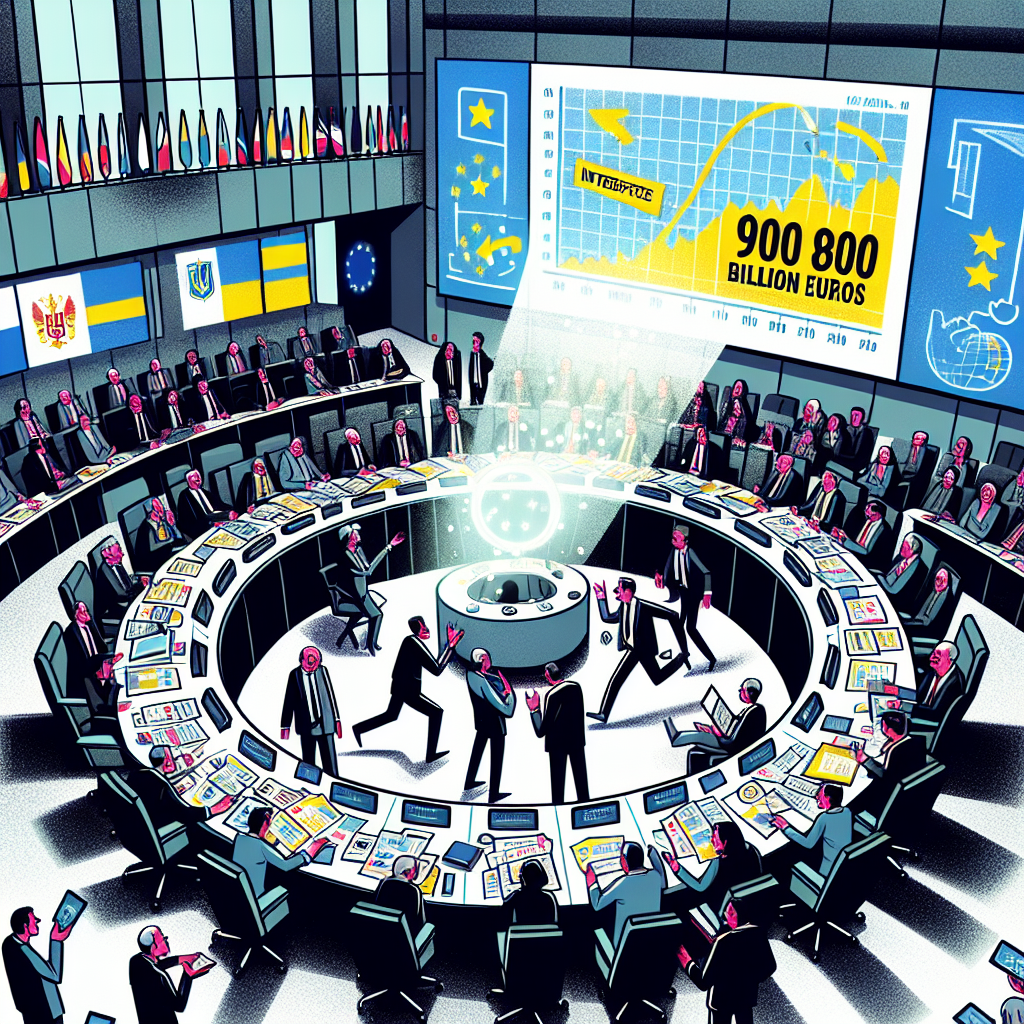
European Union leaders reached an agreement at the eleventh hour of the Brussels summit on Friday, December 19, to provide Ukraine with a 900 billion euro interest-free loan through “joint borrowing” to support its military and economic needs over the next two years.
Due to disagreements among member states regarding legal issues and risk sharing, the initial plan to raise funds by using frozen Russian assets was abandoned, and instead, the EU budget provided backing for financing in the capital markets.
European Council President Antonio Costa stated, “The message we are sending to Russia today could not be clearer. First, you have not achieved your goals in Ukraine. Second, Europe stands with Ukraine, today and tomorrow, and as long as it is necessary, we will continue to support them.”
Costa noted that the plan has been approved to ensure critical funding support for Ukraine until the end of 2027 amid the looming risk of bankruptcy.
“We made commitments, and we have delivered results,” Costa added. The EU has also retained the right to use frozen Russian assets in the future to repay the loan, and the European Commission has been authorized to continue studying the feasibility of this approach.
The International Monetary Fund (IMF) estimates a funding gap of 1.6 trillion US dollars (1.37 trillion euros) for Ukraine in 2026 and 2027. The EU’s assistance will cover roughly two-thirds of this gap, helping Kyiv avoid a financial crisis in the spring of next year.
This agreement is seen as a crucial victory for the EU to demonstrate unity and geopolitical relevance. European Commission President Ursula von der Leyen emphasized that this is “Europe’s moment of independence,” showcasing Europe’s ability to shoulder security responsibilities amid international shifts.
Ukrainian President Volodymyr Zelenskyy welcomed the agreement, stating that it provides “financial security for the coming years” for Ukraine.
Zelenskyy underscored the importance of this funding for maintaining Ukraine’s drone industry and long-range attack capabilities, strengthening Ukraine’s position in future peace negotiations.
Previously, the EU had considered using around 2.1 trillion euros of frozen Russian assets within Europe as the basis for a “compensation loan,” but this was hindered by strong opposition from Belgium.
Belgium’s “Euroclear” holds the majority of the frozen Russian assets in the country. Belgian Prime Minister Bart de Wever pointed out the significant legal risks and potential harm to Euroclear’s business by directly using these assets, which could impact financial market stability.
During the negotiations, Hungary, Slovakia, and the Czech Republic opposed the aid loan to Ukraine but eventually agreed not to block the plan, on the condition that it would not burden their domestic finances. Hungarian Prime Minister Viktor Orbán reiterated his opposition to using Russian assets, calling the idea a “dead-end.”
German Chancellor Friedrich Merz and French President Emmanuel Macron also supported borrowing in the capital markets.
Macron viewed the agreement as a significant step forward, stating it is the “most practical and realistic approach.”
Merz mentioned that the zero-interest loan is sufficient to cover Ukraine’s military and budgetary needs over the next two years, and frozen Russian assets will remain locked until Moscow compensates for the war.
“If Russia does not pay compensation, we will indeed use the frozen Russian assets to repay this loan in accordance with international law,” Merz stated.