
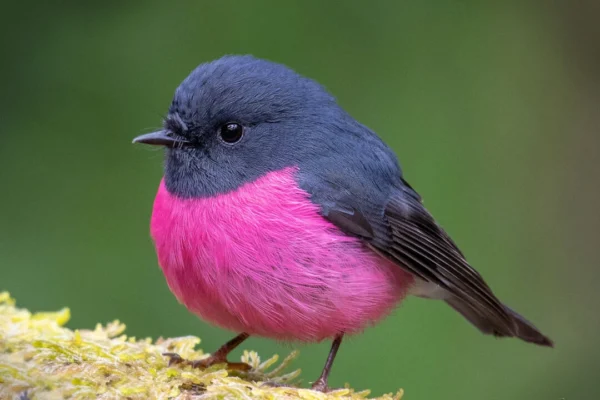
Deepak Karra, who migrated from India to Australia, is always mesmerized by the hundreds of waterfalls and brightly colored birds dancing in the lush mountains near his home every time he goes hiking. The North American familiar robins have a rust-orange breast and dull feathers, but a unique species of robin found in Victoria, New South Wales, and Tasmania in Australia stands out with its vivid pink breast. The striking neon pink contrasts beautifully with its smooth black head, tail, and back feathers, adding to its adorable appearance.
Encountering the pink robins in these regions is no easy feat. Since moving to Melbourne in 2010, Karra, who has always had a passion for nature since childhood, where he used to capture fireflies near his hometown of Allachaur, Punjab, came across images of pink robins online while preparing for a bird-watching trip in Australia. At first, he thought the photos were doctored. “Initially, I thought it wasn’t a real bird because it didn’t look real,” he told Epoch Times.
Karra, now 40, began capturing birds in 2018 as a nurse at the Royal Children’s Hospital, alongside his shifts, bird photography became his lifelong pursuit. “I believe birds exemplify the extraordinary diversity and beauty of the natural world. Every bright feather, unique pattern, or shade tells a story,” he said.
Despite having a “long” list of birds he wanted to capture, Karra finally spotted the pink robin after months of searching in the dense forested mountains near Melbourne, at Erskine Falls, a three-hour drive southwest of the city. Walking downstream along the waterfall, his photography companion quietly told him to “stop and look up.”
“It was standing straight about five feet above my head,” Karra recalled, “I couldn’t stop smiling. It was definitely one of the best experiences of my life.”
The pink robin eventually became his favorite subject to capture. The last time he saw one was in the Yarra Mountains, northeast of Melbourne, where he and his bird-watching partner encountered a special male bird with a bright pink breast, dubbed “Pinkie.” “It felt like it was waiting for us,” Karra said. “No matter how many times I encountered or captured it, it always made me smile.”
“Surprisingly, Pinkie flew over and perched on top of the camera!” he added. As the robin settled on his companion’s camera, Karra clicked the shutter. Both burst into laughter. “It was a joyous moment gifted by nature, truly unforgettable,” he said.
Karra captured a video of the pink robin singing its unique call during this trip. The bird emitted a sharp “chirp” after a series of “chirps,” seemingly warning others. Despite their petite and cute appearance, Karra pointed out that these birds might not easily scare off photographers, but their natural defense mechanism might make them elusive. Fortunately, pink robins are not afraid of humans, allowing Karra to capture many of them.
Continuing his travels across Australia, Karra pursues birds on his list, including ground parrots, rose-crowned fruit doves, superb fruit doves, grey shrike-thrushes, canaries, and the mysterious night parrot, and has captured countless rare bird species.
He particularly mentioned the blue wrens he captured in the Lotus Garden in Victoria and the yellow-breasted paradise kingfisher found in Far North Queensland as top specimens. “I took a ten-day leave and drove with my wife to Julatten,” Karra said. “We camped along the way, capturing birds.” He described the yellow-breasted kingfisher as “a striking bird known for its slender white tail feathers, rusty belly, and bright red bill.”
He explained that the blue wrens are small, brightly colored birds found in northern and eastern Australia, as well as Tasmania, emitting high-pitched “chirps” during flight.
In his recent trips, Karra visited the Artemis Wildlife Sanctuary in Far North Queensland and Perth, Western Australia, recording dozens of birds. Where will this bird enthusiast head to next?
“Next week, we will head to Hattah-Kulkyne National Park to track down the pink cockatoos and king parrots,” he said.