
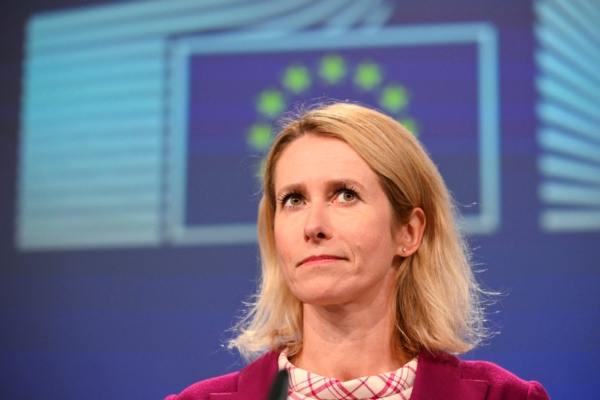
The High Representative of the European Union for Foreign Affairs and Security Policy, Kaja Kallas, stated on Sunday in Brussels after attending the EU Foreign Ministers’ meeting that the Chinese Communist Party is increasingly “weaponizing economic relations”, using economic ties as a tool for pressure to seek political benefits, forcing the EU to respond with a more resilient trade and security strategy.
Following the meeting, Kallas highlighted that discussions have been initiated on how to strengthen economic security by more effectively utilizing the EU’s “trade toolbox”, focusing on promoting supply chain diversification, enhancing supervision of key industries, and establishing a more comprehensive anti-coercion mechanism.
She emphasized, “No EU country can stand alone against China. Unity is strength.” She mentioned that the EU and the European Commission have jointly released the “Economic Security Strategy”, aiming to diversify critical mineral supply chains and reduce structural dependence on China.
This statement aligns with the EU’s recent overall policy adjustments towards China. Since 2023, the EU has officially positioned China as a key international actor with a triple identity of “partner, competitor, and systemic rival”, gradually promoting a policy direction of “risk reduction” rather than complete decoupling. Kallas’s remarks are seen as the latest signal of the EU’s increasingly tough stance towards China.
In recent years, the EU has criticized Beijing multiple times for using trade and supply chain dependence to exert pressure. Lithuania, for allowing the establishment of a “Taiwanese Representative Office”, faced Beijing’s customs clearance suspension and companies faced order cancellations, officially listed by the EU as a symbolic case of “economic coercion”.
In response to such risks, the EU has established the “Anti-Coercion Instrument (ACI)” and initiated various industrial and subsidy investigations into trading partners including China, covering issues such as Chinese electric vehicle subsidies, indicating the EU’s gradual refinement of its economic security policy framework.
The EU’s recent economic security focus has been mainly on critical raw materials, semiconductors, advanced technologies, and supply chain concentration, areas where the EU’s dependence on China is high and controversies are most concentrated.
Earlier this month, the European Commission and the High Representative for Foreign Affairs and Security Policy jointly issued the “Joint Communication on Strengthening Economic Security”, presenting a new action framework based on the 2023 “European Economic Security Strategy”, emphasizing the coordinated use of existing trade, defense, and investment tools to reduce strategic reliance on critical goods, raw materials, and technologies while maintaining openness to international trade and investment.
The EU is also advancing the “ResourceEU” initiative, enhancing risk assessment and information sharing to address reliance on overseas critical resources and semiconductors, coordinating actions with member states, businesses, and like-minded international partners to enhance overall economic resilience and strategic autonomy.