
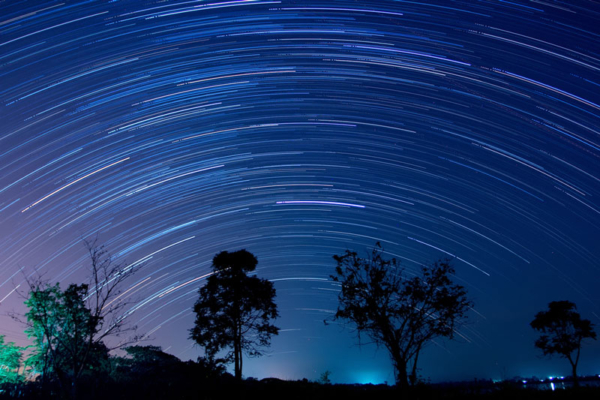
The annual Geminid meteor shower reached its peak from Saturday to Sunday (December 13th to 14th) this year. This meteor shower is renowned as one of the top three annual showers due to its brightness, rich colors, and stable observability. It has also garnered attention from the scientific community because of the unique “origin” of its parent body.
According to data from NASA and the American Meteor Society (AMS), here are some key details about this celestial event:
Firstly, the peak of the meteor shower lasted from Saturday evening to Sunday early morning. For observers in the northern hemisphere, this is the most spectacular meteor shower of the year.
Under ideal conditions in extremely dark locations, the Geminid meteor shower can achieve an extremely high meteor count of up to 120 meteors per hour.
The optimal viewing time is from 10 p.m. to 2 a.m. local time. This time frame is considered the “golden period” when the Geminid radiant point rises high in the sky, with minimal interference from moonlight. This year, the peak coincides with favorable lunar phase conditions, as moonlight only rises after 2 a.m., minimally affecting the viewing experience.
The radiant point of the meteor shower is located near the constellation Gemini in the eastern sky. After 2 a.m., it is recommended to shift your observation towards the western sky to avoid the rising moonlight.
One of the most distinctive features of this meteor shower is its source: unlike most meteor showers that originate from comet debris, the Geminids come from remnants of the asteroid 3200 Phaethon. Due to this unique rocky origin, Geminid meteors are typically more solid, slower in velocity, brighter, and display a wider range of colors.
The parent asteroid of the Geminids, 3200 Phaethon, holds a special position in the scientific community. It is an asteroid with unconventional characteristics, labeled as the “rock comet” due to its unique orbit and behavior.
It is the only known asteroid to produce a major meteor shower. While typical meteor showers are generated by comets with loosely packed fragments, Phaethon produces rock fragments, resulting in more solid, slower meteors that appear brighter and display varied colors during observation.
Phaethon’s orbit brings it very close to the sun, with a closest approach of around 0.14 AU, even closer than Mercury’s perihelion.
This extremely close orbit to the star suggests that it is composed of materials resistant to high temperatures, likely comprising rocks and metals.
Despite being classified as an asteroid, Phaethon exhibits comet-like behavior when approaching the sun: its surface material is burned off by high temperatures, creating a dust tail reminiscent of a comet, which constitutes the material of the Geminid meteor shower.
Scientists believe that studying the composition and behavior of Phaethon is crucial for understanding the early evolution of materials in the solar system. Japan Aerospace Exploration Agency (JAXA) is even planning the DESTINY+ mission to fly by Phaethon, aiming to unravel its mysteries as a “rock comet.”
You do not need any special equipment; observing with the naked eye is the best way to watch the meteor shower. However, keep in mind the following:
– Find darkness: Choose a location far from urban light pollution.
– Adjust to the dark: Give your eyes 20 to 30 minutes to adapt to the darkness, avoiding the use of mobile phones or any bright light sources.
– Stay comfortable: Have a lounge chair, sleeping bag, or blanket ready to stay warm and comfortable for extended sky-gazing sessions.
– Synchronize observations: On the evening of December 13th, observers can also see the bright Jupiter in the eastern sky, adding an extra celestial highlight to the night sky.