
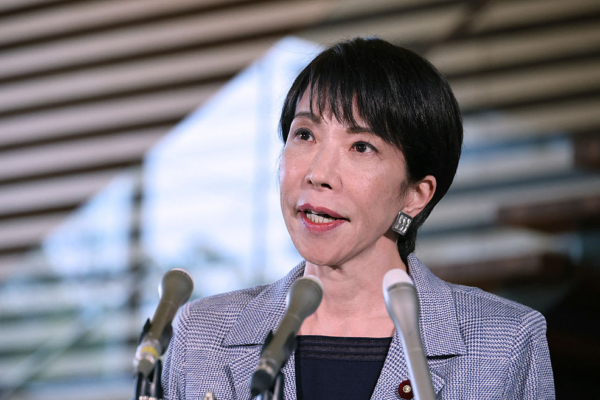
In a statement regarding “Taiwan’s situation” made by Japanese Prime Minister Sanae Takayichi, it has sparked a serious diplomatic standoff between China and Japan, with some considering it one of the most severe political crises since the establishment of diplomatic relations between the two countries in 1972. Over the past few days, official Chinese media outlets have continued to criticize Japan and its Prime Minister, using harsh language in their condemnation.
Experts have pointed out that this public opinion offensive reflects Beijing’s high sensitivity regarding the Taiwan issue. However, the tepid response from the Chinese public reveals internal economic challenges and shifts in public opinion within the country. Japan has refused to retract its statements and has escalated its defense capabilities, putting the China-Japan relationship to a new test.
On November 28th, official Chinese media outlets published successive articles criticizing Japanese Prime Minister Sanae Takayichi.
The People’s Daily published a commentary by “Zhong Yin” titled “Provocation Crossing the Line: Sanae Takayichi Will Reap What She Sows,” which criticized Takayichi’s comments on Taiwan from nine different perspectives. Other state media outlets reposted the article, referring to it as a list of the “nine sins” of the Japanese Prime Minister.
The commentary particularly emphasized that Takayichi’s statements were the first time a Japanese leader had officially declared on a formal occasion since Japan’s defeat in 1945 that “an issue with Taiwan is an issue with Japan,” and linked it to exercising collective self-defense rights.
On the same day, China News Net published an article titled “Reckoning with the Issue of Ryukyu’s Sovereignty, an Old Account to Settle,” questioning Japan’s sovereignty over the Okinawa region. CCTV also aired related news segments, featuring interviews with individuals from Russia, South Africa, Thailand, and other countries who criticized Sanae Takayichi.
Feng Chongyi, Associate Professor at the University of Technology Sydney, analyzed the situation in an article for Dajiyuan, stating that the intensified voice of the official media is a direct response to Japanese Prime Minister Sanae Takayichi’s comments. He pointed out, “The intensified voice of the state media can be interpreted as a direct statement from the highest levels, with subordinates showing loyalty by following suit.”
In stark contrast to the official propaganda offensive, the Chinese public has shown a lukewarm response to anti-Japanese propaganda, with more focus on livelihood issues such as salaries, pensions, and employment on social media.
Executive director of the Taiwan Inspirational Association, Lai Rongwei, analyzed that the lackluster response from the public stems from various factors. He believes that the “two major treasures” of the Chinese Communist regime—economic development and nationalist propaganda—are currently facing challenges. He stated, “People’s purchasing power is decreasing, they have pessimistic expectations about future income, and the regime has long used nationalist rhetoric, but the common people have long seen through it.”
He further pointed out that the current economic policies rolled out by the Chinese Communist Party are out of touch with the needs of the people. “The new quality productivity and high-tech industries introduced in the Fifteenth Plan are not what the common people want. They want stability in the real estate market and finances.” Issues such as local government debt crisis, declining real estate market, job losses directly impact people’s lives, and the “ruling class creating unfriendly atmospheres everywhere” have intensified public discontent.
Feng Chongyi also noted the changing landscape of online public opinion. He mentioned that previously, there were many online pro-government commentators, but now, “these commentators themselves are under pressure due to unemployment, economic downturn, deflation, and so-called patriotic zeal has been undermined.”
He specifically referred to the shift after the Blank Paper Movement, stating, “Since the Blank Paper Movement, a new generation of young people have distanced themselves from the party-state propaganda system, and the lukewarm phenomenon in the media reflects the severity of the economic situation.”
It is worth noting that China’s personal attacks on Sanae Takayichi have instead led to a rallying effect in Japan.
A survey conducted by Yomiuri Shimbun from November 21 to 23 showed that the support rate for the Takayichi Cabinet reached 72%, the highest in the history of Japanese Cabinets. In the survey, there were far more respondents who affirmed Takayichi’s government’s stance towards China than those who were uncertain.
The direct cause of the recent diplomatic storm between China and Japan was Takayichi’s statement on November 7 during parliamentary debates regarding a sudden situation in Taiwan. Takayichi stated that if there were a military conflict in the Taiwan Strait, it could be considered a “threat to Japan’s existence.”
This statement actually provides a legal basis for Japan to exercise collective self-defense and intervene with military force in the event of a conflict in the Taiwan Strait. As a result, China’s response has been strong, applying pressure on Japan in diplomacy, economics, military, and public opinion fields.
In response to this pressure, Japan has not only refused to compromise but has also accelerated its defense capabilities. On November 20th, the ruling Liberal Democratic Party of Japan announced the start of the revision of the “Three Security Documents,” which include the National Security Strategy, National Defense Strategy, and Defense Capability Development Plan.
Of particular interest is the accelerated pace of growth in defense budgets. According to previous government plans, Japan’s defense budget is expected to reach 2% of GDP by 2027. Takayichi instructed to expedite the growth progress, aiming to achieve the 2% target of defense spending as a proportion of GDP by the fiscal year 2025. By then, Japan’s defense budget is set to reach approximately $90 billion, becoming the world’s third-largest defense budget, following the United States and China.
On November 23rd, Japanese Defense Minister Junichiro Koizumi, after inspecting the military base on Yonaguni Island, reiterated plans to deploy medium-range surface-to-air missiles on the island.
Feng Chongyi further analyzed that Southeast Asian countries are reevaluating Japan’s role as a force for peace. He noted, “In the past, due to economic reliance on the Chinese market, Japan restrained itself in its relations with China. Now, it has taken a tougher stance.”
From a stability perspective, Lai Rongwei interpreted this phenomenon. He believes, “Surrounding countries, including the European Union, are generally alert to and beginning to guard against China’s economic and military threats.”
In this context, he said that the Taiwan issue, as a core topic, would trigger strong reactions to any external statements regarding sovereignty principles or the use of military intervention.