
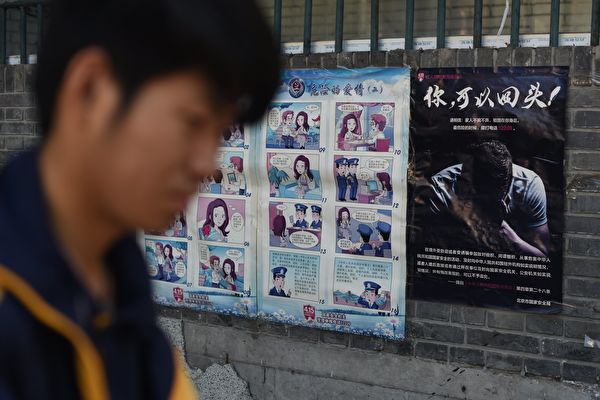
On September 4th, the Chinese Ministry of State Security announced that it had recently uncovered several “spy cases.” One of them involved an 18-year-old Chinese student studying in Taiwan who was lured into a honey trap, leaking nearly a hundred pieces of classified information from China’s defense sector. In response, Japanese media veteran Yabuta Akio raised several doubts, suggesting that this case is likely a fabricated scenario created by the Chinese Communist Party to promote awareness of counter-espionage.
According to a statement from the Chinese Ministry of State Security released on their public WeChat account on September 4th, the 18-year-old “Xiao Zhe” went to Taiwan as an exchange student at a university. During a gathering, a self-proclaimed “senior sister” actively approached Xiao Zhe, frequently inviting him to go shopping and dine together. With Xiao Zhe being away from home, he quickly fell in love with the “senior sister.”
Upon returning to China, Xiao Zhe began working in a highly confidential laboratory. During this time, the “senior sister” often coerced him to take photos of the laboratory under the guise of a couple’s outing or asked him to “share” the latest academic research results under the pretense of caring about his studies. Gradually, the information requested by the “senior sister” escalated from general information to experimental data and research secrets. Xiao Zhe attempted to break free but was threatened by the “senior sister” with the disclosure of secrets, leaving him with no choice but to continue cooperating.
The article states that upon investigation, the so-called “senior sister” was actually a personnel from a foreign spy intelligence agency who was 16 years older than Xiao Zhe. She manipulated Xiao Zhe using the honey trap strategy, leading him to leak nearly a hundred pieces of intelligence in the national defense and military industry sectors, and receiving a payment of 45,000 RMB (approximately 190,000 TWD). Ultimately, Xiao Zhe was arrested for espionage.
In response to the Chinese government’s disclosure of the aforementioned spy case, Yabuta Akio, Executive Director of the Indo-Pacific Strategic Think Tank and a senior Japanese media figure, posted on a platform on September 4th, expressing his skepticism towards the content of the article. He pointed out that the narrative seemed too bizarre, with the only memorable detail being “the spy senior sister being 16 years older than Xiao Zhe.” The methods of stealing secrets, the harm to the country, and how the espionage was uncovered were all vague, making it appear highly unrealistic.
Yabuta Akio highlighted several questionable aspects, such as the strict political screening required in China for individuals working in sensitive laboratories. It is extremely difficult for someone returning from studying in Taiwan to be accepted. Additionally, the phones and computers of personnel involved in sensitive work in China are usually under surveillance. He raised doubts about how Xiao Zhe managed to pass nearly a hundred pieces of defense industry intelligence to the “senior sister” and questioned the meager payment of 190,000 TWD for almost a hundred pieces of classified information, averaging less than 2,000 TWD per piece. He found the price to be unreasonably low.
Having spent ten years as a journalist stationed in Beijing, Yabuta Akio possesses a profound understanding of Chinese affairs. He suggested that based on his experience reporting in China, this case is likely a fabricated scenario by the Chinese Communist Party to promote counter-espionage awareness. He commented that the department where the young man worked may have some minor connection to the military, but it cannot be considered a special unit. The Chinese Ministry of State Security portrayed the exchange of letters between a couple as stealing national secrets and depicted the girlfriend supporting her boyfriend’s allowance as espionage payments, twisting the facts to extract a confession.
Yabuta Akio further stated that most of the so-called spy cases uncovered by the Chinese Ministry of State Security are likely to be wrongful or fabricated cases.