
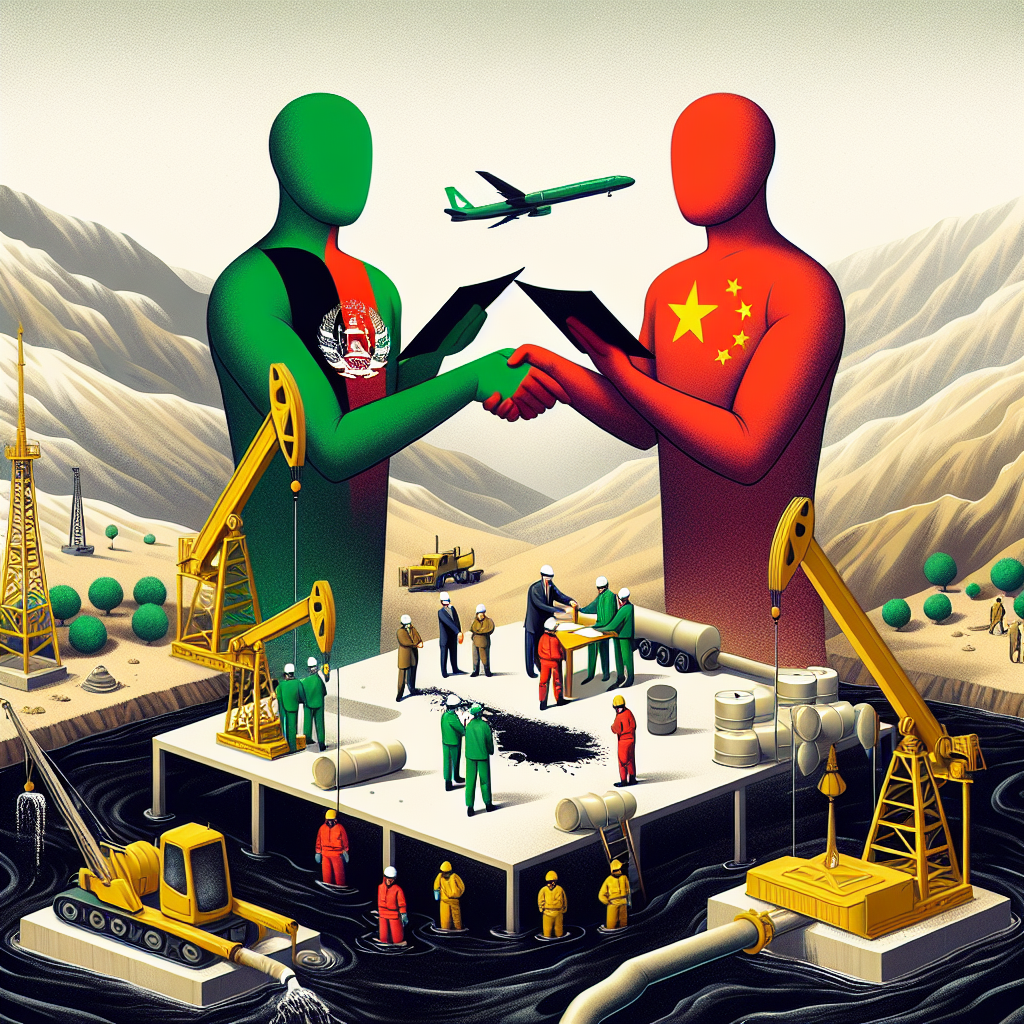
In 2023, Afghanistan signed a $540 million contract with the China-Afghanistan Petro Economic Investment Co. (CAPEIC) to extract oil in the Amu Darya Basin in the north of Afghanistan. This marked the first major foreign investment deal since the Taliban took control in August 2021.
Under the contract, the Taliban regime granted a license to AfgChin Oil and Gas Ltd., a joint venture between the Afghan Oil and Gas Company and CAPEIC with 20% and 80% ownership, respectively.
According to the 25-year contract, CAPEIC committed to invest at least $150 million in the first year, increasing to $540 million after 3 years. The oil must be processed within Afghanistan, and 3,000 Afghan citizens must be employed.
Two years later in 2025, the agreement was torn apart by both sides, leading to a breakdown amid accusations between Afghanistan and China.
Afghan officials accused CAPEIC of contract violations, while some Chinese employees of AfgChin described the Taliban’s actions as “resembling robbery.”
In June of this year (2025), the Taliban announced the termination of the contract, citing multiple breaches by the Chinese company. Hamaun Afghan, a spokesperson for the Afghan Ministry of Mines and Petroleum, stated that this decision had been approved by Taliban Prime Minister Mullah Mohammad Hassan Akhund.
Afghan authorities alleged that the Chinese company did not invest on time, failed to pay royalties, did not complete promised geological exploration and infrastructure projects, and did not respond to their complaints.
Chinese employees claimed that the Taliban forcibly took over the joint venture, and “expelled Chinese workers from the oil field at gunpoint.” According to National Public Radio (NPR), the Taliban confiscated the passports of over ten Chinese workers, effectively preventing them from leaving the country.
After Chinese Foreign Minister Wang Yi’s visit to Afghanistan on August 20, the Taliban returned the passports of 9 Chinese citizens, with 8 of them already having returned to China. However, at least three employees were detained in Kabul to handle the transfer of the joint venture to the Taliban.
Currently, neither the Afghan Ministry of Mines and Petroleum nor the Chinese Ministry of Foreign Affairs have responded to NPR’s repeated requests for comment.
According to a report by Nikkei Asia, Zardasht Shams, former Deputy Minister of Information, Culture, and Tourism in Afghanistan, believes that the Taliban is facing financial difficulties and is seeking to increase revenue to sustain its rule.
Shams suggested that despite the contract’s termination due to poor performance and failure to comply, it could impact the broader relationship between the Taliban and China, particularly in terms of economic ties.
He pointed out that since August 2021, the Taliban has shown unprecedented enthusiasm towards China, believing it to be an alternative to the United States. However, Shams believes that China cannot replace the US and its allies regardless.
On the other hand, Ubaidullah Burhani, an Afghan-American scholar, stated that the cancellation of the contract is unlikely to severely rupture Sino-Afghan relations.
Burhani told Nikkei that both sides are still bound by crucial mutual interests, especially given Afghanistan’s urgent economic and infrastructure needs, which China continues to leverage for strategic advantages.