
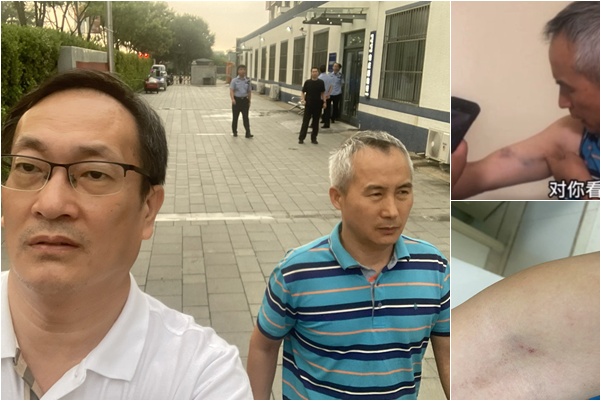
At the Songcheng Police Station, a bizarre experience unfolded.
Upon entering the Songzhuang Police Station, I was asked to register my name and phone number. Accompanied by two police officers, we were greeted by a young man in black who led us into the processing area on the left. The processing area was tightly sealed. The man in black searched me, finding only a few items in my pockets – car keys, house keys, phone, and charger. These belongings were placed in a drawer on top of a metal cabinet. Subsequently, he led me to a room labeled “Interrogation Room” and locked the door from the outside.
The interrogation room was divided into two sections, with a larger inner room of about 10 square meters and a smaller outer room of about 5-6 square meters, separated by a transparent glass wall. The glass door had a latch mechanism that could be locked from the outside, and several security guards were stationed outside. Feeling powerless in this confinement, I realized resisting would be futile. Exhausted from the ordeal and the late hour, I eventually laid down and fell asleep on a bench.
The next morning, as sunlight filtered into the room, I couldn’t discern whether it was day or night. Guards changing shift outside indicated the passage of time. Despite being offered a scallion pancake, I declined and only requested to use the restroom, judging it to be around 9 a.m.
Police officers Wang Tao and another officer then came to take my statement. Initially resistant due to their biased approach, I eventually cooperated, making amendments to the statement before signing it. However, subsequent questioning by officers Jin Honglin and Wang Tao veered towards coercion, leading me to adopt a defensive stance in my responses.
As the questioning sessions continued, the officers seemed intent on directing the narrative towards administrative or even criminal charges. Fearing manipulation, I stood firm in ensuring my statements reflected my true position. The tense atmosphere escalated when officers insisted on changing my testimony, leading to a standoff where I refused to sign anything without reviewing it thoroughly.
Eventually, facing pressure from the officers, and realizing the futility of the situation, I remained steadfast in defending my position against unjust treatment. Despite attempts to paint me as obstructive, I maintained my innocence, asserting my rights within the confines of the law.
After a prolonged period of uncertainty and confrontations, a shift in the officers’ attitudes signaled a potential resolution. With promises of leniency if I admitted fault, I remained resolute in my assertions, unwilling to compromise my integrity in the face of unjust coercion.
Finally, after nearly 19 hours of ordeal, the officers relented and allowed me to leave, providing me with documents and returning my belongings. Reunited with friends and family outside the station, the sense of relief was palpable as the ordeal came to an end. Amidst the challenges and injustices faced, the unwavering support of loved ones served as a beacon of hope amidst the turmoil.