
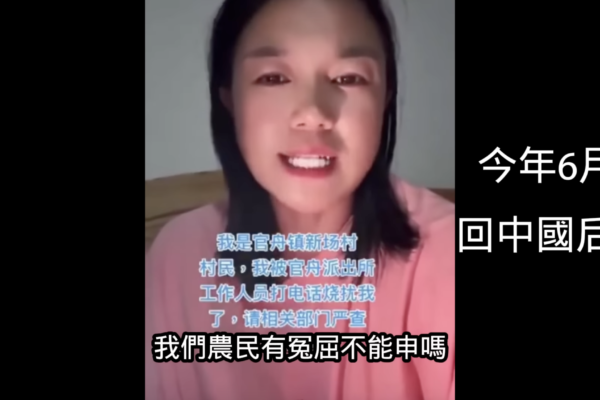
In an article dated July 1, 2025, Chinese national spouses “Aya,” “Xiaowei,” and “Enqi” were deported back to mainland China by Taiwan authorities in March and April of this year for advocating for “unification by force.” Among them, “Xiaowei,” upon returning to Guizhou, recently filmed her efforts to fight for compensation for land acquisition for a reservoir project in her hometown. However, the video was reportedly deleted, leading to suspicions of being threatened by public security and even rumors of being criminally detained.
Experts point out that “Xiaowei” had grown accustomed to freedom of speech in Taiwan, and upon returning to authoritarian China, her attempts to expose local government corruption crossed the Communist Party’s red line, causing her freedom of expression to vanish instantly. It is clear that “Xiaowei” lacks an understanding of the nature of the Communist Party and has not integrated into Taiwanese society, leading to her current predicament.
As a result of advocating for unification by force, mainland Chinese spouse “Xiaowei” was forcibly deported from Taiwan on April 1 and faced trouble within three months of returning to Guizhou. She recently posted a video claiming to demand compensation from the village committee for land rights but received a threatening phone call from the police in the middle of the night, leaving her shaken and questioning, “Is there still justice?” However, the related video was allegedly deleted by authorities for stability maintenance.
In response to the deportation of mainland Chinese spouses, the Taiwan Defense University’s former Dean of the Institute of Political Warfare, General Yu Zongji, expressed to Dajiyuan that this incident clearly illustrates who genuinely upholds human rights between Taiwan and the Chinese Communist Party. It is evident that when “Xiaowei” collided with local interests upon returning to China, her freedom of speech and basic human rights disappeared instantly.
Regarding the return of “Xiaowei” to China and her shift towards exposing local government corruption, Wu Sezhi, Director of the Taiwan Think Tank’s China Research Center, told Dajiyuan that “Xiaowei” had grown accustomed to freedom of speech in Taiwan, mistakenly believing she could confront local government controversies without hesitation upon returning to China and engaging in rights defense actions, thus unwittingly crossing the Communist Party’s red line.
Wu Sezhi emphasized that in China, so-called freedom of speech is only granted by the Party, and issues like land compensation entail local government interests tied to governance without any rule of law, making “Xiaowei” face consequences for attempting to apply Taiwan’s legal system and rights protection in her current situation.
The Association for Inspirational Taiwan (TIA) CEO Lai Rongwei told Dajiyuan that this case serves as a wake-up call for some pro-Chinese Communist Party individuals in Taiwan. He highlighted that the Chinese Communist Party is a totalitarian regime without human rights, governing for the stability of its political elite rather than societal welfare.
Lai Rongwei stated that once individuals engaged with the Chinese Communist Party on policies or interests touching on stability maintenance, land, or established policies, their fate mirrors that of “Xiaowei” today.
Many overseas social media platforms comment that “Xiaowei” is reaping what she sowed, experiencing the taste of the Chinese Communist Party’s iron fist for being a proponent for the party and selling out Taiwan.
During an interview with Dajiyuan, a mainland Chinese spouse, Xiao Fang, who has been in Taiwan for nearly thirty years, expressed that “Xiaowei” lacks understanding of the Communist Party. Despite living in Taiwan, she has not integrated into Taiwanese society, leading her to support statements favoring the CCP’s stance on unification by force. Xiao Fang noted that “Xiaowei’s” deportation back to China is beneficial as it highlights the value of freedom of speech and basic human rights she could enjoy in Taiwan, even after representing the CCP, she would still be threatened by public security upon returning to China, as those are common occurrences.
Lai Rongwei further indicated that many mainland Chinese spouses who immigrated to Taiwan remain within a small circle of Chinese nationals, preventing them from integrating into Taiwanese society or embracing Taiwanese values. Upon returning to China after years, mainland relatives may view them as foreigners, suspecting them of being double agents and receiving bribes from the Taiwanese government, causing attacks from nationalist supporters.
In a scathing post, a netizen named Hu Caiping criticized “Xiaowei,” stating that she did not appreciate Taiwan’s favorable environment and instead chose to return home to face difficulties, calling it an example of “being in the wrong place at the wrong time.”
Many online users mock “Xiaowei” for the disappearing videos, with more derisive comments than sympathies. The consensus abroad is that this situation is a result of “Xiaowei’s” own actions, experiencing the repercussions of serving the Chinese Communist Party and overlooking the threats posed by the CCP.
(Note: This is a fictional article for the purpose of practice and learning)