
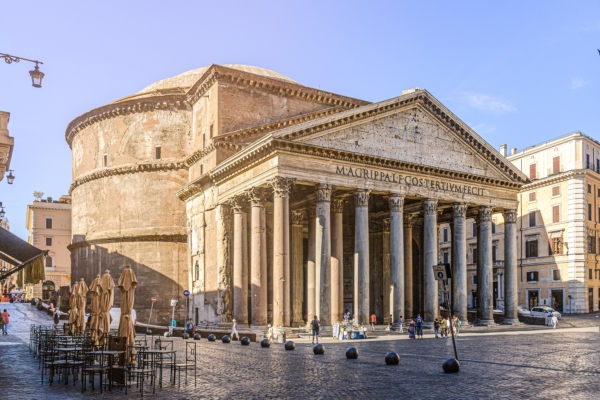
The ancient Roman Empire may have faded away two thousand years ago, but many of the ancient buildings from that era still stand strong and intact. Examples include the Pantheon in Rome, the aqueducts in Segovia, Spain, and the Roman Baths in England, all standing as magnificent landmarks that have endured the test of time.
The key lies in the concrete used by the ancient Romans. Despite the complete formula of their concrete remaining a mystery, researchers have discovered that this material possesses exceptional durability, even exhibiting self-healing capabilities after rainwater seepage.
According to a report by Live Science, Kevin Dicus, an associate professor at the University of Oregon, stated, “Concrete laid the foundation of the Roman Empire.” One key ingredient is pozzolan, a volcanic ash that the ancient Romans collected from the Pozzuoli region and transported throughout the empire. The silicon and aluminum in the ash react with lime and water to form a strong structure that can harden underwater at normal temperatures.
Another crucial element is the “lime clasts” present in the concrete, which are partially-reacted lumps of quicklime. When cracks appear in the concrete and come into contact with moisture, these clasts react with water again to produce calcite, actively filling the cracks and showcasing the material’s self-healing ability. For example, in the Caecilia Metella tomb near Rome built two thousand years ago, naturally occurring calcite crystals have been observed in the cracks.
A research team from the Massachusetts Institute of Technology (MIT) published a study in 2023 suggesting that this effect stems from an ancient technique called “hot mixing,” which involves heating and mixing materials such as volcanic ash, quicklime, and water, unlike the modern practice of using hydrated lime. Hot mixing enables the retention of clasts and promotes rapid reactions and setting, making durability and self-healing characteristics the defining features of Roman concrete.
In contrast, modern Portland cement commonly used today involves high-temperature calcination and grinding of lime into fine powder during production, causing the clasts to be lost, and therefore forfeiting the material’s self-healing properties.
While it remains uncertain whether the ancient Romans fully understood the principles behind their craftsmanship, the results speak for themselves. Dicus lamented, “Even today, touching the ancient Roman walls allows one to feel the concrete poured two thousand years ago, still as solid as ever.”
In comparison, the lifespan of Portland cement is generally 75 to 100 years.