
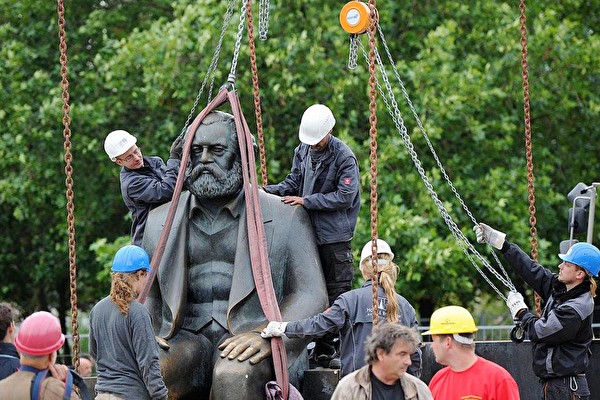
Recently, the Chinese Communist Party (CCP) has been promoting the concept of “Marxism with Chinese characteristics,” and a scholar has stirred up the internet by claiming in a new study that “Marx was Chinese,” causing widespread mockery before the post was deleted.
Professor Du Gangjian from Hunan University, a former dean of the Law School at Shantou University, gained attention with an article published on May 5th on a public platform. The article presented research results claiming that Marx was Chinese, even suggesting that Marx was of Hui Muslim ethnicity and descended from Chinese ancestors who joined the Mongol army during the Yuan Dynasty’s western expedition, stretching back to Jewish roots in the Zhou Dynasty.
These claims sparked criticism and ridicule online.
On Weibo, a social media user commented, “You can make up stories, but historical facts cannot be casually distorted!” Another wrote, “Unbelievable + absurd.” Yet another said, “Experts, professors, authorities, what kind of people are they?” The internet reaction included disbelief and humor, with many expressing astonishment at the assertion.
Overseas internet users also joined in, with one remarking, “Well, no wonder China is the only country in the world that has successfully promoted Marxism, it turns out Marx is our Chinese descendant. With a perfect genetic match, of course he won’t go astray.” Another commented, “Marx’s ancestors being from China may be unknown, but the specter of Marx remains unyielding in China.” The reactions highlighted the absurdity and incredulity surrounding the claim that Marx was Chinese.
Xu Quan, a Ph.D. in Philosophy from the City University of Hong Kong and a news commentator, condemned the claim that “Marx was Chinese,” calling it a shameless joke propagated by academic cliques and unscrupulous scholars who ignore the societal issues in China. He criticized those using such false narratives to deceive and manipulate people, undermining historical facts and academic integrity, reflecting systemic corruption in China’s academic circles.
The article further criticized Du Gangjian for his previous controversial claims, such as “Germanic giants originated from ancient Hunan region,” “Egyptian Buddhism derived from ancient Western Hunan culture,” and “English comes from ancient Chinese, and the British originated from Hunan’s Ying County.” He has been labeled as a “wolf warrior scholar” within the CCP for his book titled “Origins of Civilization and the Great Harmony World.”
Lili Yi, a current affairs commentator, suggested that these outlandish claims by CCP scholars in recent years are aimed at appeasing Xi Jinping’s push for “Marxism with Chinese characteristics,” manufacturing legitimacy for CCP rule. She remarked that while these scholars may seek to flatter, their extreme methods often backfire, leading to ridicule and embarrassment.
The CCP, emphasizing Marxism and atheism, has increasingly focused on the “Sinicization of Marxism” in recent years.
In the CCP’s 20th Congress report in October 2022, there was unprecedented mention of “integration of Marxism with Chinese elements,” emphasizing the need for enhanced propaganda in this regard. Xi Jinping further asserted in the party journal “Seeking Truth” that “we must never abandon the essence of Marxism, nor the root of Chinese excellent traditional culture,” underscoring the importance of combining the two ideologies.
According to an exclusive report by Epoch Times, this cultural manipulation by the CCP signifies a cultural conspiracy.
The former Central Party School professor in exile in the United States, Cai Xia, revealed that the current Minister of Propaganda, Li Shulei, ascending to the CCP’s Political Bureau, is linked to earlier research on “integration of Marxism with Chinese culture” at the Central Party School, serving the ideological interests of the CCP.
In October 2023, Hunan TV aired a promotional video titled “When Marx Meets Confucius,” portraying dialogues between Marx and Confucius in line with Xi Jinping’s 2021 proposal to combine the basic tenets of Marxism with traditional Chinese culture as part of its Sinicization efforts.
Critics found the juxtaposition of Marx and Confucius in the show absurd. Commentators highlighted that the program aimed to provide a foundation for Xi Jinping’s ideology, legitimizing the current regime by merging traditional figures with contemporary power structures, despite historical instances of the party orchestrating anti-Confucius campaigns.