
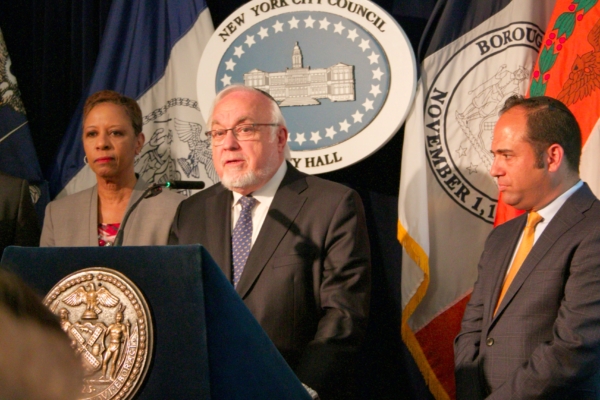
The Simon Wiesenthal Center, a Jewish human rights organization, held a press conference at New York City Hall on April 29 to release the 2025 edition of the “Digital Terror and Hate Report Card.” The report highlighted the inadequate performance of mainstream social media platforms in combating hate speech targeting religious groups and anti-Semitism. Attendees called for stronger regulations and accountability for social media platforms.
According to the Simon Wiesenthal Center (SWC), using nine indicators, they evaluated major global digital social platforms based on factors such as response time to reports, policy enforcement, transparency, cooperation with law enforcement agencies, and adherence to international standards like the International Holocaust Remembrance Alliance’s definition of anti-Semitism and the EU Digital Services Act.
Rabbi Abraham Cooper, the Vice Dean of the SWC, pointed out that online hate speech is not only directed towards Jewish people but also affects other faith communities, facing unprecedented cyber hate threats. The report revealed that mainstream platforms like Facebook/Instagram, Google/YouTube, and TikTok only received a C grade, while Telegram and X scored D or F, illustrating their inadequacy in preventing hate messages.
The report highlighted that online hate speech forms a network of threats across religions and ethnicities, with social platforms failing to effectively curb the spread of hateful content, exposing young people and the general public to an increasingly toxic digital extremist environment.
Rick Eaton, the SWC’s Director responsible for monitoring the report, added that despite TikTok establishing a reporting mechanism, there are significant shortcomings in dealing with extremist content, such as the failure to effectively remove content glorifying extremist behaviors. Other platforms like Facebook have shifted the responsibility of content moderation to users, leading to the continuous spread of hate and misinformation.
During the press conference, New York City Council Speaker Adrienne Adams stated that hate crimes are on the rise, with religious groups being prime targets, posing threats to everyone’s safety. She mentioned that the City Council has collaborated with the Simon Wiesenthal Center to promote online etiquette education to over 25,000 high school students within a year, aiming to help the younger generation recognize and resist online hate.
Rabbi Cooper further expressed, “The issue we face today is not merely offensive remarks but an organized attack on truth, democracy, and human dignity, and such hate speech fuels the chain of terrorism development.”
Council members present at the meeting shared their firsthand experiences. Councilor Shahana Hanif recalled facing discrimination on campuses and on the streets as a Muslim child after the 9/11 incident, emphasizing how religious hatred amplified on digital platforms inflicts deep wounds on the entire diverse society. Councilors Eric Dinowitz, Lynn Schulman, and Lincoln Restler, who participated in the press conference, also shared their experiences with hate crimes in their respective districts, calling for enhanced regulations and accountability for social media platforms.
Facing this new form of threat, the Simon Wiesenthal Center proposed several urgent recommendations, including: (1) restoring and strengthening weakened content moderation policies; (2) permanently banning accounts linked to terrorism; (3) proactively identifying and combating state-sponsored online disinformation campaigns; and (4) enhancing algorithm transparency to prevent the amplification and spread of hate messages.